Do you feel like you give great clinical care, but then sometimes patients don’t end up sticking with care and it feels really frustrating because you feel like, Oh, I could so help them if they only stuck with care. So welcome.
Disclaimer: The following is an actual transcript. We do our best to make sure the transcript is as accurate as possible, however, it may contain spelling or grammatical errors. Due to the unique language of acupuncture, there will be errors, so we suggest you watch the video while reading the transcript.
Do you feel like you give great clinical care, but then sometimes patients don’t end up sticking with care and it feels really frustrating because you feel like, Oh, I could so help them if they only stuck with care. So welcome. This is Chen Yen, six and seven figure practice make-over mentor at introvertedvisionary.com. Your host for our AAC live show here today. And so let me give you the number one most practical tip that you can use to help with retention, whether with your own patients or your associates practices, because maybe you’re, you’re actually pretty busy, but then you have an associate and you would like them to stay busy. Have you ever thought about this with, with retention? That if you are actually, um, if your patients don’t really understand why they should stick with it and they drop off care, it’s almost like, like, uh, not helping them fully.
It’s also, uh, something where if you’re feeling like I’m not consistent enough with patients, then it’s a leak. It’s like you bring in patients on Linden and then on the other end, they end up not coming back to the extent that you could really help them. So this is a number one practical tip that you can use right away is to think about these three key things. Number one is that patients need, and then I’m going to give you a specific strategy you could use in, in specific, um, thing that even a template that you could, you could use right away in your practice to increase retention. So then, um, three things. Number one is that patients need to understand if they’re not actually understanding why the care is helpful for them and why to stick with it, especially with the number of treatments many times with, with acupuncture could take, then they’re not going to actually stick with it as well. The second thing is to remind them, because even if they do understand, and they’re not reminded of it, they might not actually understand it fully because for you, it’s, it’s something that
Jen we’ll be right back. She has a little internet issue going on. We’ll fix that in a second. So hang in there, she’ll usually come back very quickly here. She comes
For you. It’s something that is, uh, you know, you get, get it clinically. But then for someone who, who is brand new to what you’re doing for them, they don’t really, uh, always understand things clinically. So it’s up to you to remind them and educate, continue to educate in each visit so that they will actually, uh, understand what you’re, how you’re helping them and why it’s important to come back. The number three to think about is to make it really easy to book an appointment. Again, I can’t tell you how many times I’ve heard from acupuncturist where it’s like, Oh, would you like to book it your next appointment? And then if someone says, no, I’ll just wait until next time. Well then they don’t end up booking, right? I mean, I’ll just wait until I, I fig figure out my schedule and then I’ll call you and then do they have ended up calling?
Sometimes they do. Sometimes they don’t. So how can you make it easy for them to book, for example, what are you saying right then? And there at the end of the appointment, are you actually saying, let’s get you scheduled notice. Even the tone of that is different than would you like to get book your next appointment? When would, when would you like to book your next appointment? Like that is not taking leadership of, of recommending what, what would be best for them? Because people are looking up to you for guidance. People are looking up to you as their acupuncturist to, to tell them what would be best for them. So those are three quick things to think about. Now, let me share with you specific strategy that my clients have used that have helped them double the retention rate in this Cub. So this, this retention piece comes from the fifth step of the consistent patients formula for introverts.
So as far as the, uh, practical tip related to this is one at the beginning of the visit, what do you do? Uh, do you always have an, a short, a very short intake form that they fill out very brief, just literally three questions and that, and what are they? So the first question is something more about, um, what what’s been happening since the last visit and the reason why you would want them to, to actually take a moment and write this down. Cause I, I hear from some acupuncture loads, do I really need to do this? I ask these things during the visit, or I, I actually diagnosed them during the visit and, and they it’s pretty obvious. And then I’d talked to them about it. There’s something about, um, patients taking that moment and writing down, reflecting on the progress that they’ve made.
Have you ever had people who, who have actually made great progress and they don’t seem to remember it? So this is why it’s important to do this. So the first question is the first thing is describe what’s been happening since your last visit. Um, and then with, with what you originally came in for, by the way, I’ll make sure that you get this template. If you want to just PM me and I’ll make sure you get this progress assessment form template. So the second, um, thing to have on there, actually. So I mentioned having three things, I’m gonna give you four things, but, um, the, the second one kind of ties into the first one. So the, the second one is to share any improvements you’ve noticed. So first they describe what’s been happening since the last visit. And then the second thing they share is, is the improvements that you’ve noticed.
Then the third thing is something that measures their, um, feeling of progress, right? So for example, if it is pain level, then, then you could say, what is your X level on a scale of one through 10? So what’s your, what’s your pain level on a scale of one through 10, and then they actually read it. Then the fourth question is, and this is the most powerful question. What it, what, what are your top three most frustrating health issues right now? What are your top three most frustrating health issues right now? And why is this so powerful? Because have you ever had people who came to you for one thing, but they didn’t even realize you could help them with other things? Well, this helps them have a moment to write down those things that are actually bothering them right now in this moment. And some of those things, they might not even have thought that you could even help them with.
So then during the visit, you can bring this up, you can say, okay, I noticed that this has been happening for you. And then you’ve mentioned that you’ve been having these issues. Tell me more about that. So that helps you to be able to have, um, a conversation with them about what’s most pressing for them right now. And again, you know, I get the question well, uh, from acupuncture sometimes like, well, do I really need to have them fill this out ahead of time? And the answer is yes, because, um, they w that’s where you end up having that opportunity to,
Oh, she’s coming back, ladies and gentlemen, hang on, Chad. I believe you’re muted. I don’t know if you could hear me, but you’re muted. Nope. You hold on. Okay. Wait, try it again. Let me hear you talk, talk, talk. Okay, there we go. There we go. Good. Keep speaking. Nope. Oh, wait a second. I hold on a second here. We’re sorry for these technical difficulties. Let me see if I can bring chin. Can you hear me? I can’t hear you. You must have muted yourself up and she’s gone again, ladies and gentlemen, um, we’ll make sure that you get a copy of this. Um, uh, here she comes.
So they need to be able to have that moment to actually reflect on their progress. And literally, how can these this be done logistically? Is that before they actually have their visit with you, they would actually fill this out, just this, you know, three or four quick questions out in the waiting area, like on a half sheet of paper, or if you are doing this in EHR, you could end up having, um, like a, a kind of like an iPod thing and iPod iPad, and then have them fill out the answers to this. And, uh, the finally the final tip I wanted to give you is that at the end of the visit, are you also giving context and also same thing at the beginning of the visit? So perhaps you could say, okay, last time we worked on this, this time we’re going to work on this or this I’m going to focus more on this.
And then at the end of the visit, acknowledge the progress they’ve made. For example, I have, um, a craniosacral therapist I’ve seen and, uh, she’s so good at this. You know, after every visit, she says, what got you? Or what some version of this, right? Like, Oh, you look like you’re glowing. You look so vibrant. You know? So then I feel really good at the end of the visit. Right? And she reinforces that for me. So if you see visibly that your patients look more relaxed or they just seem more, more like they’re in the flow or in a goal, it glowing, then, then recognize them for that. And then say, this time we focused on this and next time we’re going to work on this, you know, something like that. Right. So, uh, and I know that as, as a clinician, as an acupuncturist, you are already good with diagnosing things and you feel like, Oh, I don’t, you know, I probably don’t need this thing.
It’s not like I need them to tell me that this such and such is wrong. Sometimes, you know, you do a pulse, I’ll tell him and you, you know, exactly what’s going on. But when patients are bought into the idea of what you’re doing for them, when they understand, when they can actually see that they’re making progress, when they are actually feeling better and you are acknowledging that they are feeling better, they feel more excited about their care and they’re going to actually stick with it. And they see a context to, okay, this is what I need to do. Um, like continue on. And this is, this is what you’re going to do for me next time. And then as a quick reminder at the end of the appointment then mentioned, okay, let’s get you in the calendar for the next appointment. Let me see here.
I have such and such a for such and such date. Right? So, so there’s none of this, this kind of thing like, Oh, would you like to book an appointment, the right kind of tone, but rather an assertive, a tone of you knowing what’s best for the patient and you’re in terms of your recommendation and then giving it confidently and getting it on the calendar. So with that, I love to see you comment below. What did you find helpful most helpful about this? What’s one practical tip that you can use. And then go ahead and PME, go ahead and click on my name there and then private message me. And I’m more than happy to give you that template that, um, that I gave you in terms of the progress assessment form. There’s also a script that goes along with it in terms of what to say to, so that way you can actually benefit and help your patients get to the best outcomes as possible when they stick with care.
And they’ll appreciate you for it also when, when they get better care. And then when they’re also actually getting better results as a result of that, then they’re going to refer more to, and your practice will be full, or your practice we’ll get into more of the snowball effect and you’re going to help more and more people. So with that for more six and seven figure, practice, makeover tips, go to introverted, visionary.com. And if you’re struggling right now and feeling like you’re at a plateau, um, you, and you just know you’re capable of so much more, you’re meant to help people who, who really need you then feel free to reach out on our website and happy to give you insight into your situation, how it can help you. So that till next time.
“we weren’t really given the tools on how to effectively market and grow our practice. So that’s what I’m here to do. I’m here to spend the next 20 minutes or so with you to share some insights about how you can do just that.”
Hi folks, Jeffrey Grossman here, and I am really glad that you are joining me here. And I’m really grateful for the American Acupuncture Council. We yet, again, to invite me for an opportunity to share some business and marketing with you, I’m thrilled to be back here to share 20 minutes of insights and inspiration to help you build your practice, um, and to attract more patients and to really tap into the tools that we weren’t really given when in acupuncture school, we really received everything that we needed in order to grow our practice. We were given all the tools, all the know-how, all the insights and all the wisdom to be amazing pulse diagnosticians and tongue, tongue readers, and pulse readers. But we weren’t really given the tools on how to effectively market and grow our practice. So that’s what I’m here to do. I’m here to spend the next 20 minutes or so with you to share some insights about how you can do just that.
So, um, you know what we’re going to be talking about today, we were talking about a couple of things that some of you might not think are appropriate. We’re going to talk about email marketing, but I want to hear me. You, I want you to hear me out as we talk a little further, I’m going to lay out the facts as to why email marketing should be important and incorporated into your marketing strategies. And at the end of today’s training, I want to give you a link because I know that if I give you the link now that, um, you’ll go ahead, I’ll lose you, you’ll download it. And I want you to stay focused with me because our time together is really important. So I want to give you a link to an ebook that we just released. Um, um, uh, it’s called resetting your practice for 20, 21, how to get patients on your treatment table.
So if that’s okay, just stick with me at the end, I’ll get that link for you. So welcome. My name is Jeffrey Grossman, though, for those of you that don’t know me, I’m the founder and the owner of acupuncture, media works and acupuncture websites, and Accu downloads 2.0. So I started my practice back in 98 and I struggled just like many of you did back in the days. My background was as a graphic designer. And, um, and, uh, that was what the world that I was working in before I became an acupuncturist. So when I became an acupuncturist, I realized that like, there weren’t enough tools for me to help me grow my practice. I didn’t have the know how to grow my practice. I didn’t have the skills, the techniques and the insights on how to make that happen. So I, I sought some help.
I actually started coaching. Um, I paid about 15 grand to work with, um, a chiropractic coach to help me maximize my patient communications and my marketing strategies. And it paid off in spades for me. So it was one of the best things that I ever did. Um, I just want to just encourage you guys with the fact that marketing is important. And the idea is that in order to grow your practice, you need new people coming in. Therefore you need to have tap into these ideas and these skills and these insights that I’m sharing with you and that the AAC brings to you on a weekly basis. So you guys are an incredible resource. People are looking for you, especially now. They want the type of healing that you offer, right? They want something safe. They want something natural. They want something that lets them feel less anxious and more balanced. And this
Is what you have to offer. This is how you,
As an acupuncturist, changes lives, and people need you. They need your services, but a lot of people don’t know that you exist. And that’s what I want to do is I want to help you get more people in your treatment table. And that’s what these talks are all about us to help you be seen, to be heard and ultimately to bring people into your practice so you can make more money, help more people and change the world. One person, one needle at a time. So if at the end here, if you’re interested in learning more, if you need a little bit of hand holding some help, I’ll, I’ll give you, um, uh, an email address at which you could reach out. And, and, and, you know, if you’re looking for some support, please feel free to reach out to me. So there are more opportunities than ever right now for you to be tapping into growing your practice, especially now, especially now that we’re many of us are working from home and we have to reinvent ourselves.
And one of the easiest ways to do it, excuse me, is what I’m going to be talking about today, which is using email marketing, right? So, um, um, you know, one or two of these suggestions that you come up with in the ebook that I have for you at the end today, that you could download and even in today’s training, could that you put them into use, can make a massive change and a massive difference in your practice. So, today what I want to do is I want to talk to you about, um, a resource that is such an easy tool to use in your practice. And most of us use it every day. All of your patients have access to it and those kids, they probably use it too, right? So this is about tapping into the power of it and to grow your practice.
And I’m sure that when I talked about email marketing and using emails in your practice, I heard a universal grown, right? And, um, I heard people saying that, Oh gosh, email marketing. There’s no way I’m going to be using that in my practice. So sending emails is one of those things that every practitioner should embrace, whether you’re an acupuncturist, a dentist, a chiropractor, massage therapist, or even a big box store, everyone is using emails these days to communicate with your audience and it should be a priority for you in your practice. And here’s a couple of reasons why it’s important. One, it allows you to reach more patients in real time, right? It’s affordable. It keeps you on top of mind awareness within, um, it’s personable and it can be action oriented and you can see results almost immediately after you send out that email.
So think about your own experiences, right? You have email how your friends and family members have emailed. How many times do you check your email out every day? Right. Do you know anyone who doesn’t have an email address these days? Okay. So it’s here to stay and email us something that you need to embrace in your practice. And when you approach email marketing, um, there are a couple of things I want you to consider. Um, and a couple of things to think about when you formulate your emails and your plan to make that happen is the first thing to think about is why are you emailing them, right? What do you want to get across to them? What kind of message are you sending? And what do you want people to know? Okay, these are all important aspects. When you sit down to draft your emails or when you sit down and, and, and, and, and think about what you want to, what kind of messaging and what kind of things you want to get across to them.
It’s important to think about that first. Why are you emailing them? What do you want to get across to them? What’s the message. And also what’s the next step that you can get across to people, uh, to, you know, how can you get them to take the next action? Okay. So you got to have a valid and valuable reason that would motivate them to take some form of action in an email. And I’m going to review five types of emails with you that you should be sending to your patients on a regular basis. And these five emails are the perspective, email, the offer, email, the newsletter email, um, add the benefit email and the simple email, right? And I’m going to talk about each of these five briefly. Um, so let’s talk about the perspective email. This email is designed for you to offer, uh, your, to offer your take on a relevant and trending topic, right?
So the key to this email is not to chime in, um, every time there’s a celebrity gossip or a story or a new figure that are released in the economy. This type of email should be commentary, right? And old area areas that can imply expertise. And when things are relevant, like if there’s, uh, some information about acupuncture and immunity, that’s relevant for today, acupuncture, anxiety, that’s relevant for today, acupuncture for alleviating low back pain from people working from home and sitting in their chair all day that’s relevant for today. So think about how you can chime in to what is on people’s minds these days, and how to make it relevant for them in one of your emails, a couple of tips to consider are be current, okay. Make sure your content is based in today’s right. Think about what your audience or in this case your patients are going through.
Now what’s on top of their mind. What’s their most pressing concern. When you tap into that, you can talk to them and tap into what’s on top of their minds. It’s the what’s in it for me syndrome, right? People want to know what you could do for them. They don’t. They like to understand about all the cool things that you have to offer, but what they really want to know is what’s in it for me, what are my benefits? Okay. Therefore you need to play into their current state of mind and to get that information out to them. Next thing to do is to be factual, okay. Facts for, from up belief. And they can be very important when adjusting people who may not have all the same views as you do. So when you use facts, people can rely on the idea that they are rooted in truth, and that the, they may be more inclined to move closer to your beliefs.
And then the other thing about making stories relevant or emails relevant is to share stories from your perspective. There’s a saying that facts tell and stories sell. So people learn through stories and it’s part of our DNA. It’s what we want. And we really can learn more when things are given us in story form. And when we facts into a story, when you re read the relevance of a study or a program or something, or, or, or research into an email, um, it makes your story more relevant, excuse me, and, um, and gives you a better perspective that you’re talking on it with that topic. Okay. So the next type of email that you should be sending is the offer email, and everyone loves a good offer, right? So that’s why sending out an offer email can bring in inactive patients and prospects. And this email is perfect.
When you have a, a new therapy, a new technique, a new topics to talk about new research that you just unearth new products that you’re carrying or whatever it is when you have something that you want to offer, this is the perfect type of email to get out there. So there’s a couple of types of offers that you could be doing, which is one is a test drive offer. Okay. The test drive offer is exactly that. It’s exactly what it sounds like. Letting people come in to test drive a therapy or a service before they buy it. And before they sign up as a new patient, it’s getting them to take step foot in the door so they can learn about you learn about your offer and then take the next steps, become a full fledged pain patient. The next type of offer, um, is a solution offer.
Okay? And this offer provides answers to people’s most pressing problems, and it can be very powerful and invites people into your clinic. They get them clarity on a particular condition, right? So your offer could be, learn five ways that acupuncture can alleviate headaches or migraines, or, um, you know, it could be come in to get a seven point, you know, back paid assessment exam. Okay, whatever your offer is, what solution are you offering for them? Um, that, you know, that, that th that might be on top of their mind, right? Anxiety come in to receive a two point acupuncture, anxiety, and stress reduction, treatment data solution, you’re offering a solution to anxiety. Um, and that could be part of that email, the other type of offer that you could be offering as a stress reduction offer, and this offer, it does what it says, right?
This is one of my favorite offers that I’ve done in the past. Um, I’ve used it for all of my health fairs. And, uh, as, as a marketing tool, for me, basically offering an acupuncture, stress reduction treatment, um, and who doesn’t have stress these days, right? So the stress reduction offer is perfect to get people to come in for a free or reduced rate stress reduction offer, and that’s pretty straightforward. So those are the different types of offer emails that I feel are important. The test drive offer the solution offer and the stress reduction offer. Okay. So the next, this type of email that you should be sending out regularly is the newsletter, right? So if your practice doesn’t currently send a regular newsletter to your patient base, consider starting one. Okay. It’s um, massive missed opportunity. If you overlook any type of email for that matter, specifically, if you overload, overlook the idea of sending out, um, monthly newsletters.
Okay. And I’ve said it before, and I’ll say it again. Um, it’s important to stay in top of mind awareness with your patients. And, um, you know, it’s all too easy to have patients fall out of care, simply because they were, you know, were feeling better and they just forgot about you. Life happens, they just get caught up in it and they feel good. They forget about you, but I’m not receiving a monthly newsletter or an email from you for that matter puts you back in top of mind awareness. So when they need you next time, they’ll remember where to turn because they understood, or they read an article about how you could help with XYZ condition, um, um, in that way. So hopefully that makes sense. So a monthly, quarterly, or even an annual email newsletter give you the opportunity to share important information and remind patients of the practice.
And of course, you know, keeps you in top of mind awareness. So here’s a couple of things to consider when you put together your newsletter. One thing you could talk about is discussing your practices outreach, or any sponsorship or any type of community involvement. You can highlight any new clinic changes or a new staff members that you may be brought on announced marriages or new babies or new grandchildren, whatever that is. So talk about a new line products or new services that you’ve added. You can highlight condition, specific information. You can obviously always request referrals and online reviews with every type of email you put out there, especially with your newsletter. You can also address seasonal health concerns like or sports injury, or immune acupressure routines and things like that. Um, you can remind and encourage people, um, you know, about good healthy habits. And of course, when you use any type of email, especially your newsletter, you need to promote it, um, on your social media channels.
Okay? So there’s so many topics that you, as an acupuncturist can talk about in your newsletters. There’s no lack of content that you can put in your newsletters, but if there’s any type of email that you should be doing consistently is the newsletter email, and the other type of email that you should be putting out there of course, is the benefit and tips, email. And this type of email never gets old because as long as you can talk about new benefits that people can receive and tips that can help your audience, there are always people who want to hear them. So it’s all too common for practices to make the mistake of talking about how amazing what you do is, and how awesome the thing that you have is while you’re excited about it. Um, you know, you, you know, about the latest, cool thing that you do.
Some people might not care, right? People care again about what’s in it. For me, it’s the, what’s in it for me syndrome. People want to know what they can get out of it, what are their benefits? Okay. And, um, it’s always good to start with that in mind. So here are a couple ideas that you could be using, how to end back pain once and for all three simple techniques and, um, two acupressure points you could learn in the comfort of your home or suffering from depression. Here are three supplements that you could use in two powerful acupressure points to help or seven tips to supercharge your immune system. All right. So I’m not sure if you’ve opened emails that talk about X number of tips or ideas or whatever it is. And, but people love learning from emails like these people. And there’s a couple things I want you to consider when you put out these what’s in it, the, these, um, these emails considering your patient’s view of what’s in it for them.
Okay. Is it new? Is it useful? And is it beneficial? Okay. So is it new, given your topic? Is there a new angle or twist on it that you could take? Is there an update or a surprising bit of news that you can share? Do you have something that other people don’t know about yet or something that you’re the other one in your town that’s using, right. Something that your audience hasn’t heard or considered yet that’s about being new. Is it useful given your topic? Is there an application that your audience could use, right. Can you help them sort through or think through a common problem in some way, do you have a solution to something that they face and is it beneficial? Right? So again, given your topic and more importantly, given what keeps audience up at night, what is it that you have that will help them, right?
What is it about your topic that will benefit your audience? Is there a silver lining for them? Is there a net gain for them? How will, what you offer them, change their lives. And finally, the last type of email that I want to talk about is the simple email. So this is such a simple email. I send these out periodically and I’m amazed at the responses I get, and this is the type of email that can get your patients back in care pretty quickly with just a couple of sentences, even it’s so simple, but it works. And, um, it’s short, it’s sweet. And it’s getting an interested party to take notice. So here’s the framework. You have a simple subject line, something like patient’s first name only. So it would say like Jeffrey, right, or something like patient’s name Jeffrey. Can I share this with you?
Okay. One email that I’ve sent to other practitioners is, Hey, Jeffrey, are you looking for new patients? And that got me a ton of responses. And as you can imagine, most practitioners are looking for new patients. So emails like this with, um, curiosity, uh, subject lines, really pique people’s interest. They’re short, they’re sweet they’re to the point, and they get people to take quick action. So first think about, on your patient’s mind right now, right? Is it stress? Is it good health? Is it immunity? Is it better sleep? Okay. So what do they want to learn about where are they at with that? So send off a couple emails, says, Hey, Jeffrey, do you want to learn about better sleep? Hey, Jeffrey, do you want to learn about four points for immune health? Hey, Jeffrey. Um, do you want to learn about, um, you know, uh, five ways to alleviate your back pain?
Okay. So I want to run down a couple of examples of, of, of what the, the S the copy itself could read, like super simple stuff. Okay. Really, really easy. So it could say, Hey, Jeffrey, um, Hey, Jeff, you want to learn about immunity? Question Mark. That’s a subject line. And then the copy of, of, of, of the body, of the text of the email, if you’d be like, Hey, Jeffrey, can I share these immune points with you? These are two acupressure points that alleviate immunity. Um, if you know, um, if you’re interested, just respond to this email and I’ll get right back to you as soon as possible, that’s it? That’s really simple, right? Hey, Jeffrey, I’ve got two acupuncture points to share with you about better sleep. Do you want to know about them? Or, you know, that’s it, you know, so, um, that’s all you’ve got to do for those emails.
Okay. So, Hey, Jeffrey, are you still interested in getting help with back pain or learning how to boost your immunity or getting help with insomnia? If so, respond to this email and I’ll reach out to you as soon as possible your name, that’s the email, like three sentences at most, and that’s it. So people will get back to you. It’s almost like these emails work like magic. And if you haven’t sent an email like this one before, try it right. And let me know what kind of response do you get? You’re basically checking in with them, nagging them as really simple offer. And it’s one of the easiest emails to really send out. And I wouldn’t be doing you any justice today. If I didn’t mention that these other types of emails that you should be sending, like the missed appointment, email, the follow-up email of the reminder and confirmation emails, happy birthday emails. And of course the, please give us a review email. Okay. So I hope that helps.
We’re looking to create an environment to support the body’s innate ability to heal. Um, the body has this capacity to self-regulate. We call it balance. And when it’s doing this well, um, we have health and vitality.
Disclaimer: The following is an actual transcript. We do our best to make sure the transcript is as accurate as possible, however, it may contain spelling or grammatical errors. Due to the unique language of acupuncture, there will be errors, so we suggest you watch the video while reading the transcript.
Thank you. Um, again to the AAC for having me on their series called To The Point. My name’s Lorne Brown and a little bit about myself. I’m a doctor of traditional Chinese medicine. So my clinic is in Vancouver, British Columbia, Canada. It’s called Acubalance Wellness Center. I’m the founder of healthy seminars where we offer online continuing education. I’m the chair of the integrated fertility symposium. And I’m the author of this book of my past experience called missing the point why acupuncturists fail and what they need to know to succeed. And I’m a passionate about learning and passionate about consciousness work. And today I wanted to share with you, um, three mind hacks that your patients will love and you’ll love as well. If you incorporate these into your daily life. Um, my background also that I didn’t mention a moment ago is I’m also a trained clinical hypnotherapists.
So I really love working with the mind. Now, the reason I think this was real valuable tools to share with you for you yourself personally, and for your patients is because our whole goal often is to support the body’s innate ability to heal. Right? We understand this as Chinese medicine practitioners, that our bodies have this innate ability to heal. We’re not trying to override it. We’re not trying to suppress symptoms. We’re looking to create an environment to support the body’s innate ability to heal. Um, the body has this capacity to self-regulate. We call it balance. And when it’s doing this well, um, we have health and vitality. And when we ha when we catch a cold or we have an injury, we rebound, we recover. And if our body Lee loses this ability to self-regulate to a disability to heal, then we get a cold or we get, um, an injury.
But then we see this with our patients. They don’t heal, they don’t recover. And so these three mind tacks, I’m going to share with you how they’re going to support the body’s innate ability to be heal. And often I’ll share with my patients, you know, cause I want to educate them on why they’re going to use Chinese medicine and how those will benefit them. So I’m explaining some of our philosophies, um, how we see the body. And so one of them is your body has an innate ability to heal. And I often say, if you get a cut, you don’t sit there and stare at your hand and say, he’ll he’ll he’ll know, your body knows how to do this on its own. It can do this. And if you get a really serious kind of big gash, you may need stitches, but the stitches does not create the healing.
What that thread does is it creates an environment to support the body’s innate ability to heal by bringing the tissue together. It creates an environment which allows the body to do its job, to heal. And I often say Chinese medicines like that, red, we’re going to create an environment to support your body to heal. So the reason these three mind hacks are crucial in life. When we feel stressed, we often call this like cheese stagnation. Um, some people in the conscious world call this resistance or friction. You know what it feels like when you’re out of balance, you’re feeling stress. It doesn’t feel good. You can tell. And when you are in flow and she is flowing, you feel inspired. Your, your chest feels open. And like, there’s this expanse to you versus this tight contraction. So you have this built-in mechanism when you are off track and we call that stress or cheese stagnation.
And so when you think about our autonomic nervous system, this is the part that’s doing the healing, right? This is the part where you bite an Apple, but you don’t think about what digestive juices need to be released. You don’t have to think about what nutrients get absorbed and what waste gets eliminated. This is part of the subconscious mind is the body, the autonomic nervous system. When you sleep at night, your blood pumps, your heart pumps, I should say, in your blood circulates, you don’t have to think about that. And so really this innate ability to heal our goal, if we’re thinking of the body like a garden is if there’s weeds, we want to pull these weeds out. So the plant can do its things. We may pull away obstacles. And one of them is this stress, this chiefs technician. This is really key, especially in our time, people are living in stress.
They’re watching the news and this is putting us into the fight or flight, um, uh, nervous system, the sympathetic nervous system. And when you are feeling stressed, your energy is being mobilized for survival. And if your energy is being mobilized for survival, then this energy, these resources are no longer available for healing and creativity. And so by using these three simple mind hacks, you’re going to tell your body that it is safe. And it’s going to go from that sympathetic fight or flight where it’s mobilizing for survival or to fight. And we’re going to put it into the parasympathetic nervous system, the rest and digest the breed and feed system where healing, where healing can happen. And when we think about our medicine, it sets us up so beautifully because we understand the mind body connection. It’s bi-directional. So your physical being your physical can impact your mental, emotional, and the mental emotional can impact your physical it’s bi-directional.
And if you’re going to use these tools for yourself, um, I will share with you that you will also start to find more success in your life because by getting yourself into alpha brainwave. So parasympathetic alpha, brainwaves, sympathetic high beta overwhelmed brain brainwaves. When you’re in the alpha brainwaves, you get to tap into parts of your mind. That’s not normally available to you. These areas of creativity, that research is showing in these cool ideas. Ideas can just pop into your head that you get to grab and run with. And we mentioned that when you’re in the parasympathetic, you’re going to free up your resources for healing. Because if you’re in the sympathetic, in that high beta overwhelm, then your energy is being mobilized and it’s not available for healing because it thinks it needs to survive, but there is no survival benefit when you’re usually in this there, you’re not about to get eaten by wild animals.
So often this stress response that we have, we’re thinking about something that’s happened to us. We’re worried about something that we think may happen to us, but you really, there is no survival benefit to be engaging this stress response right now, it’s not going to help us, um, jump out of a moving car for example. And so we have to relearn or have to train our bodies to regularly elicit the relaxation response and by doing so, your patients will get more benefit from your treatment because our goal is to support their innate ability to heal. And so if we are teaching in these simple tools and they’re coming to your treatment for dietary therapy, Twain, acupuncture, mocks are herbal. They will get so much more from your treatment. If you also teach them these tools and who doesn’t want to feel good. So in my experience, patients on the table, and it takes a minute or two to teach them each one of these.
So every session I teach them one out of the three and I have many more I’m teaching you today, three of them and with the needles in and resting on a table. And then I give them this little mind hack that they can take home with them. Well, just on the table, they feel amazing. So the healing is amplified. It makes them want to continue the treatment because who doesn’t want to feel good. And they’re going to get so much more of the treatment because you put the needles in today. But if you’re not going to see them for a week later, you want to have that momentum. And if they’re using these simple mind hacks, then they’re going to benefit from this. And we remind our patients. It’s never, the it’s never the stress or the condition that causes the problem. It’s not, COVID, it’s not your clinic being closed.
It’s not a divorce that’s happening. It’s not bad weather. There’s always everything that happens is neutral. And then we give it meaning. So then we have a perception. It’s always our perception of the event that causes stress, not the actual stressor. It’s our perception, how we perceive what’s happening. And as soon as we have that perception, then we get a mental, emotional response. And it’s either positive or negative based on what’s happened. Often the response is based on programming. I say subconscious programming. So you see the world through the lenses of your subconscious program that you inherited, whether it’s negative or positive. And then you kind of have these electrical changes in the heart and the nervous system, which will affect your immune and hormonal response, which then affects a physiological effect. So your thinking leads to emotions. Emotions are, um, our end results of chemical reactions and these impact your DNA, your genetics, they turn on and off genes epigenetics. So your thoughts and feelings, positive thoughts and feelings, negative thoughts, and feelings can impact your biology, your gene expression, and turning you on towards health or turning your ons more towards disease and learning to elicit these relaxation responses throughout the day on a daily basis. As we mentioned, frees up your resources, your energy for healing and for creativity. So here’s the three, and then we’re going to practice them. And so I’m going to explain to you why I use each of these and why they’re kind of my favorite three.
And then I’m going to encourage you to
Work through these with me. The intention I’ll set out is that these are simple. They are powerful, and they are effective. Everybody likes the powerful and effective. This simple, ironically simple often has the risk of being ignored or dismissed because they are so simple. You know, in our life, we, things need to be difficult. We need things to be complicated. And my practice, why I think I kind of skip around the room is I don’t do complicated. So if you like complicated as a patient or as a student of mine, you don’t tend to gel with me. We don’t resonate because my frequency is about simple. I want things to be as simple as possible. And so, um, these are going to be very simple. So the first one we’re going to talk about is just called shaking it out. And there’s been some research on this. There’s some, um, books written on this and an interesting enough, um, I, the, the author of the book, I think it’s the tiger tail, but it it’s skipping my mind. Um, but that does not matter. Um, I’ll still teach you the technique and why we want to shake it out. When you go into this fight or flight, you’re in high beta, you’re in overwhelm, you’re in the sympathetic nervous system. The energy is being mobilized. This is a massive
Amount of energy. And
They, there are stories of mothers lifting cars off their children. And then the next day they can’t budge the car. This is an amazing amount of energy. And if you’re stressing yourself out through your thinking, again, there’s no survival benefit. You get all this energy because your body’s going to respond as if you’re being attacked by a wild animal. And you have all this energy, but it doesn’t get discharged in the wild with animals. Cause this is where this was observed. When an animal has a stressful experience, it’s fighting. So it’s discharging the energy it’s fighting or it’s running. And often what they’ve observed in the wild is animals. After there’s been a stressful experience, they see them shaking, twitching, everything out. And this is a way of discharging this excess energy. Because if you hold it in your cells, it leads to disease. We need to discharge Y yoga, chigong running exercises, healthy for you.
You’re discharging the energy. And so you can purposely do this. And so if you’re at your computers there, I invite you to stand up. Um, I know that I take myself probably a little bit out of camera, but I’ll come back to the whole Sarah. But if I was going to stand up, I’m going to move myself back and you really want to kind of pound yourself, like pound your heels to the ground and shake it, or really shaken up Twitch to edge. And you want to do that for about three minutes. I do this for patients sometimes before we put the needles in just because they’ve had a stressful experience, they’re telling me their stressful story and we just get them to shake it out like a duck. It was a story I share with my, when my son was a toddler, he was really stressed out.
And so you can do this. If you have young kids, um, he was upset about something and he was having his tantrum again. He was a young kid here. This is like before age of five and I’m listening to him and I say, Hey, let’s shake it out like a deck. And we start to shake and he’s crying. He’s looking at me and I go, come on, let’s shake it out. Let’s shake our tooshie sir, shaking our tooshie. And he starts shaking. He starts because children are in the moment. They’re great. They’re not like us. They don’t have all this baggage yet. And within 30 seconds, he is shaking, shaking his tail, his duck tail, and he is laughing. And he’s out of that experience. Same thing for us as adults. It’s a great, great way to create a change in state and to discharge the energy, to get you out of that high beta sympathetic and getting yourself more into that parasympathetic.
So remember I said simple, powerful, effective. Is that not simple? So I hopefully you have, um, stood up and you’ve tried this out just now just shake it out for three to five minutes, mind hack number two, the breath. I love the breath because it’s always with us and it is free. And the reason the breath is so important is again, as part of the autonomic nervous system. So as you’re listening to this lecture, um, you’re not thinking, Oh, I need to inhale and I need to exhale. I need to inhale. I need an exhale. It happens all on its own. You don’t have to really think about it. You sleep at night. When you go unconscious, you continue to breathe. You do not have to think about it. Your heart’s part of your autonomic nervous system too. And if I asked you to slow down your heart or stop your heart for four seconds, most of you, maybe one or two of you, of your super monks, um, cannot do that.
Um, I’m assuming none of you on here can do that, but your breath, you can control your breath. And so, although your breath is part of your autonomic nervous system, you do have some voluntary control over it to a degree. And by changing your breathing, you can communicate to your nervous system that you are safe because when you go into that survival mode, that fight or flight is your eyes. Pupils, change, blood flow changes, your breathing changes. And if you can, in the moment, start to change your breathing. It’s a mind hack. And if the body’s breathing a certain way, it tells the nervous system, Hey, we’re safe here because remember most of the stress responses we experienced, there is no survival benefit. It’s like, you know, when you pass a car on a highway and you accelerate, they say current enthusiasts, that that’s actually beneficial, healthy for the vehicle to clean up the exhaust or the engine.
I don’t know, I’m not a car enthusiast, but they say every once in a while, it’s really good to bring those RPMs to the read every once in a while. It’s good for your, your, your car. But if you drive a hundred miles, um, with the RPMs and red, you’re going to damage your car. So the sympathetic nervous system is not bad. It’s just that we’re in it too often. We’re driving a hundred miles with the RPMs of red and that damages the body. And so every once in a while, it’s okay. So going back to our breath, we can communicate, we can put on the brakes basically, and we can tell the body we’re safe. And there’s some literature suggesting that when you do the deep belly breath, um, it’s somehow stretching and impacting the Vegas nerve, which engages the parasympathetic nervous system, the rest and digest the breed and feed nervous system.
And they have shown through heart rate variability research, where they’re looking at the variability and the heart, looking at the autonomic nervous system. That is the exhale that’s engaging the parasympathetic nervous system. So the breathing technique that I have used, I first learned, and it’s a version of box breathing that I learned from Dr. Andrew Weil, who is a integrative MD. We spoke at a conference together many moons ago, um, at UBC. And he taught her version of this. And I’ve modified it because of the research of the long exhale is engaging the parasympathetic. So you breathe in through your nose for a count of four. Your mouth is closed. You’ll hold your breath for a count of four. And then you exhale through your mouth for a count of eight. We want the exhale to be twice as long as the inhale, because the exhale engages the parasympathetic nervous system.
The time at the roof of your mouth juice behind your front teeth. So do 26 area because we want to create that orbital circuit of the rent in the Duma. Okay. So that’s why we want to have her tongue up there. Also, I always like practical reasons because some patients don’t buy into the channels and the meridians. And so if your tongue is at the roof of your mouth, um, then it keeps you from clenching your jaw. When you are stressed, you often will punch your jaw. And if you put your tongue gently at the roof of your mouth, your lecturer close your teeth, we’ll have a little bit of separation in that will relax your jaw as well. The rhythm is up to you. If you practice this for a while, you can really have a slow rhythm of in, for four hold for four Oh for eight.
Um, I start my patients that are pretty quick rhythm because it can get them out of breath and be uncomfortable if, if the rhythms too slow at the beginning. But with, with practice, you can definitely slow it down. They say it takes about at least three of these in, for four hold for four, for eight for your brain to start to realize it’s safe. So do four to eight of these with your patients, um, sitting or laying down. And again, let’s do this together now. Um, and I’m going to add a few things to the breath that you can do as well. So I usually ask that you take a breath and just get rid of the, your mouth close into the nose. One, two, three, four, hold two, three, four. Now exhale through your mouth. One, two, three, all the way out. Five, six, seven, eight, inhale through your nose, big belly breath, three and four, hold two, three, and four.
And now slowly exhale through your mouth. It’s a gentle exhale. Like you’re almost blowing out of a straw. It’s not a forceful, it’s a very gentle, slow for count of eight and breathe in one, two, three, and four, hold two, three, and four. And as you let go, just release any tension, any worry on the exhale. As you count out to that age, just letting go of any tension. And this time as you’re breathing, I invite you to close your eyes and breathe in peace and calmness on the inhale for a count of four. And then as you hold just marinate and Bay in this calmness and peacefulness your choosing, and as your exhale, just surrender and let go of any tension, any worry and stress. And again, breathe in peace and calmness on the inhale, holding, just take it in and now surrender and let go.
Any tension, any worry on the exhale at all, the way on the eyes closed is always beneficial because when your eyes are open, you’re into an external, you’re looking at your external environment, more of a sympathetic or a high more beta brainwaves, and an inner experience. More alpha, alpha brainwaves are detached relaxation. So if you can close your eyes and start to create that inner experience, you’re just going to help elicit the relaxation response a little bit easier. Now, often what I will do is I’ll get people I’ll check in and people will notice, Oh, I feel a little dizzy, or I’m starting to feel a little different. It’s a mind hack your body can’t help itself, right? Because you’re changing your breathing rhythm. And when you breathe this way, your body tends to know that it’s a safe, relaxed time. Let’s do it again.
We’re going to add another, um, a feature to this another little mind tack. Um, so this is two, two eight two B I gave you. One is, shake it out to eight is the breath and imagining peace and calmness on the inhale and releasing tension on the exhale. This is to be part of the breath. So again, exhale and through the nose. One, two, three, four, as you inhale and hold two, three, four, and exhale out for count of eight, two, three, all the way out this time, you inhale. Keep her islands close. And as you inhale, roll your eyes up as if you’re looking through your forehead on the inhale, don’t strain that it hurts. But look as imagine if you’re looking at a moon, um, through your forehead is your eyes are up eyelids down and hold that during the whole. And as you exhale, keeping your eyes closed, lay your eyes, rest comfortably on the exhale all the way on for [inaudible].
Now roll your eyes up. One, two, three, four, eyelids down eyes up on the hold, two, three, four. And now as you exhale, let your eyes rest comfortably. And as I continue to talk, keep breathing in for four, rolling your eyes up, holding, keeping your eyes up, and then on the exhale, let your, um, your eyes rest. As you exhale the air, keeping your eyes closed the whole time. The benefit behind this, again, it’s another mind hack. When your eyes go up, if you notice your eyes are lids, you’re closing, your eyes are up. You may sense a little bit of a tremor, twitching your eyes, right? Well, this kind of mimics REM when you’re in REM sleep, how your eyes go up and there’s that bit of that, that Twitch. Again, it’s a mind tag, the body’s memories like that. Pavlov’s dog experiment, where you rang the bell for the dog.
And it was salivating. Even though there was no food there, hopefully you’ve heard of this experiment is quite old and well-known well, if you start to breathe and roll your eyes up, it takes you from a high beta into low beta unit to alpha because your body, when you do this every night, your body thinks it’s safe. It’s sleeping. You’re not asleep. If your body does not think it’s safe, your subconscious, our nervous system will have you alert. So if you are doing this, the breath remember engages the parasympathetic. We know through heart rate variability study, and you had the eye roll up. Um, then that also starts to bring you into the alpha brainwaves. And it’s just your body can’t can handle it. And not that it can’t handle it. Your body just responds to that kind of behavior. So if you do this, your body’s like, Oh, I’m safe.
I can turn off the alarm system. I’m safe, engaged parasympathetic. Now let’s do the third, um, uh, mind hack that your patients will love. And I’ll encourage you to do that as well. And it’s a form of open focus and the research comes from Les Femi, and we’re going to wrap up here. Less family did some research, trying to engage alpha brainwaves. He studied shamans. He studied Buddhism, different cultures, and he had people, uh, hooked up to the, uh, uh, the, I think there, the EEG machines, um, on their head. And I’m sorry if I got the term wrong again, a little brain lapse here, but he was measuring the brainwaves. So he’s going to see what’s going on and he couldn’t get into, um, he couldn’t get into alpha. And when he finally surrendered, um, and let go, um, he went into alpha brainwaves.
He just turned it. They just turned out automatically. So it shows you these techniques. A lot of this is about surrendering and basically getting to present moment to getting into alpha in his research though, what he also shared is what he talked about. Narrow focus and open focus when we have our eyes open and we’re focusing on the external environment and we’re very, narrow-focused, um, we’re more into the beta brainwaves. Um, and if we go high beta we’re into overwhelmed, medium, low you’re good focus, and alpha is a form of open focus. So it’s best done with your eyes close. And if you can start to sense your body parts, this is a form of awareness and open focus. So for you guys, again, I invite you to close your eyes and just do some nice breathing in. You. Don’t have to do the four, four and eight, but a nice in deep inhale belly raise and a nice, slow exhale.
And without looking at touching or moving, can you tell you have a right hand, just bring your awareness and notice if you can tell you have a right hand. Excellent. And can you tell you have a right thumb without touching, moving, or looking at it? Just, can you sense that you have a right thumb? What about a right baby finger? Just notice it, bring your awareness now to your left hand. Can you tell you have a left hand without moving or looking at it? What about our right foot left foot? How about your right ear low? Can you sense? Can you bring it up awareness to know that you actually have a right here, a little bit attached to your head, and if you’re really stressed, you’re not, it’s going to take a while to feel these things. If you’re in a high beta, this is an open focus in our awareness.
And again, it’s another mind hack because if you start to sense your body, then you are going from externally referred, looking into your environment and you’re going inside. And the practice of going inside is an open focus. And it’s more of a low beta alpha theta brainwave activity. And now you’re engaged in the parasympathetic nervous system. And from here in my practice, I jump off and do belief change work because once I can get them into alpha, then they are now in that suggestible stage, they’re in that state of ability to heal. And you’ve now allowed the innate ability to heal to you’ve amplified it. And so just like when you’re putting your acupuncture needles and by the way, acupuncture for most induces the alpha feta, they get that Accu buzz. So you’re inducing that already. For some, some patients, they get stressed. Don’t, don’t like acupuncture, you’re inducing high beta.
So some people don’t respond to our noodles, you know, this right majority do. And if you bring in the, the, um, the shake it out, if you bring in the breathing technique, if you bring in the open focus and it only takes moments, then you are going to enhance their, um, innate ability to heal their ability to self-regulate. And then if you encourage them to do this several times a day throughout the week, they are going to benefit so much more from your treatments because the autonomic nervous system is going to have more energy and resources available to them and their creativity. It’s amazing what happens to creativity. And this is why meditation is so becoming so much more popular amongst entrepreneurs is we’ve learned that by quieting the mind and engaging the alpha brainwaves, um, we can tap into areas of creativity and you don’t need to go to burning man and take psychedelics to tap in there.
Like some of the billionaires have done, um, um, in the past you, and now you can do without the residue of those drugs. You can sit there and tap in and tap into creativity, um, areas that aren’t normally available to you. And bottom line, you just start to feel happy who, who doesn’t want to feel happy, have that peace in comments anyways, that’s the wrap for today? Um, check out my website@healthyseminars.com. Um, I have lots of online courses, um, there, and also you can check out my website, lornebrown.com for more of this conscious work. And I want to remind you next up on to the point is Jeffrey Grossman. So please make sure you tune in and, um, hopefully you’ll pick up a copy of my book, missing the point and thank you for listening and please practice these three mind hacks. Your body will love you for it. And so will your patients
And today I want to talk with you about a few things that are going to be helped. Put patients on your treatment table. When we were in acupuncture school, many of us were not really taught, um, how we can build our business and how we can grow a practice.
Disclaimer: The following is an actual transcript. We do our best to make sure the transcript is as accurate as possible, however, it may contain spelling or grammatical errors. Due to the unique language of acupuncture, there will be errors, so we suggest you watch the video while reading the transcript.
Hi there and thank you for this opportunity to share some business and marketing insights with you. Thank you. The American Acupuncture Council for inviting me back to help talk about building your practice in this day and age. And today I want to talk with you about a few things that are going to be helped. Put patients on your treatment table. When we were in acupuncture school, many of us were not really taught, um, how we can build our business and how we can grow a practice. And we seldom received the foundations of building a successful practice and how we can keep patients coming in. You can have all the know-how in the world, but if you don’t know how to consistently attract new patients and how to systematically keep your patients in care, then all the herbs, the points, the prescription, the tongue diagnosis, all that know-how, won’t be much help.
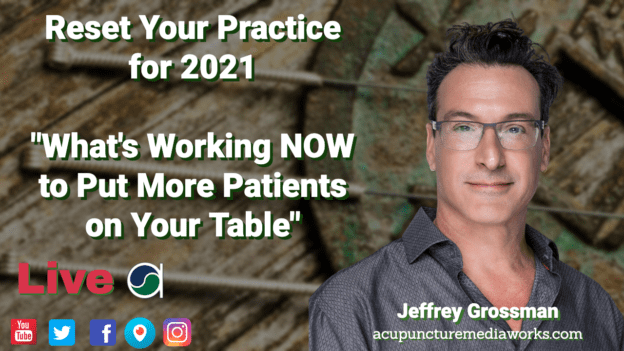
So this is the reason why I’m excited to host this web class about how to reset your practice for 2021. What’s working now to put more patients on your table. So welcome for those of you that don’t know me. My name is Jeffrey Grossman and I’m the founder and owner of Acupuncture Media Works, Accu Perfect Websites and Accu downloads. And I started my practice back in 1998 and had a lot of trials and tribulations and many struggles. And I basically had no business or any type of marketing savvy. And I had to start from scratch like many of you guys listening today. So I noticed that when I was in practice, I had a problem knowing how to market my practice and properly communicate to my patients, because all I wanted to do was to treat people and not to market to them. But the struggle that I faced took me down the path to create companies that I run today.
And it’s a longer story. And I’ll reserve that for another time. So what I want to do is to remind you that we, as acupuncturists are an incredible resource where natural healers, we know how to get people to feel balanced, to feel healthy. We know how to help people using safe and natural methods. And we change lives, right? We help, um, help w we people want our services, right? And they need our services. But a lot of times people don’t even know that we exist. Let alone know that we can treat this vast array of conditions that we can work with. And I want to help you change that. I want to help you get more people on your table. And that’s what these talks are about. They are here to help you be seen. They’re here to help you be heard and ultimately to bring more people in your practice so you can make more money and help more people.
And I want to remind you that you’re never alone. I’m here for you. And at the end of today’s talk, if you feel like you need help getting set up or becoming focused, or if you just need a little motivation to move forward, please feel free to reach out. And I will share some information with you on how to do that. So I’m here to help you give you a fresh perspective, 2020, and COVID changed how the public thinks about and looks about looks for health solutions. There are more opportunities now than ever to help more people, because you have to understand what people are looking for now and the best way to present it. And I want you to have the latest updates and research. So I created a detailed report for what is working now and any recommendations for you, how you can make it work for your practice and get more people on your treatment table.
It’s a 15 page resource, and you’ll find this information invaluable. And I’ll share that link for you at today’s training, uh, at the end of today’s training. So you can actually download that right away. So I want you to use, today’s talk. I want you to use the ebook that I’m gonna share with you as a resource to reset your practice, because just one or two of the simple changes that you pull from the top or from the ebook can make all the difference in your practice. Okay? So let’s jump right in content marketing. What is it? And why should you care? So content marketing is a proven business strategy that brings you more ideal patients without the expense of advertising, but helps you build trust and establish personal connections with patients even before they come into your practice with content marketing, you’re providing value for patients at no cost to them in exchange for their time for reading your content.
And the more time they spend with your content, the more that they will begin to know, like, and trust you. So content marketing amplifies your credibility, your 30, and the desire ability for people to choose you to be their healer. It is a marketing tool for patient engagement, retention, branding, and professional reputation building. And it gives your community an in-depth perspective of how you can help transform their lives for the better these days. The vast majority of Americans seek health information online. Plus we know often people often times find and choose practitioners online. The first place they go to is to Google you and your treatment modalities. And that means if you’re producing valuable medical content online, you’re much more likely to garner attention and authority for you and your practice and to get new patients. So since COVID the average Americans online content consumption has doubled to almost seven hours a day.
And there’s a consumer survey that found that most respondents cited, that they were looking online for personal health and health for friends and family members as their biggest concerns. And they’re looking for answers about their health, how to stay healthy, professional advice on living with a specific ailment and how you may have helped others with their particular problem. So content can take many forms, and here’s what you can offer. You can offer blogs using written articles and patient stories and videos, patient education, videos on your website and on your social media channels, email newsletters, and patient help sheets e-books and PDF reports, uh, live events and trainings on any health condition. So you need content marketing because if you’re a healer, you’re not a sales precedent and the content does the selling for you, right? So here’s a few content strategy that you can start doing today, make sure that your content is compelling enough to people want to share it, right?
So, you know, as you know, your prospects can get a second opinion or forward it to friends. Another thing to do is to post the latest industry news. People expect you to know about medical breakthroughs and how acupuncture can help with this, or how acupuncture can help with that condition. And the other thing that’s really important to do is be niche specific, okay. Have separate content for whatever problems that you deal with most and that your patients are in particular are looking out for. Okay. So I hope that makes sense. Um, and here’s a question that I received a while back from one of my coaching students, and you may have the same question as well. So the question is I’m an acupuncturist, I’m a trained healer, and I’m not a salesman. What is the best way to find new patients to get patients to commit to a full treatment plan?
And that my friends is the million dollar question, right? And there are a million answers to that, but here’s one answer use something that everyone understands and what that is just connecting with your patients through story. I think that you, um, most of you would probably agree that building trust with your patients is paramount in, uh, in with them accepting your care and staying with you for the long-term. And, and you have to build empathy. You have to build trust. You have to build likeability and one sure. Fire way to do that. If I telling stories and the stories that I’m talking about are success stories about how you help people and other patients with similar problems. And when you do this, the sales will take care of themselves. People will read and resonate with a particular patient success story and practically sell themselves on coming to see you.
Nothing is more powerful, right? Patient success stories are the most effective and least expensive ways to find new patients. And they get patients to accept treatment plans. There’s a native American proverb that goes something like this. Tell me the facts and I’ll learn, tell me the truth and I’ll believe, but tell me a story and it will live in my heart forever. So the number one questions that your prospects want to know is, can you help me with my problem? That’s it, it really is that simple. They don’t need a medical explanation. They’re not looking for a TCM diagnosis. They’re not looking for you to convince them that acupuncture helps. They need something simple to understand and that they can relate to. And storytelling helps people learn because stories are easy to remember. Um, so there’s an organizational psychologist. Her name is peg new Hauser, and she found that learning, um, which stems from a well-told story is remembered more accurately for far longer than learning derived facts and figures and Jerome Bruner’s, who is a research psychologist also suggested that facts are 20 times more likely to be remembered if they’re part of a story.
So stories boost our feelings of trust, compassion, and empathy, and they connect you with your patients on a whole different level. So when we hear facts, it activates the data processing centers in our brains. But when we hear stories activates a sensory centers in our brains, so here are some things that you could do, right? So have at least one patient success story for every major element that you treat in your practice, give hard copies of those stories to patients, post them in your clinic, post them on your website and use electronic versions of those on social media, blogs, and emails. And also, the other thing that’s really important to do is have a story about why you became an acupuncturist. What was your journey to be the healer that you are today? Okay. And I have a rhetorical question for you. What is the number one way your prospects meet and judge you okay.
Online, especially through your mobile device. So my question to you is your website and content mobile ready. We’re obsessed with being connected with the world, through our mobile phones, many Americans check their mobile devices up to 96 times a day. And that’s once every 10 minutes. And that’s a 20% increase in the last few years. And here’s another disturbing fact that 66% of all Americans check their phones 160 times a day. We are obsessed. It’s really true. How many times do you check your mobile mobile device in a day? So you might be saying to yourself, Jeffrey, I get it. I check my mobile phone a lot of times, but how does this affect my acupuncture practice? Well, the number one, your website must be mobile friendly in this day and age. So given how many people own a smartphone and how often people use their phone, um, to access the internet, it’s really good for business to have a mobile responsive website.
And when we are done here today, um, um, take a look at your website on your mobile device and ask three or four friends to do the same. Ask these questions. What’s how’s it working? What happens when you scroll up and down on the homepage? Is it easy to find your contact information is easy to clip a, cook, a button and make an appointment? Can you find your social media links? Can you schedule or call with one click if I’m ready for an appointment, but what I’ll learn if I’m not ready for an appointment, but I want to learn more about your success in helping patients. Is there good content that is easy for me to find? Do you have content or proof on your blog or webpage that tells me why acupuncture is a good clinical modality. Excuse me. Can I download any digital reports, any newsletters, any patient help sheets, anything that can help me further my knowledge or experience about acupuncture?
Is there a way for people to join your mailing list? Is it easy to find reviews that you have? Is there video, okay. There’s no escaping it. We live in a digital world and both your website and your content must fit into that world. Okay. Or you may be losing patients and referrals every day. Make sense, check your site, make sure it’s 100, a hundred percent mobile ready. If you need a second opinion, feel free to request a free website evaluation. I’ll give you a link towards the end of today’s training, where you can access that free website evaluation. All right. And finally, the number one way to positively positively influence prospects to become patients is with video. I know many of you are cringing with the idea of actually producing videos, but video continues to be one of the most effective elements in a patient digital marketing strategies that we roll into 2021.
And with good reason, because as a visual species, humans find videos, more engaging, more memorable, and more popular than any type of content out there. So video as a means of storytelling, marketing and content is no longer just a nice option, right? It’s a necessity. If you want to increase conversion and exposure, incorporating a video marketing strategy is the only way to go from. I understand that viewers retain 95% of a message when it’s in a video versus 10%, when they’re reading it in text and mobile consumption this year about watching videos on their phones has gone up 100% this year, over last year. And by 2022 videos are going to be more than 82% of what drives traffic to people’s websites. Okay. And if that wasn’t enough, a website is 53 times higher to be ranked on the front page of Google. If it includes a video that’s huge.
When you Google acupuncture in your state, in your zip code, you need to be on that front page. Having video will increase that by 53 times and that’s massive. Okay. So how does this affect your practice? Video is the fastest and easiest way to establish credibility and connection and a 30 and reputation healer. And you might be wondering, you know, do I have to do the videos? And the answer is no, you could have, um, you could use done for you videos. You can outsource your video. You can do audio only videos on top of a PowerPoint, um, and the types of videos that work, uh, um, you know, you also might be wondering what types of videos work best? Well, the answer is that any video is better than no video. So with good lighting using your phone is a great way to do a video.
And the great news is that most videos on Facebook today do not have a video. It’s all audio with images, right? And slides that are, that are rolling across the screen. So it’s not actually you or a person on there. It’s just images. And that’s really easy stuff to create. So using videos for your marketing can take many forms. You could use it, um, as explainer videos or Intelihealth on your website or presentations on educational events or tutorials on how to use these points for these particular conditions or cooked foods for these particular elements or customer testimonials or interviews or product or service videos, or even a live video like we’re doing today. So imagine having one to two minute videos on your social media and on your website, about a few key conditions that you deal with that you can use over and over and over again, to educate patients on the effectiveness of your services.
That’s huge. Okay. You can talk about back pain and allergies and digestive problems and stress and anxiety. These are all topics that you would use over and over again and make sure well, practice more memorable. So dope, intimidated. Your video does not have to be perfect. It just has be honest and sincere. So my hope is that you received some answers and inspiration and insight for what you needed today. And I want to encourage you. If you need to reevaluate your plans and to make actual strategies feel free to reach out to me, I would love to give you a fresh perspective. I, if you need help reach out and let’s just start with a free 15 minute mentoring and discovery call. And all you have to do is shoot me an email at Jeffrey, J E F F R E Y at acupuncture, immediate works.com and I’ll get back to you as soon as possible.
So again, J E F F R E Y at acupuncture, media works.com and I’ll get back to you as soon as possible. You are an incredible resource. You change lives every day, day in and out, and people need you. Okay. So, um, I promise that I want to share with you, um, go download this ebook. This is resetting your practice for 2021. What’s working now to get more patients on your table. I go through a bunch of different topics that really show you everything that you could be doing now in this year to re set your practice, I have to do is go to Accu media dot U S um, slash reset, 2021. Again, Accu media dot U S slash reset 2021. And you’ll be able to access this 15 page ebook that you could use as a resource for this year and future years coming down the line, too.
And for those of you that are interested in getting the website evaluation, um, all you have to do is go visit this URL and, um, request, uh, fill it out, request an eval. So that URL for you are your evaluations, acu.pw/p E P hyphen evil. Okay, so again, a C U dot P w slash P E P hyphen evil that’s for that free evaluation, you guys are awesome. You change lives every time you put a needle in somebody you’re shifting people for the positive. This world needs, you reach out. If you need some support, I’m here for you. I got your back and thanks again for having me, uh, to share some more insights and more wisdom with the AAC on this call today. Take care, stay beautiful. Talk soon. Bye. Bye
Please subscribe to our YouTube Channel (http://www.youtube.com/c/Acupuncturecouncil )
Follow us on
Instagram (https://www.instagram.com/acupuncturecouncil/),
If you have any questions about today’s show or want to know why the American Acupuncture Council is your best choice for malpractice insurance, call us at (800) 838-0383. or find out just how much you can save with AAC by visiting: https://staging.acupuncturecouncil.com/acupuncture-malpractice-quick-quote/.
Hi folks. Welcome. Thank you for joining me here today. And thank you again for the American Acupuncture Council for inviting me back for yet another Wednesday training for you guys. I really enjoy doing this and showing up and sharing this information with you, especially since many of us have not had much marketing and business tools to help us build a solid business.
Disclaimer: The following is an actual transcript. We do our best to make sure the transcript is as accurate as possible, however, it may contain spelling or grammatical errors. Due to the unique language of acupuncture, there will be errors, so we suggest you watch the video while reading the transcript.
So before I go further, I want to ask you a couple of questions and you can put your answers to the questions below. Where are you currently in your practice? Where are you going in your practice and what kind of roadblocks are you facing in your practice? Currently, I’ll check back at the comments towards the end. I’ll respond back to you, but I just kind of want to get a sense of where everyone is and what your concerns are. So today we’re going to talk about three success factors to grow your acupuncture practice now next month and beyond.
So the thing is, is that you, as an acupuncturist have so much expertise and the world absolutely needs you right now, probably more than ever before people are suffering and they’re looking for what you have to offer, but most likely people don’t actually know that you can help them with all of these amazing things that you can help them with. So I’m sure you would agree with me that acupuncture and most patients understand that you could help them with pain, right? This is the most widely known use of the medicine to help people alleviate pain. But what about everything else that we could do on noon, support, allergies, support, improving sleep, helping families make, you know, make babies up, reducing stress, alleviate all of those things that people are looking for, but maybe they don’t know that you could do that. So most people are looking for these kinds of solutions, but they don’t even know that you could be the go-to practitioner to help them with what you can.
So how do you make more people aware of what you do and how you, what you could help with? And part of this challenge is that you need to put on your business person cap and get out there and do the work of marketing your practice, especially in these times, especially in slow times, because if you’re not out there marketing and staying in top of mind, awareness with your patients and your prospects, someone else is. So it’s really important for you to figure out how to remain and maintain and get out there and be in top of mind awareness. When people think about allergies, they think about you. When they think about immunity, they think of B, they think about you and what we’ve been sharing all of this time, all of these weeks for the AAC are the different tools and tips and strategies to give you options and marketing strategies to grow and build your practice.
Um, but before we go any further, um, before we, you know, get into marketing, you need to know that your practice, your business needs to be rooted in a solid foundation of proper messaging, business modeling, service offerings, pricing, fees, and systems. And when you have all these things in place, you’ll stand out from the friendly neighborhood competition and position yourself as the go-to acupuncturist in your community. And that’s my assumption of what you want is to be the go-to practitioner in your community. So when people think about all of these things that, um, that are going wrong with them, you come to top of mind. So today what I want to do, I want to dip into some of the waters and talk about the three success factors to help you create a solid foundation to grow your practice. And these successful, these three success factors are clarity, focus and decisions.
Okay? And these are really important pieces to help support all aspects of your marketing, all aspects of your patient communication, all aspects of you being the business entrepreneurial acupuncturist that you are. I know you did not go to school to become a business person or an entrepreneur, but you are since you’re in private practice and you own a business and you are a business person, so you’ve got to embrace these ideas. Okay. And that’s what we’re here to share with you today. So clarity, okay. Clarity is getting really clear okay. On you, your practice and how you stand out, what makes you and your practice different? Okay. So you need to ask yourself these two questions. Who are you and what do you offer? And with that, what kind of transfer w can you cause to happen with a person’s health in their life, in, in the change that you are able to offer them in what you offer in your practice and why is what you offer different smarter, better than any competing clinic.
Okay. So that the first part of really identifying who you are is really understanding, getting clear on what makes you different. Okay. Now I hope that many of you have an idea of like, what makes you different from the practitioner down the street? If not, you need to get really clear on that, that this, this, this clarity portion really will allow you to identify this little piece of marketing wisdom, this little piece of practice knowledge that allows you to differentiate yourself from the next person down the street. So my question to you would be this, if you were to think about the acupuncturist down the street or the chiropractor that has an acupuncturist on board or the chiropractor that does acupuncture, how are you different? Do you offer a different specialty? Do you offer a pain-free technique? Do you offer pain-free acupuncture? Is your clinic beautifully inviting and Zen, like, and people just walk in there and they melt because of the atmosphere and the function way.
What is it that makes you and your practice different? Okay. So who are you and what do you offer as far as transformation so that you can cause in people’s lives and in their health. Okay. That is the first part of, one of these success factors is wrapping your head around this idea. The next idea is focused, right? The idea is to get laser focused on exactly who you serve and what problems you solve. Okay. I know many of us were trained to be general practitioners, and that’s amazing because we could help with so many different conditions. And that’s, what’s so beautiful about this medicine, but you’ve got to figure out who you serve and what’s unique about you and also what, what will resonate with your clients. Okay. So with this, you’ve got to really, you know, like in, come up with the idea of getting clear on the type of person that you want to work with by getting into the mind of your perfect client and find out what resonates with them.
So for instance, if you are a fertility clinic, what would resonate with those clients that you to attract, get it? How can you get into their mind to understand what they need, what their pain points are? What, what, what, what kind of transformation they are looking for? So you can offer that and that could be unique to what you offer in your clinic. Okay. So getting focused is really coming up with who do you serve? And I know that you want to serve everybody, but here’s the same. If you serve everybody is just like taking a big net and casting out over the waters of the population and hoping that you’re going to pull everyone in. But you know, you might pull a few people in, but what you want to do is you want to get really clear, really laser focus on the specific type of person you want to work with.
Okay. And, um, and then when you do that, you can, you can focus your marketing message. You can focus your communications, you can focus your website, you can focus your branding and all of that towards that. What’s unique about you and what resonates with your clients. And the other part of getting focused is what problems do you solve? Okay. And the key to understanding what problems you solve is to understand what your patients are thinking. Right? So they’re thinking w I F T okay. So they want to know what’s in it for them or for me as a patient. Okay. And they want to know what’s in it for them. Like, like, like if they come see you, what are they getting out of it? What kind of transformation is going to be happening? So part of your, um, expertise as a business entrepreneurial acupuncturist is really getting clear around the problems that you self.
Okay. And really being able to tell someone that in 30 seconds or less, like if you were trapped in the elevator, how can you communicate who you serve? What you, you know, uh, what problems you solve and who you are and what you offer, right? Those are the three things that are super important for you to begin this process of getting really clear on growing, you know, creating the solid foundation for your practice. Let’s say, so you have clarity, you have focused. And now the next thing to really come up with is decisions, right? And meaning what marketing tools do you use, where do you find your best prospects and your new patients, and how do you build your following? Okay. These are decisions that you’re going to be making. If you’re not making them already, or if you don’t make them, when are you going to make them, right?
When are you going to start embracing this idea that you’ve got to market your practice? You need to have a deep understanding of what your patients want. You need to have an understanding of what they need and what they value. Okay. You also need to develop content and communication strategies that address the things that keep them up at night. So for instance, let’s handle, let’s go back to that fertility issue. What keeps those families up at night that are looking to make a family and make babies, right? Maybe they am I going to get pregnant and am I going to be a good parent? Um, is birth going to be easy? Um, am I going to be, you know, am I going to keep, you know, keep the baby, uh, for full term, okay. Those are things that keep them up at night. And when you can come up with those ideas, when you can, you know, get into the mind of them and figure out what it is that resonates with them, right.
Um, in the sense of, um, uh, what’s on their mind, then you can talk to that with them. Then you can share that with them, even if they’re not expressing those problems and those things that keep them up at night. Okay. You need to ask yourself a couple of questions. How can you add value before money changes, hands and, um, with your patients? Okay. So how is it that you can add more value to your clients now to your prospects and your inactive patients now, before they come in and schedule them before they come in and, um, and, and, and, and, and become a paying patient with you. And that’s important because people want to see people that like stack on all of like, like, it’s like you, over-deliver right. How can you over-deliver for your patients in that way? You know, um, how can you make it so that your marketing, your efforts, your communication strategies leave them better off than when they first came to see you.
Um, and when you are teaching them, when you’re doing a webinar or a training or anything like that, how are you teaching and giving them actionable things to make their life better? Okay. You’ve got so many tools in your arsenal of, uh, of teaching ideas and potential that you should have no lab of what you could be sharing, how you could teach and give them actionable things to make their lives better. Acupressure techniques, breathing techniques, moving technique, different seasonal recipes and things of that nature. So part of the decision making is really coming clear as to, you know, understanding what your patients want, what they need and what they value. And talking to that for them coming up with ideas on how you can communicate to that, to them. So a couple, you know, like straight up marketing tools that you, that are hyper-relevant for, um, for, for what you, what you can be doing for your patients are to make sure that you have a really strong call to action to motivate your audience.
Okay. If you’re a fertility expert, what would make someone who’s looking to start a family, raise their hand and come into your clinic. If you are a pain specialist, what can you offer them that would make them raise their hand, to motivate them to come into your clinic? Every single communication you have, every single marketing you do. Every single event needs to have a really clear, strong call to action at the end, that gets people to raise their hands said, yes, you are the practitioner for me, because you resonate with me because you know what I want, because you’ve already done the work that we’re talking about here today. So that is one of the biggest and most important things about your marketing is making sure that you have a really good, clear, and solid call to action. And a few ways to find prospects are internally and externally, right?
And online. So internally you could be doing referral drives. Uh, you could make sure that your patient education strategies are really solid and, uh, make sure that you have a plan to keep, to nurture your patients. So they would fall out of care less. And if they do fall out of care, you need to have a plan to get them back into care. So that is, you know, a few really important internal marketing strategies that you need to tap into referral drives having a communication plan and having a patient reactivation plan three really important pieces of your internal marketing, external marketing content is King these days. And you need to be out there doing social media, doing video marketing is really important. And even these days direct mail marketing is actually gaining more traction because people, no one’s doing it anymore. Once everything’s online email and newsletters, everything is online, but when you can do direct mail marketing or send a letter or postcard in the mail, it’s actually touched, they open it up, they look at it.
So it’s actually been showing that, um, that, uh, that, that direct mail marketing is actually making a little bit of a comeback in some instances. Um, so with external marketing, make sure that you have a content calendar set up, that you can be out there and in front of your audience regularly, again, talking to them about what resonates them, talking to them in, in explaining, you know, through your content and your communications, what’s in it for them. Okay. So you can really get clear and focused on your communication patterns with them and online, make sure that, um, all of, you know, all leads are gonna be pointing to your website. So make sure that your website is really dialed in. And, uh, you know, when you come up with your clarity and your focus, you need to add all of that to your website. You need to make sure that you have a really strong call to action on there that, that, that, uh, communicates with what you’re, what you’re offering in there.
And when people hit your website, they to know exactly what you do and what you offer and what is what’s in it for them within the first few seconds of landing on that page. So your website needs to be checked out and audited. And, um, and if any of you are interested in audit, um, you know, check, uh, put some, put some, um, information below the video over here. And, um, I will reach out to you and, uh, you know, just let me know that you want a website audit and I will reach out to you and we’ll get something set up for you. So, um, you know, without clarity, without focus, without decisions, your marketing strategy is always changing. Your marketing tactics are scattered, and it’s going to be exhausting because you’re going to try something. It’s not going to work. Um, you’re going to, um, you know, you’re going to get disenchanted because you’ve done marketing.
You’ve put some efforts out there and you’re not getting the type of return on that investment. Um, and your results might be inconsistent and subpar. So focusing in on these foundations of clarity, focus and decisions will help you create a better strategy, you know, more effective tactics and, and give you some consistent, reliable, um, techniques that you could be using to pull patients into your practice. So decide who you are, who your practice is not for, which is important, because if you can identify who you, you know, who you don’t want in your practice, um, then you can really focus on, you want to focus on in your practice, who you want to fill your practice up. And then, you know, when you can, you can focus on their behaviors and their traits and their likes and dislikes. And you can pull in the type of people that you really resonate with, that you want to fill your practice of. And also the last thing I want to talk about is to really simplify what you do. So
Figure out what, what, what you offer, like
Really simplify what you offer as an acupuncturist. And also come up with an idea of when you’re asked at like a cocktail party or some type of event or a networking event, or if you’re doing anything online, you know, w w you know, how you help people, you need to get really clear on your message. You need to have some laser clarity on your mission, on who you serve and why people should choose you, and what’s in it for them. And lastly, I want you to think about these four questions that you can just go away with, um, and just ponder on. Um, and if you have any questions you can reach out to me, um, at, uh, Jeffrey, jeffrey@acupuncturemediaworks.com. Um, or you can put some comments below, uh, some comments below here, and now I’ll ask, ask them, but how do you stand out from the noise and get attention?
Okay, what makes you stand out? How do you leverage the season and create marketing campaigns to result in new patients, and how do you continue to grow your audience and deepen your relationships with them, and what creative ways can you use content to get clients? Okay. So those are just four things that you should be thinking about on a regular basis. These are questions that, um, CEOs ask themselves often. And I would want you to ask this of yourself because you are essentially a CEO of your own business. So I want to remind you that you’re never alone. I am here for you. If you’ve got any questions, please reach out. Thank you again for joining me. Thank you again for the AAC for hosting me once again, so I can share some insights and wisdom and some knowledge with you. Please let me know what your thoughts are. I talked to you guys soon. Take care. Be well. Bye. Bye.
Please subscribe to our YouTube Channel (http://www.youtube.com/c/Acupuncturecouncil ) Follow us on Instagram (https://www.instagram.com/acupuncturecouncil/), LinkedIn (https://www.linkedin.com/company/american-acupuncture-council-information-network/) Periscope (https://www.pscp.tv/TopAcupuncture). Twitter (https://twitter.com/TopAcupuncture) If you have any questions about today’s show or want to know why the American Acupuncture Council is your best choice for malpractice insurance, call us at (800) 838-0383. or find out just how much you can save with AAC by visiting: https://staging.acupuncturecouncil.com/acupuncture-malpractice-quick-quote/.
Thank you again to the AAC, the American acupuncture Council for having me host To The Point. UMy segment is on practice management. My name is Lorne Brown. I’m a CPA. I’m also a doctor of traditional Chinese medicine. I practice in Canada, Vancouver, BC at Acupuncture Wellness Center. I’m the founder of healthy seminars, previous known as Prodigy seminars.
Disclaimer: The following is an actual transcript. We do our best to make sure the transcript is as accurate as possible, however, it may contain spelling or grammatical errors. Due to the unique language of acupuncture, there will be errors, so we suggest you watch the video while reading the transcript.
I’m the chair of the integrated fertility symposium. And I’m also an author. I have a couple of books out there. The one on practice management is missing the point why acupuncturists fail, what they need to know to succeed. And I enjoy coming on to this segment of the show to share my practice management pearls, because I have both the clinical experience and being a CPA, the knowledge and auditing experience of what it seems to take to, uh, to succeed. Um, our topic today is on, you got this, how you’re going to grow your practice now and for the future. So what I plan to, um, talk about today are the following three things.
Um, my prediction for, um, a future, what’s the future opportunity for Chinese medicine practitioners? I think that’s a lot that’s on our minds a lot. Um, how do I not only survive and, uh, more so how do I thrive now when there’s any other major events happening in life? This has been throughout life. Um, not everybody survived, so there will be what we call casualties. There will be, um, from the practice side, people that will not be practicing. And so my expectation is to help more people, um, make it way, make their way through any change in life. So any type of difficult change in life. So that’s what I’m hoping to share with you today. And not only so you can just survive and get through these challenging potentially challenging times, but also, so you can come out through it, um, thriving and better for it.
So I’m gonna talk, I’m gonna give you my prediction of what I think is happening for the future. What are the future opportunities for the Chinese medicine practitioners? Um, I’m gonna talk about, uh, how you can change just one perception just by changing one perception. You will start to see opportunities that have always been there, but you’re blinded to them. And by changing a certain perception, um, all of a sudden more opportunities will open up to you. And then I I’d like to share a mind hack, um, how to support you in being able to see those opportunities, um, that are available to you, but you’re constantly I’m missing those. So first I’m going to share my predictions. Now when it comes to entrepreneurs and guess what? You are small businesses. If you are practicing on your own or you are a contractor, regardless, you are, um, a small business.
And, um, if you’re going into succeed, we’ll call you an entrepreneur and entrepreneurs, um, tend to look for needs, where are their needs in the world that need to be filled. And then they find ways to fill them. So they look for these needs and then they fill this need by either providing a product or service. And so there is a need in our world right now as well. And my, for the future of Chinese medicine right now, I see it that if you could learn to focus on treating long haulers, um, so post COVID infection or any infection from a pandemic, but in particular long haulers, um, I think you would have a thriving practice and also, wow, what a service to the community, because there are people that ha get infections. We’ve seen this route throughout history, throughout the history of Chinese medicine and throughout our history of us living on this planet.
And now more so with COVID-19 that some people, um, get these latent pathogens in their body and they struggle to get back to normal. And right now it’s very new, but there is evidence and documentation of people. Once they’re no longer infected with the, COVID not showing up positive, they are not back to normal. And some of the symptoms they are experiencing are fatigue, joint, pain, brain fog, and mental health issues. Lots of things that we see already in our practice, that we are probably pretty equipped at supporting and Chinese medicine has an excellent way to deal with these latent pathogens on the way we’ve mapped out the body. We have, we have tools that can support people. And to let you know, I was talking to a dentist friend of mine that teaches in the dental school here in Vancouver at the university of British Columbia.
And I just said, how are dental is doing right now. Are they struggling? Because you know, people are afraid to go to dent what’s going on for your industry. He said, they are busier than ever TMJ jaw pain because of COVID and all the stress and anxiety that people are experiencing. There has been an increase in people clenching and grinding during the day and at night, which is leading to TMJ and other job pain disorders. And so, um, they are very busy treating jaw pain, and I’m apparently I think acupuncture can do a good job at TMJ as well. So, but nobody may not know this. And so this is, um, my prediction for us is post COVID long haulers. So learning to really treat well these long haulers and seeing what the main symptoms are. There is some neurological symptoms, but the most common ones are fatigue, joint pain, brain fog, and mental health issues.
And then just on his own mental health issues, um, people are experiencing and will continue to experience anxiety, feeling depressed and insomnia, um, from the uncertainty in our world. Um, and then taking your practice online, a lot of people are taking their practice more online to offer consults, supplements, verbal acupressure chigong. So having an online component, I think would be a great idea. I do want to let you know that eventually, if you are able to make it through this period of time, you can’t do acupuncture online. And so there will be a need for our service eventually because it’s something that just can’t be done online. So I just want to remind you of that. However, you have to adapt during these times, and this is the time to really, um, get this knowledge and really learn how to treat post viral infections. According to Chinese medicine principles, I would encourage you.
So my prediction is if you want to, if you have a practice that’s not booming. If you’re a new practitioner, if you don’t have a waitlist doing what you do now, um, then now’s the time to start to prepare yourself, um, and get those, um, tools and that knowledge. So you are able to help this population because there is going to be a large population needing this help. So who am I like, how do I have the credibility? Why would you want to listen to me? Do I have the knowledge and experience to share my predictions? And so far, I think I’ve been a good at predicting, um, or going into things that have turned out to be the right prediction. At the time I was told I was crazy and many of them, and I’ll share a few of those. I’m the first Canadian clinic to focus on reproductive health back and around.
I started in 2000 by around 2001. And just so you know, many of you know, that people treat fertility with acupuncture all over the world. It’s common. You see it everywhere in 2001, that wasn’t the case. Just so you know, I think if you and I was on the web with that, if you went on the web and you search, I think two people would come up mainly in the States, Mike Berkley and Randy Lewis, nobody else really had websites, um, or many websites. And definitely not just focusing on fertility, think about it back in that day, back in 2001, um, fertility and your gynecology, Chinese medicine textbooks was under miscellaneous diseases. It didn’t even get its own chapter. So it wasn’t something that you would think if I treat mainly fertility I’d have a busy practice. When I went into treating just fertility, it was a passion of mine.
I saw a need for it. Um, I was told that I’m going to starve to death and not, it’d be crazy because back then people with fertility issues, weren’t seeking out Chinese medicine acupuncture. There wasn’t that policy study that put us on the map. It hadn’t happened yet. So, um, when I decided to do this out of passion and saw a need for this and this niche, um, I was told that, um, it was practiced suicide in you. You’re not going to have a busy practice. And I ended up having to hire many associates because word got around and my practice became so busy that I actually only would treat reproductive health and, um, I couldn’t handle the volume. And so I needed other practitioners and so five or six acupuncture practitioners now and naturopathic physicians and mind massage or in my clinic and acupuncture.
So, um, that one would, I will check off saying, um, it was a good prediction. Um, I’m a CPA. Um, and so, um, I spent years auditing companies. So from that experience I’ve seen, what has, um, why some companies have been successful and why some companies are not successful and don’t survive. And so I bring that, and not only the knowledge of being a CPA, but an experience as being an auditor, I’ve seen how, um, I’ve seen what, what can happen. And I bring this to you as well. When I share this with you. Um, I pioneered online learning with, uh, for Chinese medicine back in the day, it’s around, um, 2007 ish. It was just pro D seminars was the name of the company. It’s now called healthy seminars, but it was protein. Then when I launched it and it was just us in blue poppy that were doing online learning, and I was told that this was a bad idea.
Who’s going to want to learn acupuncture online while you can see now, um, online is everywhere. And people take courses all the time doing online, their doctorate, a doctorate in Chinese medicine, et cetera. So, um, back in 2007 ish, not too long ago, um, more than a decade behind you, but back then I was told that’s not a good idea. And I made that prediction that this is where learning will go. It was feasible, no hat, no planes on have to travel, no taxi. Um, all the people in rural communities, just very easy to access people and to access these great speakers with textbooks. Um, wouldn’t it be great that we can get them online versus having to find them once or twice a year and travel to them. So I, again, it’s obvious now, but it wasn’t obvious when I started out. And again, I was told that would not work.
Um, I launched the integrated fertility supposing in 2015, um, and we sold out five years in a row, 2015, 16, 17, 18, and 19. Now, the reason that was special is the ifs was related only to fertility. So it was a condition specific conference and it was a destination conference for Americans. Now, back when I was planning this in 2014, um, a lot of American conferences were struggling that tendencies was get tendons was getting lower and to put a conference for Americans in Canada had never been done and was not considered a good idea cause they can’t even fill them in the States. And then to pigeonhole, um, fertility conference, they didn’t think it would work well. And many of you have heard of it or attended it. It did very well until 2020 when COVID I’m interrupted would we would have sold out. We were almost sold out and we chose out of health and safety to counsel the conference.
And again, predicting we counseled the conference before conferences were really being counseled or at the adventure being counseled. We did this, um, early on in February just to just, just decided to not risk people’s health and safety. And then, um, three weeks later, um, everything got shut down anyhow. And one more thing for my credibility is I wrote a book called missing the point. So I’ve taken some time to do my research and write a book. So what I would be doing and what I am doing as a practitioner, if you don’t have a waitlist, um, I would be looking into developing your knowledge and your skills. There’s lots of ways to do this. Now, online healthy seminars, we’ve put together some online classes, um, to address mental health issues like anxiety, post traumatic stress disorder. Insomnia is we’ve got lots on there. Um, plus we have some herbal courses by Sharon Weizenbaum and Hein or fruit Hoff, and many more verbal courses.
And then there’s acupuncture. There’s guash awe there’s the acupuncture of the balance method, acupuncture som uh, Korean style acupuncture. There’s many things out there that people are discussing that could help, um, these long haulers. So, um, it’s an opportunity for you now to, um, to address that. And so again, if I was an acupuncturist, starting out two things, I’d be really focusing on how to communicate to people, um, why and how I can help you. Cause you remember there’s a need, but they don’t know you exist. For example, they’re going to their dentist, they have job paying, Oh, jaw dentists. So they go to their dentists. So it’s your role to educate through communication. Some people call that marketing. It is marketing is educating. So educating the public, um, how and why you can help them, um, with the need and the need here is do you have, if you had COVID fatigue, brain fog, you know, lifts up the symptoms, educate them, educate them how Chinese medicine has a long tradition of treating pathogens and viruses where people are struggling afterwards.
So this is not new. And then I would increase my knowledge cause you want to be congruent and have that knowledge. So now it’s a time you’ve been trained to just kind of sharpen that tool and really look to reading journals, textbooks, online courses, um, finding ways that you can get your knowledge to a great level. So you can communicate clearly to your patients and constantly treat them with the tools you have acupuncture. Gwoza herbal medicine. Now I always say, I like Einstein’s quote, make everything as simple as possible, but not simpler. So it’s simple to say the prediction is there’s going to be a lot of long-haul up haulers and there’s an opportunity for the Chinese medicine profession to step in and support these people. There’s going to be there is people now with mental health issues, anxiety, um, feeling depressed and insomnia so that, that there is a need for people to support, um, in a non-pharmacological way to support these people.
But knowing is not enough. So you’re going to need to take action and up your knowledge and get the word out. So again, just hearing this going, Oh, that’s great. Not going to help you. There is effort on your part. So simple, make everything as simple as possible. I’ve given you my prediction. I gave you a little bit of my history just to let you know that I’ve been fairly good at a fairly good track record. And some of you are like, yeah, that’s obvious. Yeah, to me, it’s obvious as well. But for some people they’re still focusing on what they used to do and how they used to treat. And I’m suggesting that things have changed and now you want to adapt and a huge opportunity. If you’re flexible and willing to not do everything the way you used to do it and see that there’s another opportunity available to there is a need out there and you are set to fill that need.
The other thing I said, I want to talk about. I said there three things. I want to talk about how you can change your perception, um, and how this can shift you from living basically from lack and abundance. And it’s a simple concept again. So going with that theme make things as simple as possible, but not simpler. And so the perception is how you look at an opportunity. And so most people look at, um, when they’re going to do something, invest in themselves, they look at the cost and not what the return is, not what it’s going to bring back to them, how they’re going to benefit what we call an accounting return on investment. And of course, I like to use an example of, um, a Jane Littleton course that we offer. Um, cause it’s, it’s not, uh, it’s not the least expensive course.
Not the most expensive course either, but it’s about $500 for her course, 19 hours of continuing education credit. And a lot of people see that as a sticker price and go, Whoa, I’m not going to take that. So just by seeing that price, they’re like, I’m not, I’m not interested. That’s intimidating. Some patients are like that with your services as well, by the way, most people look at the cost. I’m saying, look at the benefit as well, actually more importantly. And so for those that treat infertility and, um, you will know that majority of your patients will come for like 24 visits, maybe 12, because as you learn in Jane Little sins course, and other fertility courses, it’s recommended to treat on average three months, um, twice a week for acupuncture. And if you can explain why and my patients, most of them come in twice a week at the beginning, and then if they need maintenance afterwards, so minimum of 12 to 24 patients.
So if you’re looking at the return on investment, how many patients do you need to see to kind of break even right? If I’m going to spend $500. So if you are charging $90 a visit, now I know some of you would charge many more in the fertility world for that. And many of you charge much less. I just chose that number. If you’re charging 90 U S or Canadian dollars and whatever it is in your currency, um, because we’re using the currency 500 a us dollar, so let’s call it 90 us dollars. How many patients do you need to see? Well, the mass says once you’ve had six visits, so one patient, because one patient will come 12 to 24 times, once six visits happen at $90, you are actually now profitable. Those six visits have now covered the cost of the course. Plus you’re profitable.
I share this as an example, because if I had to see 10,000 patients or 10,000 visits to pay for that, I may wonder whether that’s a good benefit. Is there a value there, but by taking that course and having confidence to treat infertility, know how often and how often to treat and what to do in those treatments. And I can communicate to that patients, to my patients, just seeing some six visits we’ll pay for it. So that to me is an easy, like right away, which is what I did. And now I carry the course. I went and took Jane’s course right away. It was a no brainer for me, cause I always start my perception. I don’t look at what it costs. I look at what it costs of course, but I’m more interested in what it’s going to benefit me. So for an example, to take another ridiculous example, let’s say you found a course for $25.
Now that’s not too expensive. That’s not a sticker price. That’s going to prevent you from taking a course. It’s $25 and it’s a course to teach you how to do acupuncture on astronauts on the moon. Now, even though it’s cheap, my return on benefit, the return on investment. Hmm. How likely is it that I’m going to get to the moon? Probably not going to happen. And I don’t even know if there’s astronauts hanging out on the moon on a regular basis. So I wouldn’t, even though it’s a low in cost to get into that course for 25 bucks, I probably wouldn’t take it cause that 25 bucks is gone and I’ll never make that $25 back. Cause I’m never going to go into the moon if I take another invest. And this is for anything, you invest in a piece of equipment for your clinic.
When I invested in laser therapy, these are 20, 30, $40,000 lasers. I have, I had to do the math and see how many visits it would take to cover that cost. And how long would that be? Months or years. So what I’m sharing with you is just a change in perception, your patients have the same thing. So they come in and they go, Oh, this is this much. You need to be able to communicate the benefit to your patients so they can decide whether there’s value to spend the time and money to see you to get that benefit. If they don’t get the value, how they’re going to benefit, then it may be difficult for them to part with their money. Just like you find it hard to part with your money. And so that’s why I use that example because you’re going to start to invest in, um, maybe certain products to carry, to treat the long haulers, certain supplements, certain herbal remedies or herbs.
Um, you may need to bring in, um, you may need to take courses, um, to get your knowledge to a certain place. So you can confidently and effectively treat these long haulers. And so when you do this look and marketing, you may start to update your website or brochures. So when you do all this and there’s a cost outlay and you’re like, Oh, I’m already feeling lack right now. I don’t have the money to do it. So how am I going to do this? Think about the investment and how this is going to bring back tenfold to you hopefully or more. Okay. So I just wanted to share that part with you. And then the other part I wanted to share. Um, but I think because of time, I’m going to save it for another date. I’ll come back and I’ll do another day. I wanted to share with you a mind hack.
One of the things I didn’t share with you is that I’m trained to clinical hypnotherapists and I love to do mine hacks, um, basically to get into your operating system. And there’s a really cool one or two mine hacks that are, again, are really simple, that help you see opportunities that are there, but you’re missing it. You know, like there are so many things that are available to the subconscious, sees everything. And when you’re, when you get into a certain, um, whole brain state, I’m an alpha brainwaves, you start to access parts of your brain that aren’t always available to you and certain areas of creativity. They’ve done this with research, that there are certain, um, creative ideas that are there, but you’re missing it. And when you get into this place, you’re able to access them consciously and come up with these cool ideas, you know, think about when you’re the stories you’ve heard, where somebody is focused on a difficult problem.
And then they, um, um, they go decide to take a walk or take a shower or bath. And then all of a sudden the relaxing in a hot, the answer comes to them because they’ve gotten herself into a different state. Well, you can purposely do that. You don’t have to work yourself into a frustration and then leave and get, um, get access through surrender. There’s a way to mind hack that and get into that on a regular easy basis. So I’m going to save that for another session, um, where, how you get into your, how do you hack your mind? So you can see these opportunities that are always available to you, but you’re just missing them. It’s like unlocking that certain level on a video game for those who play video games, it’s there, but you have to be able to unlock it. I’m going to help you unlock that.
So what I wanted to talk about today and just a quick review is what does the future hold for acupuncture profession? I think for those that are going to survive, um, it’s really promising. One is acupuncture, still something people they need to come in person. So if you’re doing GWAS Shaw Twain on massage or acupuncture, that they’re gonna need to go online to get consultation, herbal stuff, and supplements that can be done and diet that can be DOL done online and more, more people will be doing that online, but the physical part of the medicine they need to be in person. And I think there is a need now how to support these long haulers, how to support people that are post viral infected that are experiencing the fatigue, the pain, the neurological symptoms, the brain fog, and then mental health issues from post viral infection, as well as just because you live in the, if you watch the news, if you’re on Facebook, you probably have some form of post traumatic stress disorder and are experiencing some anxiety, depression, insomnia, et cetera.
Um, and so how do you remain attractive for the public to choose you for the healthcare? Well, continue to invest in yourself. You know, there’s an express, there’s an expression. I heard that, um, um, health is not an expense. It’s an investment and the same thing. If you want to be attractive to the public, then invest in yourself and then communicate that value to them. If you don’t communicate, then they don’t know. Just like I mentioned, the job pain people go to dentists. Cause that’s what they think about. However, it’s up to us to educate people that we can treat pain really well, like jaw pain. Okay. So next week on the American acupuncture council, to the point, we’re going to have pony Chong and his normal Radian and integrative acupuncture. I will let you know that Poney Chiang has numerous courses on healthy seminars and they are fantastic.
So definitely check him out at the AAC To The Point. And if you want to study with Poney, you have that opportunity to do that online. You will be blown away. You can check his free previews on healthy summers as well. You’re really unlike them. Definitely check them out on to the point, um, next week. And I look forward to seeing you in the future. Um, you can find out more about me@ healthyseminarsdotcom and mybook is available at missingthepointbook.com. You have to put book in the, um, in the URL, missing the point book.com and the best way to either email or contact me with your questions is through healthyseminars.com. Thank you very much until next time.
Please subscribe to our YouTube Channel (http://www.youtube.com/c/Acupuncturecouncil ) Follow us on Instagram (https://www.instagram.com/acupuncturecouncil/), LinkedIn (https://www.linkedin.com/company/american-acupuncture-council-information-network/) Periscope (https://www.pscp.tv/TopAcupuncture). Twitter (https://twitter.com/TopAcupuncture) If you have any questions about today’s show or want to know why the American Acupuncture Council is your best choice for malpractice insurance, call us at (800) 838-0383. or find out just how much you can save with AAC by visiting: https://staging.acupuncturecouncil.com/acupuncture-malpractice-quick-quote/.
This website uses cookies to improve your experience. We'll assume you're ok with this, but you can opt-out if you wish. Cookie settingsI ACCEPT
Privacy & Cookies Policy
Privacy Overview
This website uses cookies to improve your experience while you navigate through the website. Out of these cookies, the cookies that are categorized as necessary are stored on your browser as they are essential for the working of basic functionalities of the website. We also use third-party cookies that help us analyze and understand how you use this website. These cookies will be stored in your browser only with your consent. You also have the option to opt-out of these cookies. But opting out of some of these cookies may have an effect on your browsing experience.
Necessary cookies are absolutely essential for the website to function properly. This category only includes cookies that ensures basic functionalities and security features of the website. These cookies do not store any personal information.
Any cookies that may not be particularly necessary for the website to function and is used specifically to collect user personal data via analytics, ads, other embedded contents are termed as non-necessary cookies. It is mandatory to procure user consent prior to running these cookies on your website.