Tag Archives: American Acupuncture Council

Callison-LauHD02232022 Thumb

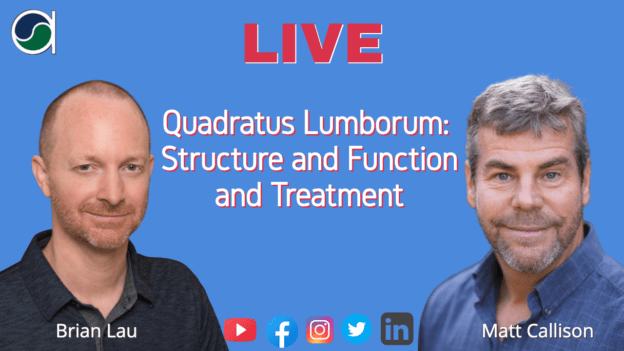
Quadratus Lumborum: Structure and Function and Treatment


Click here to download the transcript.

Disclaimer: The following is an actual transcript. We do our best to make sure the transcript is as accurate as possible, however, it may contain spelling or grammatical errors.  Due to the unique language of acupuncture, there will be errors, so we suggest you watch the video while reading the transcript.

Hello, everyone. Thank you so much for coming to our discussion on the quadratus lumborum structure, function and treatment. My name is Matt Callison. I’m here with Brian Lau and we’re here to shortly discuss this. Amazing muscle that we use quite a bit in acupuncture. That’s also very popular in massage therapy, as well as functional medicine.

It’s a muscle that has been discussed for four decades as being a primary pain generator. But with the advancements within mile faster research and also with biomechanics and functional medicine, the quadratus lumborum is actually evolving into a muscle that is different than from when I first learned about it in sports medicine in 19, late 1986.

Early 1980s, actually. So it has evolved quite a bit with its actual functionality. So Brian and I here to be able to discuss a little bit about this muscle give some quick assessment and some quick treatment techniques with us. And Brian, is there anything that you want to go for as an overview before we jump right into

slide two now I think we can jump on in the presentation up.

Yep. All right.

All right. So the quadratus lumborum is a complex muscle with a various fiber directions. Okay, this is, what’s so interesting about this muscle is that it’s just not one pancake of a muscle. That’s going to elevate the ilium or lower the the 12th rib, which is the way that I was actually taught in the early 1980s, late 1980s is that it was an elevator of the ilium, which we’d really don’t see that very much at all anymore.

What we’ll be discussing is looking at these different fiber arrangements and how this muscle is seen more of a, like a cross-link between. At other muscles acting on the spine or the ileum. So it’s really quite interesting that its role as more of a, synergist or an assistant to a lot of other muscles in different movement patterns.

So we’re going to start to talk about that here in just a little bit. Let’s look and see where it is actually oriented. You can see that the muscles part of the post, your abdominal wall, looking at this cross section of as directly connected to the transverse of dominant. So Brian, can you get the cursor in there?

And maybe we can see that the quadratus lumborum has a direct line along that core line, right into the transverse of dominance. Now that’s via the lateral Rafa tissue. And because it’s got such a strong connection to the transverse abdominis, that is the quadratus lumborum. If there are dysfunctions or increased tensions or lack of.

Tension actually in the transverse of dominance in the Antar aspect, it will directly affect the quadratus lumborum and the poster aspect, and also vice versa. Common commonly you’ll see this with certain fascial distortions as well. Let’s get into the latter Rafa just a little bit more here and the next slide.

So let’s look at the quadratus lumborum and how it’s sandwiched between the anterior and middle layer of the thoracolumbar fat. As we know, the thoracolumbar fascia has three different layers. It has an anterior later layer. It has a middle layer and it has a

post to your person

noticing you’re actually doing a really dumb job plus, cause that’s not easy to do right now.

All right. So we’ve got the quadratus lumborum and the three layers of thoracolumbar fascia. Increased tension, lack of tension to the quadratus. Lumborum how it’s going to affect the transverse abdominis, how it’s also going to affect all layers of the thoracolumbar. So that poster layer, the thoracolumbar fascia is what we commonly see in the anatomy artwork or anatomy charts, where you can see on the backside, the white tissue, that’s connecting the store side down to the glute Maximus bilaterally.

So that would be your post to your thoracolumbar fascia. And we just need to remember that there are two other layers and the quadratus lumborum is sandwiched between those two layer. Very important. And let’s see what’s next.

All right. So looking now from an anterior view, you can see that post to your abdominal wall. You see the quadratus lumborum from there. And also the psoas. The psoas is something that Brian and I spoke about for, gosh, it was a three hour conversation on the structure, a tree, a function and treatment.

Which was great. It was a lot of fun because there were so many things to discuss on the psoas. And that was in January or was that Brian? He did that.

Yeah, we it was early, earlier in January, maybe mid January. I think it’s a loss of now recorded the week we had the live class still online live class in January 10th.

It sounds like. I think it seems about right.

That was the first of the acupuncture anatomy series that Brian and I. Intending to do quite a few videos. Within this realm or the folder of acupuncture anatomy. And this is the second one actually, but it’s coming up soon. So what this presentation today is actually going to be able to give you a couple of pearls that you can be able to really use with the quadratus lumborum and some knowledge about some possibly new knowledge about it.

And then if you wanted to actually go a little bit deeper with it, we’re going to talk for about two hours or just over two hours. I’m just the quadratus lumborum and it’s connection. And it’s connections. Like I was saying before the quieter, some borrowers is seeing more of a crossroad now, like an assistant or a synergist to a lot of other functional movements.

So it’s a lot of fun. It’s a lot of fun to be able to discover that and how it can actually be able to change a needle technique and also treatment protocols or extra points that you can be able to use in addition to the quadratus lumborum so not just local, but also adjacent and dystonia. So looking here at the view, you can see the quadratus lumborum there, that Brian has his cursor on I’m gracefully placed.

I might add. And where are the quadratus lumborum inserts? You can see how it has a direct connection to the diaphragm there at the RQ at ligament. So that would be the lateral arcuate ligament. Okay. Going over the, so ads would be your medial, Q it ligaments. So they act as like a sleeve where it is part of the function of the diaphragm, which is an important thing to remember when you are treating low back.

So then also take a look inferior where that quadratus lumborum attaches to the iliac crest. It interdigitates, it becomes as one with the Illy axis. And it’s really quite fascinating to see on a cadaver because the fibers do actually come together. So if we were to tease away the fibers underneath the iliacus and the quadratus lumborum with a scalpel, just riding along the periosteum, you could lift that up and it would just become one to.

And all the way to the diaphragm, if you continued up that way.

Yeah. True. True. All right. So Brian, I think, are you

taking it away now? Yep, I believe so. Okay. All right. So this is a from research with six cadaver specimens, really looking at the physical arrangement of the quadratus. Lumborum not keep in mind.

This is six specimens. So it’s not a hundred or 200 or 300 spins. But at least it gives a, it starts to give an idea of the complex arrangement of the quadratus lumborum. And when looking at these specimens in this research, there’s three layers to the quadratus. Lumborum, we’re looking at the back through the the, posterior part of the body right now.

So we’re looking at the posterior layer, but then there’d be a middle layer and there’d be an anterior layer. So there’s really three layers to this complex muscle of the quadriceps. And this particular research then compared the six specimens and looked at the various fascicle arrangement. And this is something we might expand upon when we do the the longer two hour class.

But just to give a quick overview of this now there’s first of all, there’s a lot of variability from specimen to specimen, variability, and size or place. Really number of assets, musicals all those types of things. But generally there was mostly at least half of the physicals acted on the 12th rib and there were Leo costal fast tickles.

So that’s what outlined in green from ilium to the 12th rib, there was Leo lumbar facet. That’s what in that more yellow line from the alien to the lumbar spine. Actually, there were some Elliot thoracic basketballs that went all the way up to the body of the 12th thoracic vertebra, but by and large, these are the bulk of the, vascular disease.

Leo costal, Emilia lumbar. The middle layer is the one that has the lumbo costal from the transverse processes to the 12th. You can’t see those from this image, but that would be sandwiched in that middle lane here. So do you have to memorize all of these different farcical arrangements? Not necessarily but, to understand the role or at least to understand the complexity of this muscle, it’s important to remember that there are these various layers, some going from alien to rib, some going from ilium to the lumbar spine, some going from lumbar spine to the 12th rib.

So very complex. And it’s a classical arrangement in size. And. So because of this complexity, the muscle fiber and physical orientation of the QL, it’s difficult really to identify the actions when you’re looking at the quadratus lumborum and this line of pulse the one thing, if it went from ilium to 12 three, that was just like a straight shot from the ilium to the 12th.

Speculate much more easily of what these this role would be because it would be acting from the hip to the rib. And it would be a little more of a straight shot, but because of the fact that there’s these various forces, various vectors acting on it, there’s a lot of uncertainty on the role, the action of the quadratus lumborum.

So let’s go over the general actions. Notice that all of these, at least the first two bullet points on the actions have an asterisk. So let’s talk about the asterick first. So these actions are really placed under question right now by researchers because of just what we said because of this complex arrangement.

So it seems that maybe the quadratus lumborum has not so much to do with a particular action. Let’s say lateral flection of the trunk Obliques are in a much better mechanical advantage to do lateral flection of the trunk, but the quadratus lumborum is there to help out with the, to assist with that, to be a helping aid at same time, it can stabilize the spine.

So there’s a lot of stabilization roles of it probably in potentially. And that’s what the research seems to show extension some sources say extension. It doesn’t really have a good leverage to do extension, but it has leveraged to help with extension help with directors. You can see a lot of different rotational aspects based on the fiber direction.

So really what it seems is that like, when Matt mentioned is really more of this cross link where it’s helping in assisting more functional units of, structures that are moving together. But the traditional roles of the quadratus lumborum is that there’s a unilateral contraction or when there’s a unilateral contraction that does lateral flection of the vertebral column of the lumbar spine.

And whereas the opposite side then would be stabilizing. So we were looking at this right QL that could laterally flex the the lumbar spine. So it’d be come. The lumbar spine would become concave to that side. Bilateral contraction is where it’s usually talked about as a extension, but it seems like it’s pretty minimal and extension and more about assisting if it doesn’t mean.

And then it does seem to have a role in assisting with inspiration because of it’s a poll on the 12th rib as the diaphragm contracts, it would want to lift the 12th rib. So the QL is under there to stabilize the 12th rib and, aid in countering the, diaphragm’s pole. So this would be important, but things like speech anything where you’re getting up there and really projecting your voice in particular, you can picture that QLD in there to assist with that.

So complex muscle.

Yeah. So those, oh, Hey Brian, can I add something to that? Sure, absolutely. So the first two bullets, you guys with those asterix. That research. They actually did some EMG studies on that and they had the patients go, or the models go into extension of the lumbar spine as well as lateral flection into a number of the D into the muscles that actually act on the spine.

And what they found was that the erector spinae was actually like 90% involved in the extension of the lumbar spine. Whereas the quadratus lumborum only 10%, which truly is very interesting. And they basically had the same results with the unilateral contraction. The quadratus lumborum as well. How is wasn’t really actually a primary mover.

It’s just, again, it’s like more of a cross-link across road, a synergist and assistant a stabilizer. So it’s really quite fascinating with that. And I think

we were discussing this recently about myself and I feel like working on the muscle, which is jumping ahead and I don’t want to get into too much on that now, but if the lumbar spine isn’t hyperextension.

To me. I’d never really think that I really want to lengthen the QL so much because it does have, it seems like it has a minimal role in extension, but to be able to get that free gliding of the QL and the erector speed and to be able to decompress the tissue. So you can almost try to lift the tissue out from, being buried deep into the lumbar spine.

To me, that’s how I think about it more. And its role of extension is more postural and less dynamic.

Yeah, the QL being more of a posture muscle, like for example, in single lady, single leg weight bearing in order to have the stability of the lumbar spine than the lateral sling comes into play. So you’ve got the glute medius and minimus and the tensor fascia Lata on one side, and then you’ve got the quadratus lumborum on the opposite.

With that sling, being able to keep the balance in the frontal plane when somebody is standing on one leg and how important that actually is, this is something that we’re going to discuss quite a bit further in the law. And discussion of the quadratus lumborum is coming up in a couple of months. It’s important gives you a lot of great treatment protocols and ideas about what senior channels to be able to treat locally, adjacent and distal as well as mild work and addition exercises to prescribe as well.

That’s going to be very important with that frontal plane. Cool boy, we talked about that slide for a long time.

Okay. A you’re on stuff. Yeah. The quadratus lumborum has a, relationship in terms of at least the topography of it with the lumbar plexus, but it’s really a little bit more complex than just that. So first of all, just a review of the lumbar plexus. This is coming from the ventral Rami of L one through L four, but if you look at this top image the subcostal nerve, the T 12 intercostal nerve, which is called the subcostal.

Share some fibers down into L one. So really the subcostal nerve five contributes to the lumbar plexus. Why are we focusing on the lumbar plexus, these specially, this upper portion, the subcostal nerve, the Elio hypogastric nerve which I don’t know. I can see this on the screen, but subcostal nerve would be right under that 12th rib.

Then the next one to come out would be the ilial hypogastric and then the ilioinguinal. Those travel right on that anterior surface of the quadratus. Lumborum okay. Interesting. But th those are also the primary innovation sources, which especially the subcostal nerve, which is map it’s going to get into in just a moment.

But something to bear in mind as we get a little farther in the lecturer, we’ll come back to this and talk about it is if we follow these these nerves that wrap around the posterior part of the abdominal wall and start to become anti. Because they have cutaneous sensory branches that create sensation that, that supplied the skin and then the sensory aspect for the posterior lateral gluteal region.

I think that says thigh, but that’s really say the gluteal region. Posterial lateral gluteal region. The greater trocanter region, the suprapubic region and the proximal medial thigh. So hold that thought, we’ll remind you about it. But just keep that in mind that, the nerves that are kind of part of the innovation of the quadratus lumborum that have us a structural relationship into, in terms of where they are have the sensory distributions to the lateral.

Greater trocanter grind and I’m up in the superpubic region. So we’ll come back and look at that and how that applies in just a bit. Anything you wanted to add to this map before jumping into the,

no, it was a good setup for what’s to come

fix some interest on it. All

right. So we’re staying within the motor nerve innervation. So this isn’t some research that I gathered. It’s really quite interesting. I found this to be true is that varying research articles and textbooks. There’s not agreement on which nerves actually innovate the quadratus lumborum, but the most important one will end up being the subcostal mainly with the research that’s below because of its large Dianne.

It’s measurement of being so large diameter, therefore you’re going to have more neurons and motor neurons it within that motor nerve, that’s going to be entering the quadratus lumborum and then it also discussed the ill hypogastric nerves that were also innervating the quadratus lumborum. But with those nerves, actually having less contribution to it.

So there are, what we know of is three primary. Motor entry points with the biggest one or the go-to one in my mind will be the one that the subcostal nerve is actually going to be intervening. So let’s go to the next slide because it does show some research on here and you can see, so here a you’ve got the T 11 intercostal nerve, and then you’ve got the subcostal nerve will be B.

You can see that it’s has a larger scale. And innovations to that. Now what they did is actually they opened up that subcostal nerve so that you can actually start to be able to see the different branches then see, is going to be your

So see what ended up being, I believe part of the hill in Greenville and possibly part of the ilial hypogastric so you can see how that subcostal nerve in B is going pretty close to. Brian, can you show on the far upper left corner that the iliac crest, the ilium there? Yeah. There you go. So you can see how that subcostal nerve is going toward the muscle valley of the quadratus lumborum.

So we’ll discuss the subcostal innervation coming up in the treatment section. All right, Brian.

All right. Some of the work we teach quite a bit and work with in the, sports medicine acupuncture program is the Sydney channels. So we’ve really been working for probably 10 years now coming up on 10 years now on really building a comprehensive model for the channel, send news DJing, gen 10 new channels, whatever translation you’re using for the.

And really highlighting the specific anatomical structures that are associated with each channel sinew, how they relate functionally to seeing things like their external internal relationships. In this case, the gallbladder send you a channel or other, correspondences to have they function together.

But for today, just looking straight at the myofascial plane that makes up the liver Sindu channel is quite interesting. Cause this one. A little diverges a little bit from the classical description. The classical description has the liver sinew channel terminating or ending at their groin at the genitals, I think specifically is what it says.

But if you look at the the myofascial plane and it has a much more interesting relationship in that, Line that’s coming up from the foot through the medial thigh, up through the ad doctors doctor longest brevis pectineus Priscilla’s adductor. Magnus is a different one. That’s more in the kidney sinew channel, but this more anterior line of the abductors longest brevis and tineas, that would be then very continuous with that fascial plane all the way up into the iliac.

And as Matt mentioned where the iliac has shares fascial fibers, interdigitates in with the quadratus lumborum. And then up into the tall throne, that would be the liver send you a channel. So if you follow that plane deep into the pelvic structure for the LA axis, it would come out into the QL.

And I know a lot of people might be thinking QL, it’s a back muscle. It seems like that would be urinary bladder maybe, or maybe even. Send you a channel, but if you think about it as being less of a back muscle, which it really isn’t, but more of an abdominal muscle it’s in the abdominal wall, it’s it’s much more of a yin much muscle, much more of a core stabilizing deep structure.

And it starts to make more sense, especially then when you look at that, continuous fascial plane through the abductor line, up into the iliac is QL and The would be a part of that also, especially the distal fibers. , it’s a little more complex than, we can get into today, but we covered this quite a bit in our so as a three hour class and different sort of relationships with the cell ads, but that this, the portion in particular would be part of deliver, send new channel also.

Yeah, Brian was sold me on this one was. Okay. When you gave me a call and you said, Hey, try this liver five points. And I, my practice on every person that day, I palpated their quieter to some warm and then needled liver five. And it was remarkable how well liver five, we will point at the liver channel, soften the quadratus lumborum on not couple, but every single.

And in particular, what we’ve been teaching this for Yon syndrome or the deep layer, which we’re going to actually be talking about just a little bit that y’all, don’t send him, but he was pretty magnificent to be able to feel how liver five and in combination of liver three. And I think I might be jumping ahead with information time.

Yeah, it is. It’s remarkable how well that does work. So I think we’re going into assessment now.

Yep. That is the case. So when I go ahead, no, go ahead.

Okay. So with elevated ilium, this is one thing that we can be able to look for, that we know that the quadratus lumborum, the myofilaments, the actin, and the mind.

Are going to be in a locked short position. It’s not because it’s pulling on the alien pulling upward, but it’s because the glute medius and the amendments have weakened on are allowing that ilium to actually rise up the opposite side. Glute medius and minimus are then shortened and pulling that side down the opposite side.

So it’s it’s the opportunity for this muscle then to become shortened. Now, commonly what we’ll see with this as well is a lateral tilt of the rib cage on the same side, which want to go to the next slide.

All right. So when you get that elevated ilium, what the body wants to do is to compensate. They start to lean to the same size, so it can start to balance itself. So that would be another sign that we can address. I’m looking from the post, your review, an elevated alium always go ahead and measure it with your fingers as well.

Just to confirm your visual findings and then look at the lateral tilt of the rib cage. Usually with the love handles, so to speak, you’ll see a difference between. And left sides and more of an accumulation of tissue when there’s an elevated ilium and a lateral tilt of the rib cage. So in that case, you’ve got the this 12th rib is now going to be actually coming down.

And which means shortening of pretty much all of the fibers of the quadratus from quadratus lumborum I would think making people. Tender to palpation and also Yon tender to palpation, as well as the motor entry point. Let’s go to the next slide. Brian, you want to chime

in on this? Yeah. And this particular image.

It looks like really more just lateral tilt without so much of a elevated ilium, a little tricky to tell. We’d have to almost get in there and get our fingers on. And make sure that what we’re seeing on the exterior surface matches, but just glancing at it. I don’t see a whole lot of elevation of the helium this particular person, but more about the lateral tilt more about that 12th rib being pulled, down.

So you don’t always have to see an elevated ilium with it, but frequently you’ll see these two go together, elevated ilium and lateral tilts with routine. This particular person is a massage therapist. So she leans a lot with her right arm in terms of using a pressure with her right arm quite a bit.

So you can see how that would have a propensity to shorten that right side.

Oh, do you want to say before we move on Matt, that these distal point recommendations are just go-tos that are frequently. Helpful for this condition. There’s ways we apply these in our program and really make determinations of which points to use, but you can just try them out and experiment with them in terms of the part of the full, comprehensive treatment.

In addition to the local points, which we’re going to be getting into, this is just a portion of the treatment, right? This isn’t like a whole treatment is treat the QL out the door. You go in the person. And it might temporarily help, but but you need to be much more comprehensive to get lasting results and, looking again at the fact that the QL across links.

So we need to treat multiple structures and look at his role of communicating between multiple, structures instead of just QL, maybe put a little electrical stem on it, out the door next patient comes in.

Yeah. Yeah. I forgot because we grabbed these slides from the senior channel class, which we have.

So the acupuncture distill those points we’re using as acupuncture is in assessment. We’ve discussed this a few times before, basically trying to be able to change an orthopedic exam and manual muscle test a certain particular posture by using different acupuncture points that will change that myofascial sin, U2.

Before and after and using acupuncture and assessment, it’s just basically seeing, can you make a change in that body using these acupuncture points? And once you can see it and retest it, then you pull those needles out. But you remember to be able to plug those needles back in during the comprehensive treatment of acupuncture, because you saw how it actually makes a difference.

And I think that’s where that’s where this is coming from. Good. I’m glad you explained

that Brian. Yeah. Maybe this is not a great time. I think there was some, a question on the QL and the diaphragm. I see some references to it, but I don’t see the actual question. So we’ll catch that at the end.

If if that hasn’t been answered already,

there it is. We do believe the QL Motorpoint help with help in effect with the diaphragm. Yeah, I would say that I, used the QL personally and I’ll see what Matt has to say. But personally, when I’m working with respiratory issues, I don’t even want to say respiratory issues cause that’s a broader category.

Restricted breathing when breathing seems like it’s a component of the back pain, maybe the person is more of a chest breather and that deep diaphragmatic breath is, and it isn’t filling the low back and massaging the, spinal joints and expanding. And that elastic aspect of the inhale, exhale, expanding the lumbar spine and expanding the soft tissue structures in that lower part.

I definitely go to QL as part of the treatment. It’s

absolutely also the, so as cause we teach we’d be able to see if the low back pain is actually could be. Weakening or an inhibited. So as it’s been constricted in the diaphragm, there’s a manual muscle test that you can use with that. Yeah, for sure.

So add also GB 20 stabbing, you’ll be 17 UV 23 for the kidneys. So as, and also quadratus lumborum I think would be a good idea.

I’ll say one other thing about it then maybe move on unless you have anything else to add. And Matt to it as is, I also think about what’s at the other side of the rib cage. So you have the QL attachment to the total.

And then you have the scalings attaching to the first two ribs. And I find that, especially with people who are more of these chest breathers, who are overusing the scalings is that relationship can be very important as it is speaking to scaling. Especially the anterior scaling is a little hard to needle unless you’ve had specific training on it, but at least some some myofascial work or some, softening manual work to help free some of that excess tension in the scalings.

And. Speaking to the tension at the QL, you’re working on both sides of the ribcage. That can be really useful.

All right, this is great. But how far should we go on this? We’ll start talking about forward head posture and

we got to get going. I can never get. All right. So yes, let’s now talk about needling. These points. And the upper left image, you can see pop patient, the extra point P guns. We know that P guns going to be located at 3.5, some lateral food lower court spot. The process of hell one. Really what I’m going for in this particular case is that the corner pocket I call it, it’s where the Elliot cost Alice also the quadratus.

Lumborum where they attach to that 12th rib. Just palpating along the 12th rib from the lateral aspect up into that corner, you can see a bit of a crease there. So the needle then would be inserted the same direction as my middle. And making sure that it’s not going to go anterior to the 12th rib. So it’s a really good idea to palpate that 12th rib and the topography of that all three, because you don’t want it to go and tear that could cause a pneumothorax.

So you don’t want to insert that and go Antar to the 12th rib caution is advised. Then you can look at the motor point, which is going to be approximately halfway between P gun and Yon. It’s not on every. The directions for finding this motor point, or it’s gonna be just lateral to you be 52 on some people you could find that just slightly more superior from the midpoint being between extra point Pentagon and Yon.

So that’s one aspect that you can get it, or you go slightly higher. If you get, if you can find you be 52, that’s going to put you in the ballpark of that subcostal innervation. So insert the needle, make sure it’s going to end up being parallel to the T. With the quadratus lumborum, I’m sure all of us have gone ahead and needle that quite a bit.

Being an educator and seeing a lot of people that are needing needling, the quadratus lumborum palpation is everything here, and you need to be able to make sure you are actually on that QL and on the deeper. I see a lot of students actually needling the ilial cost Dallas, which is going to get results.

Absolutely. But it’s not dealing the quadratus lumborum so it’s going to be different intent there. And we have in the upper right-hand corner, we have Jaan. This is going to be the deep layer of yang, which would be the quadri Islam. Attachment on that lateral aspect of the pelvis. And it’s amazing how far the lab, the quadratus lumborum actually attaches to the pelvis.

So this particular needle technique is, not going to be on the edge of it, but it is going to be going through the quadratus lumborum in across fiber direction. So you’re influenced in influencing quite a bit of appropriate sectors there, the golgi, tendon, organs, and such Brian, anything to add, or you want to jump to the next.

I know let’s go ahead. And I think the next one just shows some images of the the needling placement.

All right. So we just described that pretty well. I think you guys can be able to that in the images, these images are from the sports medicine, acupuncture, textbook, and now.

Yeah. So we’ve already discussed the liver five.

So when I was talking about the lumbar plexus and there’s nerves that wrap around some of which intervates the QL, the subcostal ilial hypogastric Leland. We know Matt, do you know if it’s the, I was here, it’s the L and L to a anterior division, anterior. For for QL or at least I’ve seen you indicate that, is that branches off the Leo hypogastric Amelia.

We know. Cause I know those are one L region or are they like before the lumbar plexus ranches off?

I didn’t understand your question because it is the illegal hypogastric Ilian wino. And I do agree that it’s the ventral Rami. That’s how it’s talked about, but what is, okay. What was the question?

My question is sometimes I’m just seeing reference to L one and L two and I wasn’t sure if it was before.

If it was the, ventral Ray mine, Aramco Ramey, before they get to the lumbar plexus. And there’s like a motor nerve that branches off before intermingling with the lumbar plexus, or is it post lumbar plexus? gastric then it’s, definitely post lumbar plexus. I don’t know. It’s gonna be one more thing for us to be able to go research.

Anyways, those have an intimate relationship with the QL and it is intriguing. The re pain referral, the trigger point referrals. Many folks here are probably work with trigger points, or maybe use them as, a part of the assessment. I use them. That’s not the air, the only thing that can refer and cause pain.

But I think it’s a a useful thing to look for. Especially QL is so frequently involved with a lot of low back pain patterns. And when you look at the the QL referral pattern pretty much goes to where those sensory divisions of the nerves. To the lateral posterial lateral gluteal region to the greater trocanter region, wrapping around to the suprapubic region and then wrapping around to the groin.

There’s also some divisions that go really more posterior deep into the gluteal SSI joint or into the, kind of deep buttock region. But to me that. It doesn’t really talk about it this way and literature, when you talk about trigger points. But to me, that sort of emphasizes that segment has become irritated.

The QL has maybe the QLC irritating factor. Maybe the QL is part of the irritation of that segment, but the sensory division of that complex, so to speak has, been irritated. Maybe that’s, open to debate. And I haven’t seen it quite some depth that way and discussion of trigger point sensitization, but it would make sense to me because there’s such a neurologically intimate relationship between those nerves and the quadratus lumborum.

But to me that also speaks to the the possibility or at least a possible mechanism of how liver five it’s so effective for the QL is that. Working with that collateral circulation being the the low connecting point, it’s working with that collateral circulation that is referring pain, both to the gallbladder channel distribution and the liver channel distribution.

It’s has a referral that’s between these two internally externally related channels. And it’s interesting that it’s the low connecting point that would have. It’s such a, strong relationship in terms of removing pain from the quadratus lumborum and helping with that pain referrals, sensitization.

And then this is something that I’ve been working with in that I started adding liver three, and that seems to really increase the effectiveness on liver five by itself is quite effective, but liver three, yet the low point on that channel is just even a stronger treatment. So this is a really great disciplined.

Combination that you can use in combination with the local noodling. Let me just covered for that side where the TQL is really a pain generator. Yeah. For something like that.

It’s interesting to see the image, the trigger point image that’s on top there on the upper. You can see where the X’s are at Yan and pagan and that reasonable.

These points have been needled for thousands of years or have been known to be a referring type of point a trigger. And then the points lower. Let’s see the deep ones. Is that around you be 23 regions, that upper one. Cause the other one looks like it’s close to almost. Yeah. So

This, is what first of all, let me give a quick statement that this is the old edition of travails book, because I think that, I think it’s the third edition, the newest.

Addition, they’ve taken out these exes because trigger points can inform anywhere in the muscle. I kinda like the, I kinda the Xs, but it’s around for Lark. Chevelles passed, on now. So the decision was made after the fact that I guess they’re basing it on ongoing research and such, but they made the decision on the third one, which is I understand the decision to take out the Xs.

So I think the X’s aren’t. That this is where the trigger point is going to be in this referral, but it’s just tendencies. It’s if there’s a tendency for that upper, especially more lateral fibers to have this that’s marked one to have this referral, which I find is pretty commonly the case that it refers pain that’s, where that trigger points.

So it lives in more of that lateral edge of Yon tends to have more of that number two district. Then, if you go deeper, you advance the needle deeper. And your question, Matt, I wonder the same thing. Are you actually hitting those medial fibers of the QL? Are you starting to get into attachments of the multi-fit eye?

Cause they blend so much together. We’ve seen that a lot on cadaver specimens, but those are the ones that tend to refer deeper down. And I wonder that same aspect. QL or if it’s the relationship of the QL to the , which are on the same layer that I think that

Be really interesting the next time that we get an opportunity to dissect this, Brian is to follow the subcostal nerve into the motor entry point.

And then if we have time to do this would be great is to see if, and then do intramuscular dissection and just follow where it starts to buy for Kate. Is that smaller, small branch traveling intramuscular going to. Yeah, Yon and P going to be fascinating to see if we could follow it up there. Got you. In our system.

We’re really geeky. That’s why, by the way, that’s why I liked the Xs. Cause I think that’s what the X is. That tendency is probably more intramuscular sort of international

sites. Dr. Trevell is probably rolling in her grave because if they’re going to take those exits, I don’t know.

All right. An interesting that channel discussion, but it’s a really effective treatment.

Pate QL. We’ll give it a try. Yeah. Before you actually needle QL, especially Yon seems to be really highly effective. This way is palpated to get a pain scale from your patient. Let’s say, oh that’s, a seven. When you really get on that, that really gets to the source of the pain needle liver five liver three, and then go back and palpated and see what happens.

And I think you’ll find that if you get a really good cheap response to those disappoints, that in and of itself reduces pain by 50% or more. And then the rest you’re getting the the, local needs. It’s a really big part of the full treatment.

It’s good.

All right. We teach a lot of myofascial release techniques in the program especially like targeted ones that really supplement the treatment. And this is a a myofascial release technique for the quadratus. Lumborum especially getting to that lateral edge. If you try to reach the QL through the erector spinae, good luck.

That’s a really. Layer, especially in the lumbar region of tissues. So it’s maybe you can touch it. But you’re going to have minimal influence on it with your fingers. It’s you can needle in there, but it’s hard to determine the depth, cause you don’t know exactly where you are when you’re just going perpendicular.

That’s why the needle technique matchup is going more from lateral to medial, almost the same way my finger is there, but he was showing it with the person in a prone position. So this will be very much like the the needle technique as well. Anterior to the , I’m pretty much at Yon rubbed up right against the iliac crest.

You can angle your finger. Once you get a really deep contact there and engage the tissue, you can angle that pressure up towards the 12th rib and have the person reach their leg down to bring the hip down. So their thigh, you can’t see it fully in this image, but their thigh is in line with their.

So as they reached their foot, say, let the towards the back wall or something straight in line with the torso downward, that’ll start to pull the hip down while you’re spreading and moving that tissue towards the 12th room. So you’re elongating one direction is there, their forest is going the other direction.

And you can take that up to the tall throne. Then you could change directions because of those different fiber orientations. You can change the orientation then down towards the iliac crest and have them reach their. Upward to pull the rib cage up. So you’re decompressing the tissue away from the 12th rent on, and then bring the tissue down towards the Lem.

Is there having a force in the opposite direction, really effective technique after a needle lane and it can help return that tissue to a really good resting length.

Yeah. There’s a lot of good techniques in that class. Yeah. A lot of good ones to use. Same thing with my techniques and same thing with needle techniques is there’s a lot of good exercise techniques as well, trying to be able to accomplish on reinforce your treatment.

I’m thinking about it still as excess and deficiency is when you have a locked short muscle, it will act like it’s excess, but it will be an underlying deficiency when you have a lock long-term. It acts as a deficiency. So it’s a good idea to once you reestablish the channels and the CIM blood and the axle plasmic flow, and we discuss in the actual muscles and the channels themselves.

It’s a great idea to go ahead and strengthen the. It’s long muscles and then try to be able to stretch those lock short muscles. This is one particular stretch is one of our favorites as well. That’s a patient favorite as well. The figure for spinal rotation, where you have the ability to eat long gate, the quadratus lumborum, you can see on the lower photo that she has crossed over that figure for a position.

So her right foot is on the floor and the lateral aspect of her leg, and also thigh is going to be on the floor. So for her to be able to bring her right knee into hip AB duction that helps to lock down and pull down that ilium that could be elevated and causing a shortening of the quadratus.

Lumborum so great exercise to be able to use, like I said, it’s a patient favorite. It helps to release the quadratus lumborum as well as to activate that glute medius, which is going to end up being part of that lateral sling that we briefly talked about. And we’ll talk about it quite a bit more. Yeah. A two hour lecture coming up in just a couple of months on the quadratus.

Lumborum Brian, I think that’s it, man. We went way over time. I hope that. Okay. We have references as well. You guys, we also have something in the notes that you can buy. You guys can go ahead and take a look. We have a number of different recordings. About 75% of our smack program is now. And also on loss at OMS, which is great.

Also the psoas class, the three-hour class that Brian and I did just this last January, that’s available as well as part of the acupuncture anatomy series. LASA OMS also carries a sports medicine, acupuncture textbook, which is the next slide. And so I think we’re probably good to go.

Brian, anything else that you want to be able to quick?

This has classes is great on a Lhasa and it’s much more comprehensive because we have more. But there was no, we did do a, C a. So as if you want to get a little taste for that class that wasn’t, I knew you remembered November. So if you go on a C’s page, you can search back for the the, so as webinars we did there also, so that’s a give you a sort of a sample of that, class, and then you can see it through AAC’s page,

which we always appreciate them having us on and, a

thank you to both an Acupuncture Council. Yeah, absolutely big, huge. Thank you for having us and supporting us. Thank you so much for that, Brian. That was a good call to be able to bring that back in. So that’s good. Anything else, Brian? Ah, Lauren Brown.

Yes. He’s going to be here next week. Make sure you check him out. He’s. A big professional in our field, a wonderful academic and an amazing practitioner. So check him out. He always has really interesting things to be able to say, thank you very much. American Acupuncture Council Brian, always nice hanging out with you.

I’ll talk to you again soon. All right. Bye everybody.

 

GrossmanAACTTPHD02162022 Thumb

Storytelling To Attract New Patients


So today I’m going to talk about. Storytelling for your practice. And this is your introduction to storytelling, which is the science of storytelling to attract new patients who want your services now.

Click here to download the transcript.

Disclaimer: The following is an actual transcript. We do our best to make sure the transcript is as accurate as possible, however, it may contain spelling or grammatical errors.  Due to the unique language of acupuncture, there will be errors, so we suggest you watch the video while reading the transcript.

Hi folks, Jeffrey Grossman here. And thank you for joining me. Thank you for taking the time out of your busy day to watch this video and thank you for the American Acupuncture Council for yet again, inviting me back to share some insights and wisdom and knowledge about growing your practice and marketing and business development for acupuncturists.

So today I’m going to talk about. Storytelling for your practice. And this is your introduction to storytelling, which is the science of storytelling to attract new patients who want your services now. And I just want to make one thing. Stories are elaborated patient testimonials and testimonials are short and they don’t necessarily have the triggers and the intrigue or the emotional connection that can really pull a prospect in and communicate to them that indeed, that you are.

Able to help them. And that you’re the solution that they’re searching for. So stick with me and you’ll understand what I’m talking about. So I’m going to share my slide deck with you. And what you’re going to do is you’re going to learn about the three things that every patient thinks before they choose you and why you must consider these as part of your marketing efforts.

We’re also going to talk about the various stories. To share with every patient to build rapport and trust with every prospect and every patient coming into your practice and how to use your stories to attract qualified new patients and more word of mouth referrals. So for those of you that don’t know me, my name is Jeffrey Grossman.

I am the owner and the president of Acupuncture Media Works, Accu Perfect Websites and Accu Downloads. And I’ve taught classes for and am a regular speaker for the AAC for several years. I’ve also taught the 60 hour practice management class at the middleweight acupuncture Institute. I taught at bass year Siam and Neisser and clock.

400 plus hours of online video trainings and marketing and business trainings for other acupuncturists. So I’m in this industry and I’ve been privy to what’s been going on for this industry for a long time. So my goal, our goal, our mission at acupuncture media works is to share the latest marketing insights with you and the techniques and the protocols with you that inspired.

And educate your prospects and your patients so that you can have a fuller schedule, make more money and effect positive change in the world by helping more people. So I started practicing in 98 in height, many of the struggles that many of you have experienced or may be experiencing now. And I took a.

Of $15,000 and started coaching with a chiropractic coach. And my life changed. My practice changed, my income changed. So I want to encourage you to take some chances, make some change if you’re struggling, if you’re not as full as you are, if you’re not making the type of income that you need, something’s got to shift and take that gamble.

Take that shift in order to take those next steps so you can grow. Throughout this year. So this training is about changing your life. It’s about changing your income and just one or two ideas can transform your practice in this year. So most of us think that marketing is hard, but it’s not. And we were went to school to become a healer.

We’re not that adept at becoming a business and marketing person, the honest truth is that you have to wear those two hats that. The hat of business person, and you’re the only person who’s going to be doing your billing and your marketing and your needling, your Grosh on your cupping and your scheduling and all of that.

That’s on you. My friends, you are an entrepreneur and you are a healer. So we’ve got to own that. And we’ve got to tap into marketing and business building strategies for your practice. Oh, I want to encourage you that if you need any help, that you should evaluate your plans to create actionable strategies and feel free to reach out to me, I’ll have my email address at the end of today’s training.

And if you need help, just send me an email, says, Jeffrey, I need some help. I’d love to get together with you and I’m offering free 15 minute consults for that. Also before I go on. I know it was a little late into the Chinese new year, but we’ve got a gift for you, which are if we put together a bunch of Chinese new year, social media graphics for you, we got some newsletters, some Facebook graphics, some Instagram posts, and some blog posts that you could copy and paste and use in your practice.

And you can grab them here at this link on the video. Just go to that link at the end of today’s training and get those graphics and start putting them into your social media strategy. Okay. So one of the foundations of building a sustainable and successful acupuncture practice is to build what I call the know like and trust factor.

And this is something that we will talk about as we go on, but it’s something I want you to remember. And if you want people to know like trust and refer others to you, nothing is more important and nothing is more fundamental than telling your patient’s story. About how you have helped people just like them.

Get better telling stories, build the know like, and trust factor from the moment they’re done reading it. That’s it. If it resonates with them and triggers them to take action. And I’ll tell you about that in a second, but before I do that, I want to tell you how to do it before, but I want to tell you why stories work so well.

Okay, so let’s read this together. Tell me the facts. And I’ll learn, tell me the truth and I’ll believe, but tell me a story. And it will live in my heart. Forever stories are how humans have communicated for tens of thousands of years long before written language ever existed. And the key is how our brains and bodies aligned.

When we hear a story, people know for thousands of years and. Is just now proving it to be a fact that a story can do what facts and statistics can never do, which are inspire and motivate the reader. So storytelling, it’s the most ancient form of marketing. It’s about getting that message through to the listener.

And when a good story is being shared, the listener or the reader, they’re engaged, they’re involved in both their mind and their heart. Okay. So stories do all the hard marketing work for you, and they make our prospects remember and clear and care and story marketing works because our brains are already programmed for stories because it’s embedded in our DNA.

And storytelling also helps with learning because stories are easy to. When we hear a story, we unconsciously take the place of the person in the story and the benefits that they receive become the benefits we think that we’ll receive. So learning which can stem from a well-told story, it’s remembered more accurately.

And for far longer than learning, that’s derived from facts and figures. And that’s from research. That’s been done by a psychologist called peg new Hauser, and there’s another. Researcher, another published psychologist called Jerome Bruner, who suggests that facts are 20 times more likely to be remembered if they are part of a story.

So marketing comes and goes, but your patients will remember the stories that they read and that they heard and relate to for a long time. So having several great patient stories about. A patient’s searing back pain that goes away after true treatments or curing someone’s migraines that they’ve had for over 20 years or helping a woman have a child after not being able to conceive for many years.

It’s like having an. That people were role. Remember for years on end. And the great thing is that it’s zero cost to you. People remember, and they share stories far and wide. So stories create that emotional connection between your prospects and your practice. And they have that psychological effect that adds tremendous power to your marketing.

And this can add ultimate growth to your practice. So this. Yet another reason why I really liked stories because the advertising it’s free and the memories last and last. So hopefully now that you’re seeing that stories can be powerful for your marketing and your patient education process. Okay.

So that’s a very brief look into the science of stories and there’s real documented brain science on why this works. And when we’re done, you can Google a great Ted talk by Henri Hassan. And he did a fascinating study on how people’s brains, literally sync. When they hear the same stories and they put themselves in the story of the other person’s shoes.

So before that study, they’re like, brainwaves are all mismatched and they’re not sinked up. And when they hear that same story, they start thinking up. So do you see how this can be helpful for your practice? People read a well-crafted patient story and they resonate with it. They embody it for themselves and want the same outcome as the person that they just read about.

So I hope that makes sense. So we need to talk about how you will be using them in your practice and which ones to use. But before I go there, Let’s talk about this next aspect, which is the secrets of why people buy and what they really care about. Okay. So we’ve been buying things the same way. For thousands of years, something gets our attention.

It becomes top of mind and our interest is peaked. It increases our desire as we want to learn more. And then we buy, and this is the basic buying system that we all go through. It’s hardwired, it’s ancient human nature. And as we’ve just discussed, it’s better and easier to use the science of human nature than to just simply ignore it.

So the buying process is pretty much the same, no matter what business you are. So something, your triggers, your interest in, let’s say having lunch and you read the menu, your desire increases, and then you buy same process. When you go to see a home that you might be interested in purchasing the realtor increases your desire by demonstrating and discussing why this house is great.

They stage it beautifully. So you can literally picture yourself there and put yourself in the shoes of the owner of that house. You buy it’s the same for your practice in spite of what most people think, no matter how accomplished and brilliant you are at your modality. There’s only one thing our prospects really think about and believe me.

Unfortunately not you and it’s not your credentials and it’s not your modality. So while can it be well, they want to know what’s in it for me. And what’s in it for me is made up of three things. Okay. The three things that every patient thinks about before they choose you, and these are really important to consider as part of your marketing.

And, these are the things that prospects are concerned about. It’s what’s in it for me. And it breaks down into these three different parts. W here’s what I want right now, which is I want to get out of pain. How do I get it right? Who can help them? Okay. And what’s my life going to be like, after I get help and what will they be able to do after they are free of pain that they cannot do now, they want their pain to go away.

How could it possibly get done? And if it does, what is their life going to look like? And this is what’s on people’s mind. Excuse me. And that’s the process people go through over and over again when they’re presented with a buying decision is what’s in it for me. And this is with every single industry.

Okay. So let’s talk about how we use stories in your practice and in your patient’s journey. So right now, For probably 99.9% of you, the people in your neighborhood might not know you as the master healer. What we want to do is to get people’s attention, creating interest and desire by talking about what I, or better yet what they want right now, for instance, They want to get out of that pain, neck pain or whatever their problem is.

And they want to what that is, what I want to know. Okay. Then we want to demonstrate our skills and our success, whether it’s on the tele-health call or getting somebody in your office and sharing how you’re the best choice for them or getting them for an acupuncture happy hour or a stress reduction treatment to get them to devastate.

So you can share with them how your medicine can help them. And by using. This is where they get to know and trust you and they understand how do I get this and how can I get the positive results? W w that’s what’s on their mind too, is you have to present your treatment plan, or you present success stories.

And part of what you’re going to talk about then is how their life is going to change. And w after they received the results, of seeing you. Okay. And if the results are good, they’re going to refer friends. They going to refer neighbors and expand your practice through word of mouth in your community.

Okay. So I hope you’re following me. So now I want to discuss the three basic stories that you should be using in your practice. So there’s the initial. To desire story, which gets your prospect into your office to experience you, gets them interested in you and your services. And what’s great about this is when you use the template and practice it.

A couple of times, it only takes about 10 minutes to create because it’s only about 150 to 200 words and. Since our time is short. I’m not going to show you that what, I’m not going to show you a total interest story here, but I’m going to share a link to a video that walks you through a real world.

Example of a patient story. Number two is the desire to buy. Which is a story that positions you as the healer in your neighborhood. And this helps to create trust and rapport with your prospects. So they accept your treatment plan because they want it. And not because you sold it to them because they’re, they put themselves in the shoes of the person who shared whose story that you shared with them.

And they benefited from your care and their. Synced up with what the other person’s story is, what the other person’s experience is. And the third story that you’re going to need to have is you were own apifany story. And it’s your personal health story as to why you love Chinese medicine, why you love acupuncture, your various modalities that you offer and why you chose to do what you do.

Not about the number of credentials that you have, or the number of acronyms that you have after your name. It’s about realizing that you are human too. Maybe you had your own health struggles that made you seek out acupuncture that eventually led you to be the healer that you are today, or maybe you saw a loved one received acupuncture and it opened up your eyes and you said, yeah, that’s what I want to do.

So whatever it is. You have your own story, and it’s important to share that with your patients. In fact, you’ll be sharing it with whenever you host a class or give a talk or even meet patients for the first time, your story makes you human. It makes you relatable and real, your story should be on your website as your, about you pages.

You wouldn’t believe the, about you pages that I see are the about me pages I see on people’s websites. That’s all about how great I am. How many schools I went to, how many acronyms I do, right? When you meet somebody, you want to be like, hi, my name’s Jeffrey. I went to new Orleans with acupuncture and I have all these acronyms now my name, and these are the types of modalities.

I do know you want a story that’s relatable, that people can connect with. Okay. So what they. Is your story and your appify funny story. Okay. So imagine how much easier or how much is simpler that your life will be when you have the perfect story that makes prospects want to become patients because they instinctively know and trust you and can force the results that they’ll receive.

Just like the person in the story received. Okay. So imagine having the proof that you’re a great healer for allergies or asthma or back pain or neck pain or knee pain or gut pain or surgery, pain, or headaches or stress or not sleeping or infertility or weight loss. Whatever you specialize in your practice, when someone comes in, you have to have stories specific about the key problems that you help your patients solve and your patient’s stories are your library.

It’s your proof of success and your proof that you can address the what did it for me scenario. Okay. So the great news is that crafting the perfect patient story? It’s really not that hard. All it takes is to make it, to make a great story is answering 12 simple questions and these questions you already know the answers to.

So once you create your first patient story, you’ll be able to use it for years. In your practice. So I’m going to quickly review these 12 questions with you. And I reviewed these 12 questions in this video that I’m going to be going through, that I have a link for after this, that you can watch me go through an entire patient success story for yourself.

So the first question is who is. Excuse me, who is this story about? So you’ll be describing a patient’s age. Are they single? Do they have any children? What’s the patient’s health complaint in their words, right? Nonmedical non-technical. How long do they have the problem? What caused the problem?

How does the problem affect their. They’re looking for solutions. What did they tried before? What methods? What modalities, what are the treatments? How did that person use it? What were the results? What are the patient’s biggest fears? What were the patient’s biggest questions? Did the patient have any experience with acupuncture, Chinese medicine?

If so, what were the risks? How did you demonstrate or explain your solution and how would it be helpful? Did you do your occupant or did you do a stress reduction treatment? Did you do some Dr. Tan points? Okay. What did the patients say about the demonstration or the explanation? Did they have any answers?

What were they, did you ask, did you get questions? Did you get any answers to at least one of these questions above that I have here since you had. Had this problem. How many years in your mind would it be? What would it feel like a short-term success to start with your treatment? How will your life be different when this condition is under control?

The question number 10, did they accept your complete treatment plan or was it just a few sessions? What was their treatment timing? What happened the first few weeks or the first few treatments? They have a positive experience. What milestones did they reach? And then finally, did you get a testimonial?

What was it? Did you get a referral or did you start to treat any other family? Okay. So I, you can watch, I don’t have time to show you a real world example of the patient’s story and the 12 questions in action, but you can jot down this link here and watch me re review a real world example of a patient’s story.

And you can even download an example of. At that page as well too. So go to this link here at youmedia.us/story review. And you can watch me review an entire patient story and even download a template. Okay. So now that you’ve written and produced your story in at least one format, you’ll have to decide exactly where to distribute it.

And the goal is to choose a distribution channel that will get your story in front of as many people as possible. So you could put it on your website or your blog. You could use it on social media, you could put it in emails and you can use it for a part of your advertising. If you have. And the budget to do those kinds of things.

Okay. So now, you know why stories are important and how stories work to build an emotional connection and the universal buying decision process that a person goes through, that every person goes through when making a decision. And the one thing that patients think about that you might. Appeal to and when to use your patients’ stories and their journey and how to make a great story by answering 12 simple questions.

Okay. So time to get work on your story. So you could work with some experts, you could work with some writers, you can think about the patient complaints that you solve on a regular basis and make a list and focus on. Story first, or you can consider setting a goal by getting two patients stories done a month until you have 10 or more.

Okay. So here’s the link to the download the graphics. Here’s a link to download or watch the video that I put together for you. You can take a note of these slides here and I want to say thank you for joining me here. And here’s my email. If you want to reach out to me for any questions, if you need any help, a support, if you want a free 15 minute consult, so we can discover where you might need some help, feel free to reach out to me at this email address.

So I hope you are all doing well. I hope you receive some of the answers and the inspiration and the insight that you needed today. And I want to encourage you to reevaluate your plans and make actual strategies. All right. We’re here for you. Stay beautiful. Keep changing the world. One person, one needle at a time and talk to you soon.

Thank you so much for joining me. Bye bye.


WeizenbaumAACTTPHD02182022 Thumb

The Many Uses of Gui Zhi Tang


So first I’d like to describe how I see Gui Zhi Tang working and. Last time. I talked about the physiology of the shell hung lawn that I think is encoded into the Shang online.

Click here to download the transcript.

Disclaimer: The following is an actual transcript. We do our best to make sure the transcript is as accurate as possible, however, it may contain spelling or grammatical errors.  Due to the unique language of acupuncture, there will be errors, so we suggest you watch the video while reading the transcript.

Hi, everyone. I’m so happy to be here. And I want to first thank the American Acupuncture Council for inviting me to do this series on Chinese herbal medicine. And last time I spoke about why I’m so sold on classical Chinese medicine in herbal medicine and defined that to mean working with the formulas from the Shang Han Lun and Jin Gui Yao Lue. And today I would like to express some of the principles that I talked about last time with focusing on the formula. And this is such a useful formula. It’s an inexpensive formula easy to take formula and the way we learned about it in our kind of typical TCM education is as a formula that will dispel wind. And we usually think of it as a formula to use for coming down with a cold or what we might call an external influence or an epi. And what I’d like to do is describe how useful it is beyond just a common cold, because quit your tongue is a formula that I use all the time in my practice for a wide variety of disorders. It’s also a very small formula, so it’s easily modifiable. And actually there are many formulas in the Shang Han Lun that are based on grade your tongue. So hopefully besides my main goal is to get people excited about studying classical formulas and working with them. But I also have a goal today of having the listener. Be able to go home and think oh, I can use this formula that you could use it next week for something you may not have thought to use it for. So first I’d like to describe how I see Gui Zhi Tang working and. Last time. I talked about the physiology of the shell hung lawn that I think is encoded into the Shang online. And that it’s really about being right with time. And there’s this kind of circular movement of heaven going around us while we’re here on the earth. And this same circular movement is going on in our bodies. And so great. Your tongue is, one of the first formulas. So I think the first formula would be mentioned in the Shang Han Lun in the Taiyang section. So understanding a little bit about Taiyang it’s this steaming up movement that goes from the middle warmer up to the surface of the body. And right after the tie young movement, it’s. Going up like the sun rising, it hits noon and now it starts going down. And the downward movement is the beginning of the Yangming Conformation. So when we’re, when our Taiyang is functioning it has this really nice steaming up. And if you think about what steam is, it’s young within yen. So when you have steam. You have this kind of fire that’s inside of water and that fire and water are so mixed that it’s actually steam. It’s this water that rises up because of the fire that’s inside of it. And that’s what Taiyang does is the, has a steam that goes up and how all the way to the surface of our body and that steam creates a nice ozone layer of warmth and protection. And when it functions well, we sweat. Normally we have a nice, comfortable body temperature. And what happens in a greater tongue pattern is you usually think of it as like an invasion of wind cold or an invasion of wind. I’d like to suggest thinking of it a little bit differently, that what happens in a Taiyang pattern is that movement of stinks. Going up to the surface of the body. It resolves too quickly. And so that fire and water separate before they’ve really reached all the way to. Surface of our body. So what do you get from this separation that we also would call a Ying Wei Disharmony, meaning the way that’s the warmth inside should be nice and inside the yang so that it brings it all the way up to the surface, but instead they separate. So you get sweating as the yang droplets lose their relationship with the. They come out as sweating and the young that’s lost its relationship with the yang. We get feverishness or flushing up. That’s what the yang way disharmony is in a way it’s like a premature ejaculation, that you want it to take as long as this, before it results, but instead it resolves too quickly and that becomes pathological. So when we give Gui Zhi Tang, we are supplementing the warmth and the fluid in the middle warmer, and we’re slowing down that process. So the steam rises and makes it all the way. To the surface of the body. And in fact, a Gui Zhi Tang pattern can actually treat premature ejaculation. Know we can explain premature ejaculation with the Gui Zhi Tang pattern because it’s a leaking pattern it’s coming out of relationship. So I said that the Gui Zhi Tang comes from the middle warmer, and you look at the ingredients of Gui Zhi Tang. We have gone. So Sheng Jiang and Gan Cao These supplement and warm the spleen we have Da Zao, which replenishes the nutrition in the spleen. So we’ve got this kind of fire inside of a nice juicy herbs. And that starts that steaming process in the spleen and stomach. Now Da Zao also enriches the blood. And so does Shao Yao. So what I’d like to show is that the Gui Zhi Tang formula, supplements the middle in a warm way, and it also supplements the blood and that the warmth in the middle and the good quality warm blood is what then is the foundation for the harmonized Ying and Wei to come all the way up and out to the surface. So really the Gui Zhi Tang is a supplementing formula, supplementing the spleen and also supplementing the blood. And from that replenishment, it then supports that consolidation of the exterior of the body. So by giving wager tone, we’re not just getting rid of a wind pathogen. Really it’s a healthy body, knows how to get rid of a wind path. Rather than just getting rid of the wind pathogen, we’re restoring this function of the body, the function of the body to have really nice harmonized Ying and Wei. So I want to talk first about this flushing up, that happens in a Gui Zhi Tang pattern and what that can look like. It can look like nausea and vomiting. If the flushing up affects the stomach. Then you can have nausea and retching. And that’s why Zhang Zhongjing put Gui Zhi Tang as the first formula in the pregnancy chapter of the Jin Gui Yao Lue for Pregnancy. In early pregnancy. So that’s one little gem I would like to give you is to really think about grade your tongue as a formula that can treat nausea and vomiting in early pregnancy. And it does it, that the reason that there’s the vomiting is because of the Ying Wei Disharmony and it, by putting that way back into the. It then it’s not flushing up anymore. It’s physiologically rising to the top of the body. So that’s one thing that we can treat with Gui Zhi Tang and it’s right in there in the Jin Gui Yao Lue. The other thing I want to mention is When the Ying and Wei separate from each other. It really means that the surface of our body, instead of getting that nice from ozone layer, that separation means that the surface of our body is too open in the Shang Han Lun. It says aversion to wind. And in my opinion the symptoms that are mentioned in the Shang Han Lun are both literal and symbolic. So the wind can mean that you have an aversion to just too much going on. In other words, you get overwhelmed really easily and you feel really hypersensitive. So imagine a patient who comes in and let’s say, it’s a woman and she’s, you can see that she has blood deficiency. You can see from her complexion, from our. Maybe from your abdominal diagnosis and, she’s got blood deficiency and at the same time, she tends to be a little bit cold and then premenstrually, she becomes very sensitive. We usually think of pre-menstrual syndrome as wanting to move the liver cheese. But many of our patients don’t actually fit that pattern and they don’t benefit from formulas like or something like that. There are many of our patients who come in and they experienced, they have premenstrually is they become hypersensitive. They feel very vulnerable. And if you question them one thing I like to ask is. Do you generally flush when you have emotions, like if you’d get embarrassed or if you have to speak in front of a crowd, do you flush easily? Do you sweat easily? In other words, that kind of person, their Ying and Wei tends to separate. And there, many of my patients have been really helped with Gui zhi Tang for PMS. Because of this. So what the Gui zhi Tang then does is it supplements the blood, it nourishes the spleen and it harmonizes the Ying and Wei. And it really creates a sort of ozone layer of protection on the exterior of the body. So people don’t feel so open and so vulnerable and they can handle more. Knowing that pre-menstrual time. Many women just feel like I can’t handle anything. Someone looks at me the wrong way and I just start crying. And Gui zhi Tang is really good for that. We can think of that also for peri-menopause or menopausal types of symptoms, which. The same kind of experience for people. So we can see that this range of grades, your tongue is really is really broad. There are also lots of modifications of Gui zhi Tang. Expand its usefulness in the clinic. A lot of these modifications are mentioned in the Shang Han Lun. So for example, a really favorite modification for me is a formula that’s called Gui Zhi Jia Shao Yao Tang, but the Shao Yao is doubled, so Zhang Zhongjing is telling us you can actually use more Shao Yao if you want to, and so it’s just great. You’re talking about you’re using more Shao Yao. So what happens to this formula that harmonizes the Ying and Wei? If you add. and there’s a couple of things that this formula is so useful for. Not so often I’m increasing the shadow. So what does the show do? And I, here, I’m talking about by shell. So the Shao Yao is a blood nourishing or, and one of the main indicators for me that I might want to double the Shao Yao is. Abdominal diagnosis. So with abdominal diagnosis, if I find that the rectus abdominis from under the ribs down to the navel are very tight for me, that’s almost always a by shout indication. And so in that case, I will have more by show. The other thing that often goes along with this abdominal finding is so common and it will go with a lot of these PMs kinds of women that I was talking about is neck and shoulder tension. We know that the bladder channel and the small intestine in general, they are on the trapezius and. And by show really nourishes the muscles, especially when we have Bai Shao, like we do in your, that becomes , which is for relaxing spastic muscles. And where are those muscles most likely to get really tense in the Gui Zhi Tang pattern. It’s going to be the tie on channels and the upper body, because there’s. Flushing up called? Nobose in Japanese this, when we talk about it in terms of abdominal diagnosis, so there’s flushing up, so it’s going to affect the upper body and then it’s affecting the Taiyang channels of the trapezius and neck. So very often people will say, yes, I, I carry so much tension in my neck and upper back. It’s always tight and painful for me. That’s an indicator for adding increased Bai Shao to Gui Zhi Tang. Very common. The other indicator for increasing the Bai Shao is related to the fact that Bai Shao is also bitter and it’s. And Bai Shao when it hit like bitter, because I’m putting my hand down this way because the bitter flavor descends in the body and by show is cool. So it’s very good for opening up the Yangming and treating constipation. So it treats constipation both because it’s very lightly purging. But also because it relaxes muscles, one muscles, relax. It’s not just that. It’s not like a muscle relaxer that makes all the muscles all Saudi ends up the way that by Bai Shao works to help the muscles. It helps muscles do what they’re supposed to do. So actually helps normal pair of spouses while stopping cramping. So another indication for adding by show is. Person that you’re seeing that feels so vulnerable and sweats easily and flushes. If they also tend to get constipation, you can increase the by show or abdominal pain. No. So in the Shang Han Lun, that’s what it’s for. ? is for abdominal pain. So that kind of cramping can cause constipation. It can also cause abdominal pain. So that’s a modification of Gui Zhi Tang, so easy and easy to remember because it just makes so much sense. Another modification that’s really listed just right after this Gui Zhi Jia Da Huang. Is if the constipation has gone on for more than three days, so it’s really blocked in there, so what happens when you’re constipated is that it sits in there and gets drier and drier, and then it just makes the constipation worse. So if you want to get. Flush just to break that cycle. In other words, it’s a short-term treatment, but you want that flush to be gentle. You want it to be body temperature, Gui Zhi Tang is body temperature. Then you have Gui zhi Tang plus the little bit of the Da huang And it’s a short term just to give the body an enema, except that it’s going in from the other direction, just to flush that out. And often that formula would be followed by Gui zhi Jia Shao Yao Tang. So I hope this is just a little 20 minute talk and there are lots of other modifications of greater time that are equally as elegant. And useful. My hope is that in this short little talk that at least I’ve given you a sense of how great your tongue can work for chronic illnesses and illnesses that have nothing to do with catching a cold just maybe inspired some people to get excited about classical formulas and studying them. Cause it’s such a beautiful way to work with our patients. And it’s beautiful in large part because it’s so effective. So I would like to also let people know that I’m the founder of the whitepinecircle.org. Which is an organization that promotes teaching such as these, and it’s a really, just a wonderful membership organization. So I’d just like to encourage you to check that out whitepinecircle.org. where there’s lots of teachings, just like this. If this excited you. I also teach a. Graduate mentorship program, where we just go through all of these formulas in a way that discusses them relative to these principles of classical formulas. You can find out about whitepineinstitute.org that’s listed right here. And then finally, I would like to, again, really thank the American acupuncture council. This is such a cool thing. They do. I’m offering short teachings just for us to get to know each other in all the wonderful things that are happening in the world of Chinese medicine. And I really appreciate their service to acupuncturists. And I’d also just like to mention that the next talk is going to be Matt Callison and Brian law. So I hope that you are able to attend that one as well. And I just really appreciate your attention to the things that I love so much. So thank you very much.

AACTTPGELLISHD02112022 Thumb

Easily Incorporating Facial Acupuncture into Your Practice


So the topic of today’s talk is the benefits of incorporating facial acupuncture into your practice.

Click here to download the transcript.

Disclaimer: The following is an actual transcript. We do our best to make sure the transcript is as accurate as possible, however, it may contain spelling or grammatical errors.  Due to the unique language of acupuncture, there will be errors, so we suggest you watch the video while reading the transcript.

Hi everyone. My name’s Michelle Gellis. I am a board certified acupuncture visit. And I would like to thank the American Acupuncture Council for giving me the opportunity to present to you today. I’m going to go right to my first screen. Thank you. So the topic of today’s talk is the benefits of incorporating facial acupuncture into your practice.

A little bit about me. I was on faculty at the Maryland university of integrative health, formerly the Thaisa FIA Institute since 2004. My undergrad degree is in computer science and I have been published several times in the journal of Chinese medicine. And the Maryland acupuncture society newsletter, the acupuncture desk reference, and several other publications.

Here are some of my publications listed. You can get all of this information on my website, facial acupuncture classes.com. I have listed here. All of the classes that I teach, some are cosmetic acupuncture. Some are treating neuromuscular, facial conditions, facial anatomy facial acupuncture self-care and.

Safety course. And most recently I am offering a course in microneedle Lang for acupuncturists and also. An advanced certificate course in facial acupuncture. So today we are going to talk about incorporating facial acupuncture into your practice. So we’re going to go through an overview of what is involved and incorporating facial acupuncture into your practice and the importance of training.

Documentation safety, red flags. What tools might you need? Is it important? What sort of tools you use when you’re doing cosmetic acupuncture? The benefits of facial acupuncture, not just for your practice, but also for your patients. And also why providing a full body treatment is important. Whenever you are working on the face.

So I’d like to start out by giving a definition of facial acupuncture because most of us think of facial acupuncture as something that is done for cosmetic reasons. Facial acupuncture incorporates both cosmetic acupuncture and also acupuncture for any neuromuscular facial conditions, such as Bell’s palsy, TNJ trigeminal, neuralgia, stroke, ptosis, any conditions that affect the face.

Facial acupuncture can use acupuncture, needles, facial cups, wash Shaw tools, Derma rolling, and or micro-needling. And facial acupuncture is not some new trendy technique. It has been used as early as the some dynasty. There are several historical references in the PSU when regarding treating the face both for beauty and for other reasons.

And there have been some studies done on facial acupuncture, both for cosmetic and for neuromuscular conditions. And I’ve listed some of them here.

One of the questions I get asked all the time is, does it work? So I put up a few before and after pictures. Sometimes I’m reluctant to use before and afters because myself, I don’t have a professional photography studio in my acupuncture practice. So my photos are only. Good as my camera and my lighting.

And so I, as much as possible, I try to use the same lighting when I take pictures. But this actual, this top left picture here was taken in a class. I was teaching. One of my students was doing cupping on someone’s neck. And you can see just from releasing. The SCM, how the lines on the side of the neck relaxed, this is another patient of mine and they had a deep scar right in their nasal labial fold and through treatment.

And over time, the scar dissipated quite a bit another patient who had. Chin wrinkles. And the sides of her mouth will really turn down and through treatment. The chin wrinkles really smooth down and the corners of her mouth started to turn up. And this is a demonstration of using some intradermal needles to help, to break up the melanin that can cause some of the dark spots that we can.

A couple more before and afters. So the patient who had deep four headlines and through treatment, both body points to clear up some stagnant liver Che and some local points. Her far had smoothed out quite a bit, and this patient was concerned because her eyelid. Had started to droop and her eyebrows.

And I just treated one side of her face, the left side of her face. And you can see how much more lifted the one eyebrow is.

So what’s involved in bringing app facial acupuncture into your practice. Many practitioners are reluctant to consider bringing cosmetic acupuncture because they have misconceptions. And one of them is that it’s extremely time consuming. And if done properly, you can actually have two rooms going at once.

With facial acupuncture, you put the needles in one patient while they’re resting on the table, you put the needles in another patient, and then you can go back to your first patient or your cupping and guash Shaw. And then you can go back to your second patient, so you can have two rooms going at once.

And also the pricing should be when you’re pricing cosmetic treatments for. Facial acupuncture. Your pricing should be one and a half to two times what you would normally charge for a regular treatment, depending on what you are offering. For micro-needling you can charge two to three times some, sometimes more what you would charge for the same amount of clock time in the room.

Many practitioners are charging three to $500 for a half an hour microneedling treatment also from a marketing standpoint. Facial acupuncture. It opens up your world. You can convert your patients who are currently coming to see you for whatever they’re coming for, conditions, aches, and pains.

They can become your cosmetic acupuncture patients, and also you can specialize and capture that. Market of people who have neuromuscular facial conditions and specialize in that if the whole cosmetic thing is not what you’re interested in doing

before you begin or embark on a practice of facial acupuncture. It is really important that you get trained. And if the American acupuncture council is who you have your insurance through, they do want you to get trained in cosmetic acupuncture. And part of the reason for that is there are special forms questions.

There is a unique way of documented. Before during and after treatments, when you are working on someone’s face in that capacity, you want to be able to document any previous procedures they’ve had. You want to be able to screen them for any red flags, Contra indications, and this can be really important.

When you’re talking about putting a lot of needles in someone’s face and head unlike most forms of acupuncture although you can cause harm when treating someone just in general, when you’re working on someone’s space, the skin on the face is very thin. The skin, the space. Highly vascularized. And facial acupuncture brings a lot of energy up to the head.

People can suffer a migraine, have a headache. There’s even the potential. If you’re doing techniques. Improperly of the patient having a stroke or fainting, and these are all things you need to be able to pre-screen for also the anatomy of the face. Although we do learn about it in school. Most of us don’t spend a tremendous amount of time noodling the face.

And as I mentioned, the face is highly vascularized. There are over 44 muscles on the face. Far ahead. And then, working into the neck, you’ll probably want to work on the neck as well. So you’ve got veins and arteries, facial vein temporal vein nerves, the two major nerves that go into the face, tiny little capillaries.

And of course we know the face tends to bruise very easily. So learning how to. Take the proper precautions and learn the anatomy so that there’s no danger of harming or even injuring or causing unnecessary bruising to the face. And part of this has to do with needling technique, learning what to look for and.

Also, I’m not using so many noodles I seen, and I think I have a slide in here. I seen untrained acupuncturists take a stab. Pardon the pun at doing cosmetic acupuncture without being trained and sometimes the results or. A little scary looking and really unnecessary. You should not need to put hundreds or even dozens of needles in the face in order to effect a good result.

So here’s some examples of either poor technique or just too many needles. Here, this is a neck and these needles are very deep. And some of them are very close to the juggler vein here on the left. This person’s far ahead, has way too many intradermal needles in it. There are ways to work with lines and wrinkles without using that many intradermal needles here, the intradermals aren’t inserted in a way.

Actually it would be building college in at all. And then over here, this person just has way too many needles. Really just unnecessary. So here’s a couple of pictures I took. My students had needled in class. This is one way that I teach to help, to smooth out a deep line. And this is through submuscular needling and using special needles.

Designed for for the face to work with crow’s feet. And here is a technique I teach and it is submuscular needling to tighten the . I have a quick video. I’m going to show of another skill that I teach and it has to do with the anterior dynastic muscle. So I’m just going to, it might be a little jumpy, but I am going to hop in and get it rolling.

And I’m going to have to talk about. Because the sound is not going to work. So in order to is gastric muscle, let me turn the same. We’ll use one finger, Michelle. The sound is being picked up very pretty well. If you want to leave the sound on the video. Great. Let me start it again. Is.

In order to locate the digastric muscle, you will use one finger and you will locate that mastoid process right here. And you also want to locate the hyoid bone, which was right. But you want to do is draw an imaginary line between the two of them and then using your index finger, you’re going to pal pay along the line and you’ll find a very thin muscle right here.

And that is the posterior die-cast. And if you draw an imaginary line between the hyoid bone and the underside of the chin, you can palpate for the front of the digastric muscle. So the dyad strick goes from the man, the ball, and then it takes a turn here and attaches back here at the mastoid process.

So the part of the gastric muscle that we’re going to needle using submuscular noodling is right here underneath the chin. And this will help with the if someone has a lot of excess or laxity there. To feel the digastric muscle on the, and here, you’re going to ask your patient to open their mask, go ahead and open your mouth and then close it.

And you can feel the underbelly of the digastric muscle. It’s about the width of a pencil. So again, it comes from here and then. Comes up to the height and then it attaches here. So what you’re going to do is once you found the muscle,

you’re just going to grab it with two fingers and you’re going to just use a half an inch red Saron needle and get right underneath like that. And you can usually get two needles and just like that. And then they’re gonna come along on the other side

and you’re going to be right here. No, you get it right underneath the muscle like that. One more

get right underneath like that. And then you’re going to do the same thing on the other side. See how there’s the one muscle is right over here. And then the other one is here. So you would just crisscross the.

Okay.

Oops, sorry. So that is

that is a demonstration of how you would do some submuscular needling under the chin to help tighten the chin area. So let’s see tools. There are tools that you need that are different than you might use. Regularly. Good needles are really important. I love sirens. My experience has always been that they have a very smooth insertion and there are specialized needles for the face.

Really very tiny. Also when you’re doing any facial cupping using glass cups and specially designed guash shot tools. I love Jade very much a part of our tradition and during the lockdown period of the pandemic, I designed a cutting in wash up. And that can be found@acculiftskincare.com. Also, you need tweezers.

I liked the wide grip tweezers. Those are used to put intradermal needles and then arnica gel is my favorite to help. Bruising also, there are things that you can either use in your treatment room, or you can sell to your patients for at-home use like Derma rollers the, these items right here off to the right as a hydro roller in a Hydra needle.

And I don’t want to get into it. Now there’s information about these products. They’re great for infusing CRMs. You can even put Traumeel and different types of homeopathics in them to infuse it into the scan, but it really helps to revitalize and refresh the scan. And you can use these for some of the neuro.

Conditions as well. Microneedling is very popular right now in our profession. In most states, it is within our scope of practice and it works on the skin level to take care of scars. Discolorations fine lines, even on the body for stretch marks. And that is an entire class and topic onto itself.

But there’s just a wealth of information and it’s a great add on, and it doesn’t take a lot of time in your treatment space. So this is a and tool that you’re looking at and two batteries, the cartridges, which are disposable. That’s the new. Tip. And then this particular, the AccuLift micro pen comes with a court, so you can plug it in if you choose the intradermal needle.

Require a little bit of scale to learn how to use. And these are put around this is a picture of some encroached fee and this was a picture I saw on social media of someone trying to teach themselves how to do it. And really again, on necessary way too much. Okay, so just to wrap it up they shall acupuncture can bring a reliable stream of income into your practice.

It’s cash because we’re not working with insurance companies. Insurance does not pay for cosmetic procedures. And people tend to spend money on cosmetic things before they’ll spend money on their aches and pains. And it is a way for you to widen your scope of practice gives you a unique skill set. You can learn facial motor points, scalp acupuncture, specifically designed to help with neuromuscular facial conditions.

And as I mentioned before, you can really capture that niche market and set yourself apart because not all practitioners are going to do cosmetic acupuncture. For your patients, cosmetic acupuncture. Is a way for them to revitalize their appearance with Al injectables or fillers or toxins, they get a full body treatment.

So it helps their digestion. Their immune system helps to reduce inflammation and it’s all done. Naturally. We don’t put anything into the body. We don’t take anything out of the body. It can help with double chins. If they’ve had a facelift, it can help their facelift to last longer. And it stimulates college in naturally.

This was a patient of mine who had eyelid ptosis. And as you can see her one lid is lower than the other. And through treatment, both of her lids became more even, and she was getting married. She was very self-conscious. She didn’t want. To have this drooping eyelid, because especially as she got tired, it would get much worse.

And she was told she’d have to have surgery, but she didn’t need to have surgery. I mentioned things like skin conditions here is someone who had cupping and wash Shaw on one side of their face, not on the other. And you can see just right there on the table, how all that heat dissipated. So things like rosacea molars, melasma acne can all be helped with facial conditions.

Doing a full body treatment is really important because you don’t want to just treat the superficial signs of aging you want to get underneath. And treat the zone and the Fu the substances to help the body to get back out of disharmony and into harmony. Dealing with the emotional underpinnings of why we get some of those facial expression lines.

I have an entire class called the anatomy of expression, which gets into that and looking at something like fear. Which muscles are used. And what points might you use to help to relax the face? Because when the face relax, the body relaxes, there is a feedback system between the face and the body. I mentioned micro-needling.

This was me doing some needle Lang on someone who had sun damage on their chest, a microneedle. Again, it’s very quick. And there are a lot of benefits and the results are very, long-term and they only have to come once a month between treatments. Here is my 2022 practice schedule. All of my classes are.

And then you can come for an optional hands-on practice session if you choose. And if you sign up for my advanced certificate program, the hands-on classes are included. That is all I have for you today. And again, I want to thank the American acupuncture council. For this opportunity to present and give you an overview of bringing facial acupuncture into your practice.

CollinsHDAAC02092022 Thumb

No Surprise Billing in the Acupuncture Setting


So today’s program is going to hit a chord. I think for many of you, because you’ve probably heard a lot about this and you aren’t yet. Does it apply to me? Does it not apply? Does it really matter? And of course it does. But we have to make sure that we don’t create something where we’re creating too much emphasis on one thing and not understanding the big picture.

Click here to download the transcript.

Disclaimer: The following is an actual transcript. We do our best to make sure the transcript is as accurate as possible, however, it may contain spelling or grammatical errors.  Due to the unique language of acupuncture, there will be errors, so we suggest you watch the video while reading the transcript.

Hi everyone. This is Sam Collins, your coding and billing expert for acupuncture, the American Acupuncture Council Network and the American Acupuncture Council malpractice carrier. With another episode of, to the point to make sure your practice continues to grow and thrive and understand what’s changing and updating to make sure you’re always having the best success that you can have.

So today’s program is going to hit a chord. I think for many of you, because you’ve probably heard a lot about this and you aren’t yet. Does it apply to me? Does it not apply? Does it really matter? And of course it does. But we have to make sure that we don’t create something where we’re creating too much emphasis on one thing and not understanding the big picture.

And that of course is the no surprises act. So please let’s go to the slides. Everyone. Let’s take a look at what’s going on with this no surprises act. This has actually been something that’s been out for a while. It just became implemented January 1st. And really what it’s intended to do is to protect patients from an unexpected or undisclosed medical bills.

And I want you to think of the big picture. Think of how many times you’ve heard of this. That’s gone to a hospital when they’re there. Maybe they get a surgery and it turns out the anesthesiologist is not in their network. And lo and behold, now they get this bill out of network for thousands of dollars.

They had no idea. That’s really the onus behind this. So again, I always report to you to take a look. There’s my name, there’s our website and my email to make sure you’ve got all the right information. But here’s what I want bust. The hyperbole, you’ve all been exposed to this. And if you’re using Dr.

Google, you’ve probably been exposed to it. People love to put out stuff and not really understand it. Think of all the different things you’ve heard about vaccines that turned out to not be true as far as mandate. The other thing about this is the same thing with the no surprises act. And I always say be careful, gave away the exaggerations of a hyperbole.

And I would say use something that’s called Aquaman’s re. If you’ve never heard of that concept that often says that there are very complex questions and often the best answer is the simplest. And I’ll say, this is no different. So starting January 1st, this no surprises act was designed to protect individuals from very high out of network bills or just high bills without them being aware of it.

That’s all this is about. So you have to think from an acupuncture standpoint, aren’t you probably doing all this. Chances are you are cause aren’t you already doing some type of financial agreement with your patient. So this is essentially the design, these big bills. The law requires that providers give a good faith estimate.

You’ll hear this term. It’s an estimate. I probably don’t think in some cases you’re going to be able to give an exact, but at least a range, by the way, that range could be within $400. So you can imagine how many of you have a visit? That’s 400. So I don’t think it’s going to really fall outside of that, but I want to think of just what’s better for us is to make sure patients understand what’s going on.

Obviously, there’s going to be two things that are a barrier or a patient coming for care. Number one, they don’t know about what you do or afraid of it. Unknowing. Isn’t going to work, but number two is cost. And so the better we are at aligning what our costs are in the patient, understand that the better off we’re going to be.

So if you think of it, aren’t you already doing a financial agreement, making the patients aware of what your charges are and what their out of network or excuse me, out of pocket costs might be whether you’re in or out of network. So what I’ll say to most of you. Chances are you are already doing all the things you need to do for the no surprises act albeit maybe a little bit differently, but for the most part already accomplishing that.

So who has to do this? The, who is people with health insurance, many of your patients, whether they use insurance or not, or pay cash, we have to make them aware. So if they’re using your health insurance for. Or not, it’s simply making sure a patient’s aware of what are the expectations of costs. And this is where things can get a little tricky because if you’re in network or out of network, that’s certainly can make a big difference.

So here’s what I, to suspect that you’re doing at our hope you’re doing how about some simple language in a financial agreement that something like. Many insurance policies do cover acupuncture care, but this office makes no representation that yours does. We’re never promising think of a medical office.

They never tell you, we guarantee your insurance is going to cover, or that we take it. They’re saying that we will take some or offer it. And it says here insurance policies may vary greatly in terms of deductible and percentage of coverage. You’ve seen. Yeah, the plan says it pays 80%, but of course, 80% of what, not necessarily what you’ve built.

So here’s what we tell them because of the variance from one insurance policy to another, we require that you, the patient be personally responsible for the payment of your deductibles, as well as any unpaid balances in this office. And we’ll do our best to verify your insurance and bill in a timely manner.

But ultimately let’s always remember who is the contract, really with an insurance it’s between the patient. And the insurance company. Not necessarily the doctor and Lusher and network. So you want to be very clear if you’re out of network, we want to be clear as to what your charges are because the insurance is going to pay.

Some of it. Patient pays the rest. When you’re in network may be a little easier, but obviously you’re getting less money. What if you have a $10 copay? That would be pretty strictly. So we have to do it for the patients, give them information, but who else? Us as providers, we give that information and we have to make sure we understand our differences.

When we are in network, it’s mostly a fixed co-pay and we’re going to write off by example, let’s say you’re billing an American specialty health plan, and maybe the patient has a $20 deductible, or excuse me, a $20 copay. That’s automatically what they’re going to pay. Other stuff is written off. You remember, regardless of what you do, right?

You could do lots of services, but they’re going to include just that fixed per diem price. So it’s very, in fact, straightforward. This is what the patient will pay. This is what we get now, conversely, where it gets a little bit more complicated though, is what about out of network? And this is what I want to warn you is that so many offices do this improperly.

You’re probably setting yourself up for something that they would consider anti-kickback or a kickback as well as a false claim when you’re out of network and building insured. The patient has to pay what the insurance didn’t pay. We often use the term co-insurance because co-pay, we generally mean a fixed amount.

Co-insurance we mean, what is leftover? So here there’s no contractual write-off so let’s take an example. We build an in-network plan, a hundred dollars, but because we’re in network, that patient has a $10 copay and the insurance pays $40. So we collect 50 with $50 being written off because we have a contract with that.

Now let’s take another patient. We’re out of network. We build the same $100. The plan let’s say still pays $40. Great. It pays 40, but now because we build a hundred we’re to collect $60 and I know many of you go no, I don’t collect that. I’ll write it off. There’s the kickback you’re giving the patient again.

Of $60. They didn’t pay. Cause why are they not paying what others have to pay? So in other words, you can’t have it just because your insurance is not as good. You pay less unless you’re in network. So if no contractual, write-offs kind of what you, bill is what you have to collect. So be careful of that being a kickback, like by example, if you just told a patient, oh, you have a deductible, no big deal.

I won’t collect it. That’s a gift. And we can’t give gifts for a patient for, to become a patient with us. So I will always come back to say, if you’re willing to build it, you have to be willing to collect it. So be careful of setting your fees off of your best paying insurance or your worse, because if you have one insurance paying that much, what about the patients that doesn’t, they have to pay the difference, which means for many of you, if you’re doing that, you might as well join and be in that.

Because you’re writing it off anyway, you might as well do it legal. So here’s the difference. We have to make the patients aware of that. So as the provider, we have to do to make sure they’re aware of what those amounts are. Don’t overcomplicate it, but it’s really just the out of network of the patient.

Now, if you’re in network fairly simple, because you just telling them what that price is, and I’ll give you some examples of what these forms might look like. But what I want you to keep in mind is what you’re charging. You have to be able to make sure patients understand those. Maybe what their insurance might pay at least a portion, and then they’re going to pay the balance.

So if I’m billing $400 per visit, I can’t guarantee what the insurance is going to cover. Do I have to make the patient aware they could be liable for $400? They couldn’t be. So again, be careful don’t set your fees off of your highest. Now who else has to deal with this? It’s not just us or the patient, but the insurance company, the payer, and here’s some really good rules that they have to follow that I’m sure some of you have run into problems with.

They have to verify who’s in and out of network. How many times have you seen someone coming to your office to say, oh, I found your name on my network and it’s something you dropped out of months ago or years ago. So now they have a duty to make sure that list is updated every 90 days. And it has to be updated within two days of notice, which means many of you are going to get an additional request from insurance companies very regularly, probably every three months to make sure you’re still willing to be in network because those lists have to be up to date because if the insurance company improperly puts your name on that list and that patient comes in the patient, won’t be liable to you.

But, That insurance company, because your name was on the list. They misinformed the patient. So it puts a lot back onto that insurance company, which I liked because how often are we left on the side when we’ve dropped out or we’re not part of it. And yet they try to say that we are, it also emphasizes this, that insurance companies have to be more transparent as the amount that they’re going to allow her pay.

How frustrating is it? You bill 75, 1 insurance pays 41 pays 30, maybe one pays the full 75. How do we know that? Partly once you, bill, you can obviously keep a log of what different plans pay, but otherwise the first time [00:10:00] out, how would you know? And so this is where you have to warn the patient, that I cannot guarantee what your insurance is going to cover.

You can certainly estimate it, but you’re not guaranteed. So potentially they can, oh, the entire amount. Now insurance companies should be more transparent to give that information. There should be more access to online portals or information about what they allow. I would even in fact, have the patient call and say, what do you allow for acupuncture blue cross blue shield of Illinois through their Availity platform.

And I’m sure others are going to follow the same thing. There’s a tool available. If you’re a network you can plug in your codes and your. They’ll tell you what they allow that way. There’s going to be no guessing. What’s there now. Bear in mind. If you go back to ELBs, you’ve received, it’s probably easy to figure out what’s been paid, but it’d be nice to really more real world information about what they’re allowing get rid of that mystery.

Why is there always a mystery of what they’re willing to do all. For the payers, there’s going to be a way to dispute. So it says here out of network physicians, [00:11:00] clinicians, and facilities, wherever process, available to challenge inadequate out of network payment. So you ever seen this ridiculousness, you are billing a fee that everyone pays you and all of a sudden this insurance says, oh no, the usual customary for your.

Is 50% below that. Wait a minute. What means that they can do that? If they’re charging, what is fair and reasonable now, again, if you’re in network, they can make that provision, but out of network, no. So there’s going to be an independent dispute resolution and independent body that will oversee that.

And I think is going to make this a little bit more reasonable that these companies can’t come out and just say this is what we’re going to pay. Take it over. Unless you’re a network. So it gives a little more power for us and the patients to push back on some of these ridiculous low fees that they allow.

So in summary, here’s what I want you to do. Establish a fair and reasonable fees schedule. I did a program about, oh, just right before December, about how to use RV use, but I’m going to. Hire me as an expert, we have a service called the network at the American acupuncture council network, where I [00:12:00] help you just with that to make sure your fees are in line out guarantee.

Most of you have 50% of your codes that are probably not correct. So let’s establish a fair and. Clarify who you are or not in network with them. When people come in, you can be upfront with them. I don’t belong to Aetna, but I do belong to blue cross. Maybe in addition, disclose your fees. Now, what you can do is you can put a big list of all your codes and fees, but that doesn’t really help because that’s not what the patient is getting.

So you want to do something that identifies with this patient is receiving so they know what they’re paying. Can you imagine if you just went to a hospital? And they had a big charge list of everything they might do. How would you figure out what you’re getting done? So you want to be more specific? So the patient has a good choice to know.

Oh, okay, great. I’m going to get this care because I know I can afford it or I will pay for it or here’s what I would rather do. I would rather not treat someone and not get paid, then treat them and not get them. You get my point. That’s happened to all of us at some time, be clear with their [00:13:00] out-of-pockets eight or out of network with a financial understanding or agreement that way.

No, one’s had a mystery and you’re thinking we’ll see them. This no surprise act is what I’ve already done is try to give a patient information about what their costs are. That’s exactly what. What I will say, avoid the hyperbole of when people get all excited, you gotta do new forms. You gotta do this and that.

No, don’t post it on your website. You don’t know what they’re coming in for. Wait until they’re there and use something like this. So you notice this is a simple form that just goes into the same thing. I said, many insurance policies do cover acupuncture, but take a look at where the blue arrow is. It says our services may not be covered by insurance.

Our office and providers are not in network with any insurance. And do not accept insurance assignments, meaning we’re expecting you to pay up bill your own insurance, or you wait for the check. You will be billed the cost for your care and will be responsible for that amount and any difference that the insurance pays great, but that’s not going to be on.

We then indicated in red that the patient says, I [00:14:00] understand, and I will have the financial responsibility applicable to healthcare services provided by an out of network provider. Remember, don’t make them think that you’re in network when you’re out. And then a breakdown here are the services that are going to provide.

Now you notice I made a little spreadsheet here of common services. You might just have something you just fill in the. Of what you’re doing and the fee is, so that way they could know and notice I put an estimated payment. Yep. But is that something you’re going to absolutely guarantee?

No, it’s an estimate. And remember you have a $400 threshold, so it’s pretty easy for us. So the big picture for me is I want a person to be comfortable with their care that they can afford it and remember affording it is not always as complicated. Think of this. How many times have you seen a car that they advertise on TV?

Do they ever tell you the total price of the car? They never do. They always say, oh, it’s 4 99 a month. So here, we’re going to do the same thing. We’re going to tell them what the total fee is. And if that’s something that kind of rebuffs them, then you can talk to them about, Hey, no problem. We work out payment schedules for you.

We’ll debit your card. [00:15:00] Anything to just make it more palatable, but at least this way, no, one’s going to be surprised by how much. So this would be a good way of dealing with when you’re out of network, which frankly, I recommend now, what if you are in network though, here’s a different. It says here the same thing at the top, we’re going to bill, but notice it says our office and providers are in network with your insurance and put the client name.

We then talk about balance billing, which there’s none. So that’s why in the red section, you’ll notice it specifically talks about copay, which is fixed and maybe what’s excluded by example, many of you who belong to American specialty health, you understand that they do not cover massage or manual therapy.

So as a consequence, you can inform the patient that’s not a covered by. And they would be liable for those amounts, but you have to tell them beforehand. So do be conscientious of making sure when you’re making these types of estimates, that patients are clearly aware of what they’re going to pay.

That’s all there is to it. Is that really that complicated? I don’t think so. It’s just a matter of thinking just like yourself as a. What would you want [00:16:00] to know what the costs are that way, how you can afford it? And if you feel it’s unaffordable, now we, as providers can work out something for them to do that.

Now, if you’ve never noticed, if you go to our website, the American acupuncture council network, you’ll notice we have a new section. Have you ever been there? Have you seen all the information about. We’re putting out information on vaccine mandates, whether it is or isn’t no, it’s different a little bit for each state, not ma not nationally, but notice about four weeks ago, we put things up on the no surprise billing.

So one of the ways you can always get engaged and we’re here to help is by just going to our news. Our goal is to make sure you have a practice that is thriving, that’s doing better. How do you do that by having the correct information to make sure you’re getting paid? That’s our ultimate goal. So if you really want some day to day help, we offer a service, we call our network or hotline where literally you hire me as part of your staff or part of your.

And then you work with me directly by phone fax, email, even zoom, all types of issues, anything coding, billing, [00:17:00] documentation. We’re always here to help you. The American acupuncture council network. Here’s our site and our phone number. If you have any questions or concerns that never be afraid to reach out to us, we are your teammate and we want to make sure you’re doing well.

So I wish you all the best now coming up next week for the live program will be Jeff Grossman. I look forward to seeing you all at a future seminar until. Be well, take care of yourself. Take care of your family. Thank you everyone. Okay.


GWRHDDoran02022022 Thumb

Preventing and Treating Alzheimer’s Disease Naturally


to speak to everybody today and to give them information related to my latest book, Natural Eye, Natural Brain Support – Your Guide to Preventing and Treating Alzheimer’s and Dementia and Other Related Diseases.

Click here to download the transcript.

Disclaimer: The following is an actual transcript. We do our best to make sure the transcript is as accurate as possible, however, it may contain spelling or grammatical errors.  Due to the unique language of acupuncture, there will be errors, so we suggest you watch the video while reading the transcript.

Hello there. Good afternoon. My name is Michael Edson. I am a licensed acupuncturist practicing over 20 years in presence of natural eyecare. And you see the website, naturaleyecare.com. I like to thank the American Acupuncture Council for the opportunity to speak to everybody today and to give them information related to my latest book, Natural Eye, Natural Brain Support – Your Guide to Preventing and Treating Alzheimer’s and Dementia and Other Related Diseases.

I am a filling in for Virginia Duran today. And I’m excited to speak with you. The book. Is was the reason I wrote the book for a number of reasons. One, because I have had relatives with Alzheimer’s who are passed away from Alzheimer’s and other forms of dementia. And one of the main book from natural eye care that Dr.

Grossman and I co-wrote he’s my partner is natural. I K you got to healthy vision in here. That book is an 800 page book and goes into how to treat eye disease naturally. And while doing a lot of the research for the book, what was really amazing to me was that the nutrients that actually support the retina and the rest of the eyes and the optic nerve when I was doing, looking at the research I kept on coming with.

Additional research related to the fact that they, these nutrients, of course, the blood brain barrier. And we’ll talk more about the blood brain barrier shortly, but it went to the brain and the brain uses these nutrients to keep the brain healthy. And the critical for preventing Alzheimer’s preventing dementia reducing brain fog and just keeping a healthy cognitive.

So I started collecting all that research and gathering it. I’m sorry. I have to find my pen here. Okay. And gathering it and accumulated over 3,200 peer reviewed research references related to how to keep the brain healthy and in the book. And we’ll go into more detail. I cover over four 50 nutrient.

And those nutrients, it gets complicated because a lot of nutrients have many different functions within the brain. So there’s a chart with over 19 19 categories of what different ways that these nutrients can help the brain. And I have an X mark in each category for each nutrient, and we’re going to go into many essential nutrients during this conversation.

Okay. I think we can start with. All right. So that is the name of the book. You’ll see. That is fruit and vegetables during critical to keeping healthy. Okay.

All right. The brain is really an amazing organ. It’s the most physiological active part of the body. As you can see it only 2% of the body rate represents 25% of the nutrients. With a hundred billion brain cells and sinaps seven to 10 synopsis per second. And we’ll talk about what a synopses in tobacco with seven to 10,000 cells a second.

We’re talking about trillions of interactions per second, and it’s really, if you think about that, how is this even possible? So there’s a lot of chemical activities that go on between neurotransmitters and hormones and. Interactions between the brain cells. But the only way that I can think of, and this is theoretical is that it’s some form of light.

Cause that’s the only thing that could travel that quickly, that can do so many transactions. And so that leads me to we’ll talk about chill all the time. So maybe that is what also what she is, and that travels that quickly in the body to help promote these types of choices or transactions that go on in.

Which is quite remarkable. And I talked about the eyes and the relationship to the eyes and the brain, the optic nerve is actually brain tissue. So it makes sense that what affects the optic nerve affects the brain. What affects the brain affects the optic nerve. The retina was created in the womb and the womb from from brain cell from brain cells.

So this correlation between. Healthy efficient and healthy brain function is very strong. As a matter of fact, from an eye exam that can often seen, they can also see early signs of Alzheimer’s, which is the beta amyloid buildup in the retina before it’s ever diagnosed as Alzheimer’s not withstanding multiple sclerosis, hypertension, diabetes, and many other conditions.

Appear on the retina often before, before it becomes obvious that it’s a health condition

it’s Alzheimer’s disease epidemic. And particularly related to the fact that people live in LA. And it’s for the most part nature related disease. In my opinion, there is a genetic aspect that we’ll talk about for sure that usually appears more people who are maybe 40, 60 years old. But the reason that these types of diseases are happening as they get older is the underlying causes of what can cause or contribute to Alzheimer’s disease.

Now, withstanding poor circulation. Inflammatory conditions, auto immune conditions, poor digestion. We don’t produce it many times in our system to break down the food. People become more sedentary. Maybe the emotional balance is not, they’re not, don’t feel as engaged in society. All these things play a part in both vision and brain health.

As you see that of 6 million people today. And it’s growing dramatically every year. It’s really an epidemic. Okay.

It’s a multi, multi neuro neurodegenerative disease, which means that there’s many parts that take place that cause dementia and Alzheimer’s and other types of improv, consents, and other types of brain illnesses. And it really needs to be looked at that. Because you can’t, it’s not a single issue problem, even though beta amyloid builds up in the brain and you also have something called tap protein in February and fibers that cause brain damage.

Why is that happening? And in order to really deal with Alzheimer’s and dementia and prevention, you have to look at the underlying visas, why that’s happening. And I mentioned a few here. Let me mention a few before, which is chronic inflammation. Blood-brain barrier, compromised blood brain barrier is what prevents unwanted materials from reaching the brain.

And that would include pathogens and metals and other types of materials that you don’t want to get to the brain. And when that gets compromised, then materials are getting to the brain that are causing brain damage as well. I mentioned nor epinephrin here, cause it’s one of those.

Hormones, essential hormones that acts as a neurotransmitter, the brain neuro-transmitters what passes information from brain cell to brain cell. And so neuro-transmitters are really critical. We’re going to go into more of that and it did mention that bit amyloid, neurofibrillary, tangles. HyperCat protein.

I was, what’s seen in the brain through MRIs when they see Alzheimer’s disease cow protein in a normal balance helps keep the micro structures of the cells to have that gets effected than the self structure start. The weekend. Beta amyloid in normal amounts is very important for motor transmission and brain function.

But when it builds. It starts damaging brain cells, also affecting mitochondrial function. And I know all of, what mitochondria is, it’s the energy cell of the body. It’s the battery of ourselves that keep the battery at the end of the cells functioning and energized. So my mitochondrial function, I was supposed to be looked at by.

And in the book I go into the nutrients that support the mitochondria support, the blood brain barrier, reduce inflammation also help reduce beta amyloid plaque and hyper phosphorylated tau protein and neural or tangles. These can be done through diet and exercise. The 40, the 3,200 plus studies in the book that are all in the, and the neuro neurological Magazines.

And then the research is in there. So it’s not, it’s medically proven, but it’s not really followed by the medical community.

Let’s start with diet and lifestyle. Cause obviously these are really critical. Eating a healthy diet is essential. What is a healthy diet? What like what the best diets having. Is to have lots of fruits and vegetables. Green leafy vegetables are really great. It’s very low in refined carbohydrates.

Obviously you’re avoiding fried foods and unhealthy oils, and we’re going to go into the fried foods and what not the foods to avoid. So you want to keep a low carbohydrate diet particularly all the white foods. What do you have? White rice, white pasta, white bread all the refined carbohydrates.

You want to keep a low sugar diet? Stevia is a good alternative if you want to sweeten something up. So there are different diets. The Mediterranean diet is good. The south street diet is good, but again, the common thing is a low refined, very low refined carbohydrates sugars. And. Some people like meat, I say eating meat, it should be as best as possible grass fed organic needs.

And and then foods to avoid avoid diabetes is, is an epidemic in society. And I think the numbers are up to 70% of people that have diabetes or have. So high sugar is one of the really severe detriments to, to the brain. What happens when we have excess sugar in the diet, the brain actually produces along with the pancreas its own insulin.

That’s how important insulin is to energy production within the brain. So when this excess sugar, that means the brain has to produce more insulin to break down the show. Insulin also keeps beta amyloid in check. So if you’re not having the insulin available to keep the in check it’s one of the reasons beta amyloid can increase and stop causing brain damage.

Insulin is also critical for other functions of the brain related to cognitive function. So avoid all sugary drinks, even juices to limit a very high in sugar aspartame and artificial sweeteners. They’re toxic to the brain. They produce as pertain produces a Spotify acid and methanol, which is toxic to brain cells.

And And it causes also hyperactivity in the brain. So you want to avoid those at all costs. Again, Stevie is a good alternative avoid generally foods that are in aluminum cans. Okay. So cause aluminum producers aldehydes and aldehydes prevent the breakdown or. Cause increases in production of protein in the brain.

And that is that would, could include amyloid plaque and tau protein and diminishes the body. The protein analysis is the body’s the brain’s ability to break down protein. It restricts the body’s ability to do that. Keep meat down to a minimum. The studies have been clear that diets, high meat.

The likelihood of the risk of Alzheimer’s disease. So meats are not withstanding, but with the hormones and the pesticides that are added and void fry foods. So five foods cause damage to the brain toxic to the brain and they also they. They increase ROS reactive oxygen species, which is a very aggressive form of free radicals that put down healthy cells.

So we all know that free radicals have a, have an extra electron at the end, and they will Quip that electron from a healthy cell causing it to be unhealthy and die. And that’s why the antioxidant is just because the antioxidants provide the extra electron to neutralize the free radicals. And we’re going to go into antioxidants and essential nutrients such as gludethyon which is a master antioxidant.

This is one of the few along with superoxide dismutase that can neutralize the full spectrum of free radicals in the body. And it’s the, actually the antioxidant. And the greatest quantity in the brain and the studies have shown that people with Alzheimer’s are significantly deficient include a thigh on the brain.

So you wonder why the doctors are telling people to minimally supplement with glutathione, but that’s only one of the many ones that are deficient, while I’m on the topic. The other ones that are deficient B complex is between. Vitamin T3. Some of the minerals such as magnesium, selenium sink these are all critical and when deficient, they can cause a brain damage because the free, radical, the cause of the free radical activity.

But also what’s really fascinating is that deficiency in somebody in these nutrients can actually mimic Alzheimer’s dementia. So in fact, for people that are that have a diminishment of. They may look like the habit and they may be being treated for it by the doctors for Alzheimer’s.

But yet, if the efficiency is just because of the nutrient deficiency, that could be the underlying cause. And not that they actually have dementia Alzheimer’s exercise cuts across all. I mentioned 19 categories. I mentioned that I have in the book, it cuts across all 19 categories. By the way curcumin does as well.

Ashwagandha’s really good. They basically a thigh on these do cut of course, most, if not all the categories of what they help to help with the brain stress. We live in a society, highest stress. We know it. And I was looking at a study this morning that said 3.2% of people in the United States are suffering with PTSD.

And that could be the trauma that can be due to the chronic stress associated work relationships, money, and stress can actually reduce the size of parts of the brain, including the Mignola, which among many other things, processes our emotional memory. Stress is important to keep that under control meditation, yoga, Qigong.

These are all taking regular walks in the words. These are all really important breathing. Remember to breathe. When we get stressed out, when we get upset, we stopped breathing. Stop, take some nice long breasts, calm down, get everything going again. Emotional balance. We know that the five elements of Chinese medicine, wood fire, earth, metal, and water.

That keeping emotions in balance are really important. Being angry and stressful cake is excess cortisol production in the brain and cortisol and causes excess hyper excitability. And that can actually be as a point of cortisone is for neurotransmission can cause destruction in brain cells as well when it’s, when there’s too much in the brain.

The colon archaic system is essential for brain functioning. And for neurotransmission is the communication between cell, the cell the brain cells a set of colon. I mentioned because that’s one of the critical, among many actually born into critical neuro-transmitters in the. Coleen is one of the underlying precursors, the acetylcholine.

And what’s interesting about set of Coleen is that’s one of the main treatments that the drugs try and address is the imbalance of a set of calling through a set of colon. Esterase so set of colon esterase and shed a calling, keep each other in balance. So what the does. Is it helps reduce acetylcholine, acetylcholine esterase to try and keep the set of calling up.

But the drugs don’t work. My, my relatives got the drugs. They just continually get worse because they’re not looking at the wider picture of what the underlying causes of the imbalances are and addressing the underlying causes which can be again, stomach them inflammation chronic stress.

Metal exposure to environmental exposures. The inability to interference with neurogenesis is the body’s ability to produce new brain cells. And we can do that up until the 1990s. I didn’t think that they thought that the brain cells that we were born with were the ones that we would die with.

The brain produces to produce new brain cells all through life until we die. And then a lot of nutrients, including ashwagandha and many others actually promote neurogenesis, new brain cells epigenetic. Epigenetics underlying is the thought that again, they thought that genetics, the way we were born, not only was the way we looked, but we were controlled the diseases we got later on, but, and they thanked the fact that epigenetics is environmentally also causes cells to turn on.

So that how well we were nurtured us children and fed and how well we take care of ourselves through our lives, actually prevent, can prevent not all time, but many of the times, certain cell genes that we don’t want turned on or turned on. mentioned some of the food sources for Coleen. The book talks about food source for different antioxidants as well.

I mentioned the culinary system is related to Alzheimer’s practices, hunting. And many other psychiatric disorders as well.

We did talk about mitochondria as being critical, to relate to all these diseases I missed. I looked this year and when beta amyloid builds up as associated with Alzheimer’s, it actually can create this function within mitochondria and quiz, a cycle effect. So the more mitochondrial dysfunction, the less energy is available for the cells to function properly in a more self-study.

As well as oxidative stress, we talked about the free radicals that need to be neutralized with with antioxidants essential antioxidants. I mentioned some of the nutrients in here that support mitochondria alpha-lipoic acid cocuten some of the B vitamins resveratrol, and this is all in the book, Shandra.

Magnesium by the way is also very important for managing and breaking down a beta amyloid plaque. So create division beta amyloid plaque. That’s another reason why you can get an increase in bid on what plaque as well. So I’m really talking about a whole body Prototron health story. That’s a whole body approach act function for doing that for 3000 years.

And in order to deal with Alzheimer’s and prevention, you have to take a step back, who is this person related to this disease and what are the underlying causes of it that may be related to that. And then dealing with that, because the drugs I mentioned Donepezil and another one Mateen which has to do with reducing GABA.

So that That it helps balance out the corner metric system and GABA can be increased through foods as well. So again, whole body approach, the body’s meant to be meant to heal is trying to heal. What can we do to help that along?

I mentioned the blood brain barrier critical it’s mentioned things here that, that caused a breakdown in the blood brain barrier. Astrocytes. Cells in the body that are cells in the brain in relative high amounts, the part of the glial system and the critical also for keeping the blood brain barrier healthier.

I mentioned aspartame and artificial sweetness. They also break down astrocytes it also prevents the excess glucose from reaching the. Some, I mentioned the vitamin, a vitamin C that help keep the blood-brain barrier already healthy. A B6 B12 baseline is in robot, obviously in resveratrol.

We already talked about this and we talk about a number of the nutrients. There’s quite a few of them that can help keep everything in balance. We talk about yin and yang. And part of it is really keeping everything in balance in the body. And a way to do that is through food diet, exercise, Chinese medicine, even I bet a medicine yolk, which Yukon gut-brain connection, very powerful. The gut represents 70% of our immune system. There’s a very strong connection in your gut, in the brain to the gut and actually produces on neurotransmitters and hormones. And communicates with the brain all the time through the Vegas nerve. It’s a big problem within society that there are gut imbalances that can lead to candidiasis and leaky gut syndrome.

And these can be caused tremendous inflammation can also cause a breakdown in the blood brain barrier and neurogenesis the diseases such as Alzheimer’s and Parkinson’s so walking causes. My microbiome microbiota break down, excess sugar, poor diet, excess dressed emotional balances medications obviously excess use of antibiotics.

So we really need to focus on that. If there’s a whole community of doctors right now called functional medicine doctors, that really start with the gut as being the basis of where disease starts from gut imbalances. Okay.

Central nutrients are making these already. That tend to be deficient. I also add here cookie 10, taurine, DHA. These all are critical for brain functioning for Alzheimer’s dementia and other, and Parkinson’s as well.

Chinese medicine practitioners out there pretty much. I understand that’s what the organization is. So the kidney Meridian overrules the the, our hormone production and endocrine system. So the home, we have a lot of hormones that reach the brain that are in the brain and act as essential.

Neuro-transmitters among. Function. So that’s willing to look at the hot Meridian. Obviously we know it has to do with spirit and Chen and all circulation, but also long-term memory. The spleen Meridian has to do with short-term memory, as well as analysis and concentration, the dual Meridian overalls, all neurological activity.

So we’re obviously looking at older meridians, but these are the four key ones. I just mentioned a couple of PA patent formulas, but there are many more out there. The Buena Juan brain tonic, or the GN now on oh, good ones to look at. But when you do your intake, we’ll figure out where you want to go with with which herbal formulas might be most helpful for your patients.

It’s different complimentary medicines. I didn’t talk much about essential oils, but they play a big role. In terms of helping support concentration reducing common symptoms of dementia and Alzheimer’s is poor sleep, anxiety, poor social skills pound community paranoia poor concentration, poor ability to make decisions, analytical functioning.

So essential. Either applied directly or in an ad, Mr. Fire can do a long way and really balancing out those imbalances associated with dementia and Alzheimer’s disease.

So stem cell research is still in progress. We don’t, I think it’s got a ways to go. If this account, my contact information, you can order the book from natural eye care.com, even from Amazon. If you want to reach me, have any questions, I’m here to answer those. You have my email address as well as my phone number.

And I thank everybody for the patients to listen to my rapid discussion today. But there’s a lot of material to cover. I want to give you a sense that we can do a lot to help people and the doctors are not doing it

and also join us next week. Bring that back up again for on Friday. Yair Maimon will be here giving a presentation as well. Thank you so much.