Acupuncture malpractice insurance is critically important to all practicing acupuncturists.
Acupuncture malpractice insurance ensures you are fully protected with the right insurance to continue helping patients with care and confidence.
One of the several benefits of Acupuncture Malpractice Insurance is License Protection.
A malpractice complaint can escalate to the regulatory body, potentially hanging your license in the balance.
Acupuncture malpractice insurance typically includes coverage for legal representation in the event of board hearings, helping you safeguard your professional license and reputation.
Remember, the American Acupuncture Council (AAC) offers an unparalleled track record in acupuncture risk management.
There is a reason acupuncturists have trusted AAC with their business for 50 years.
Not an American Acupuncture Council member? Get a Quick Quote and find out how much you will save! Click here!
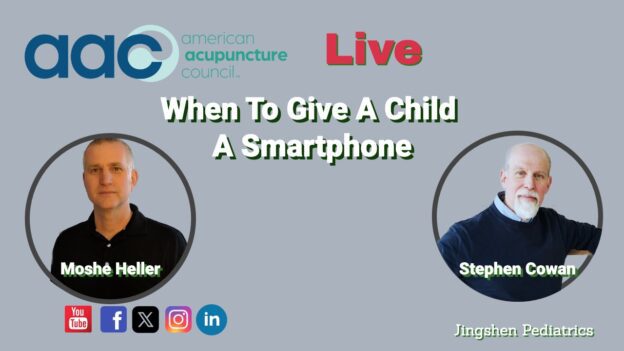
And today we’re going to talk about a topic that comes up all the time, and that is the use of smartphones and technology in children from a Chinese medicine perspective.
Disclaimer: The following is an actual transcript. We do our best to make sure the transcript is as accurate as possible, however, it may contain spelling or grammatical errors.Due to the unique language of acupuncture, there will be errors, so we suggest you watch the video while reading the transcript.
Hi, my name is Stephen Cowan and I’m happy to be presenting here today thanks to the American Acupuncture Council, very thankful that they have this opportunity, this platform. And I’m joined today by my dear friend and colleague, Moshe Heller, who teaches with me around the country on pediatrics and Chinese medicine.
Click here for the best Acupuncture Malpractice Insurance
Hi, Moshe. Hello, Stephen. Nice to be here. Nice to see you again. And today we’re going to talk about a topic that comes up all the time, and that is the use of smartphones and technology in children from a Chinese medicine perspective. So let’s go to the first slide. This is an interesting question, and I believe that Chinese medicine is more than needles.
It’s a way of life and being modern practitioners for Chinese medicine and carrying that perspective, the understanding of Smartphones and tech, this powerful technology raises an interesting dialogue that Moshe and I have been having and parents ask about it, particularly with their teenagers, but I think it’s even more important to talk about it with babies all the way up.
When is the right time to introduce a smartphone? What are the dangers, etc. Things like that. Yeah, that’s a, it’s a very big common questions. And I think one of the things that we have to understand as you mentioned here before is that we need to look at what, how can we translate what’s happening from a Chinese medicine perspective so we can help in balancing that and understand what we need to do in order to make it because Exactly.
Exactly. We can’t stop it from happening. No, the cat’s out of the bag, right? The Pandora’s box is open. You can’t make this go away. We all have smartphones. Parents are using smartphones. So it would be ridiculous to put your head in the sand and say I don’t believe in smartphones because they’re going to be here.
And there are all kinds of positives and negatives. It’s the obvious. Negatives that people know about are addiction, right? Exposure to dangerous things, pornography and violence and things that we don’t want. Bullying misinformation and, loneliness, right? These are the kind of five things that I think, We all fear when it comes to exposing young children.
Let’s go to the next slide and talk about a deeper level of Chinese medicine understanding our society. You can do the other one too. Yeah. So this idea of so much yang in our society at the expense of yin because the circle doesn’t change. If you got more yang, you got less yin. But in our case, we have both happening simultaneously.
Too much, too fast, and too little, too late. And one of the things, Moshe, you and I teach wherever we go, is the What we’ll call the sensitivity and openness of a child’s heart mind, right? This very a kind of gentle, open, innocent heart mind, body, way of consciousness that is absorbing the world.
And here we have this modern society. And I think that’s the first place we have to sensitize parents is understanding both the yin yang philosophy and understanding the nature of a child’s mind and body, right? That quality. They’re not, the classics say children are naturally more young. and more underdeveloped in their yin.
So if you add to that this sequence that we can, everybody can see here, so many things on this list of too much, too fast, that’s cumulative, that’s adding to the natural societal yang nature, right? And then couple it with too little connection, too little exercise, too little darkness, right?
You can leave lights on all night, right? Kids sleeping with lights on. Too little slow and quiet time, too little sleep, too little exposure to natural surroundings. That’s a kind of societal yin deficiency. And so it’s a lot of that stimulation. So it creates, supports that imbalance. Yeah. Yeah.
And I think your kids went to Waldorf school where they actually were very strong in holding off on screens and technology. And There’s one thing I want to just put out. There’s actually two things. One is that actually one of the things we need to think about is that looking at a screen, whether it’s an iPad or it’s a cell phone or it’s a TV, is, on one hand it really makes the feeling that the, or the parents have a feeling that it actually calms the child where the, suddenly there’s quiet, there’s nothing there’s no interaction.
They’re plugged in. But on the other hand, what is happening is all that energy goes inside and creates excessive or extreme stimulation. So it’s actually very similar to a stimulant. Oh, absolutely. And a hypnotic stimulant in that sense. But there’s another piece that’s a really good point you’re making.
As it’s going into the being, the child, there’s a natural feeding of the mind at the expense of body. So you’re creating a tension between the more yang head and the yin. body or lower part, right? So they’re not embodied. They’re so sucked into this technology because it’s so stimulating. that they’re transfixed, but it’s pulling them out of their embodiment, right?
So you’re getting this tension split of being disembodied and engaged, and it looks like he’s learning, or he loves it, or he’s, quiet for a chance, right? How many kids with ADD come to me And they say he has no problem paying attention when he’s on his video games or when he’s on his smartphone, right?
And that’s evidence of exactly what you’re saying. They’re being sucked into this very powerful technology that’s designed to capture your attention, right? There’s another component that when I mention ADD, I have seen over and over again what I call slow modem syndrome. The more you’re exposed to fast technology, The harder it is to go back to slower analog settings, like sitting in a classroom, because it’s like working on a slow modem.
You tear your hair out. You go crazy. It’s like, why isn’t this thing responding, right? And you’re being forced, after you’ve been playing for three hours on, Your screens on Roblox, on your phone, having to sit in the classroom becomes torturous, and there’s a lot of acting out behavior, distractibility, hyperactivity, impulsivity, and then they’re being medicated for that.
So yes, I think it, you’re absolutely right that if you were expecting the child to go back to the classroom after playing a video game, that seems, Extremely impossible. So one of the questions I will ask a kid when I play that out in front of the parents, I say, Let me ask you something.
Why would you want to make school more boring than it already is? And they look at me and they say, I don’t want to make it more boring than it already is. And I said the more you play Expose yourself to this technology. By default, it’s harder to go back and all of a sudden the light goes on with somebody in the family like, Oh my God, we’re actually contributing to the problem.
And so we’re opening up those ideas. Yeah, I have a question about that because I’ve been really struggling with this kind of problem that comes from exactly this point, is that I see that there’s a lot of bargaining with many of the kids that are, that the parents have an understanding that they cannot give them free use of screen time, that they will bargain and sometimes It’s almost like this kind of fighting between the parent and the child.
Oh, definitely. I see it. I earn more time, and and if you do this I see it all the time, and it’s being used as a reward or bribery, right? If you do your homework, you can do, two hours of this. I had one kid, the father was a techie, and really deep in, made a lot of money in the tech world.
And the kid He had set up these, rules, and it turned out the kid was cheating. He was a techie too and he had played nine hours of video games. And in one day and the father was like horrified, right? Nine hours where he was cheating, right? This particularly became a problem during the pandemic where kids were online for school and they were actually playing games or they were Look, I don’t want to demonize all of the screens.
They’re here to stay. It’s a way to make balance, which is what, That’s what Chinese medicine is about, finding that dynamic equilibrium of these two polar aspects of our engagement. The rule I use at home with people, with kids and families, is a one to one rule that I call the green to screen, ratio.
That for every minute that you’re on a screen in a day, You have to have equal number of minutes of time in an analog natural setting. That could be a walk in the park. It could be playing with blocks in your room, something that’s not plugged in to any electronics, right? And as long as you, because the time is limited in one day, you can’t bank the hours for later.
You It limits itself. And, so a kid who’s, I’ve had kids who said, all right, I just did two hours of exercise outside. Can I do some screens now? And I say, yeah, but there’s another rule, an hour before bed, because you don’t want to interfere with your melatonin levels. So an hour before bed, all screens are off in the house, including the parents.
They have to, Pretend to turn off their own addiction while the kids are going to sleep, because it’s not fair. And I’ll hear this over and over again if the parents don’t practice the same principle. The classic place where this is a problem is the dinner table. Screens at the dinner table, phones at the dinner table, and getting parents to break their own habits.
is critical, right? Yes, but there’s another thing that you mentioned in another talk We gave, Moshe, that is so dear to me and really important and that is when we’re asking the question of When is a good time to introduce a smartphone to a kid? Which is a big question I get asked. I think this idea that different kids have different Needs, different sensitivities, and you have to know the complexity of the temperament of a child.
For example, More fiery kids, where that phase, that element, is stronger in that kid, because we’re a complex of all of them. They’re more prone to addiction, because, I find a lot of fire kids just love scrolling through YouTubes and finding all kinds of wacky things that they can’t stop looking at, right?
Whereas, More of the woody kids are more prone to looking for pornography and violence and danger and, they’re just curious about it. I’m not blaming them. It’s part of their nature to be curious about those kind of things. Yes. Earth kids are more prone to the bullying that takes place in, in social media and to FOMO, fear of missing out, right?
They’re voyeuristic. They want to know, is anybody talking about me or are they including me? That’s a very earthy, spleeny way of thinking. So they’re vulnerable to that aspect. I think metal or gold kids are much more prone to misinformation because they’re collectors of information and data. And so they’re prone to get, coming up with the wackiest information, that we see that’s littered in the internet, some of it causing great fear and concern when it’s not even true. And then most, and probably most importantly, is the water temperament or the water within us all that is prone to alienation, aloneness, being cut off from the world because they’re so sucked in so deep.
So knowing the temperament of your child becomes a way of gauging age. When is that, knowing your kid and knowing how they’re developing and what are they prone to already helps guide you in terms of timing of introducing these things. Some people say There’s a movement in parents now called wait until 8th.
Wait until 8th, meaning 8th grade. Because waiting till puberty begins for a smartphone in particular, which is a full on computer that’s in your pocket, as opposed to what we’ll call a dumb phone, which you can use to call mom to pick you up from a basketball game or whatever. But smartphones are a very powerful computer that has access to the whole world.
So that’s one kind of global guideline. I don’t like global guidelines. I think it has to be fit to the needs of the family and the child specifically, but it’s something to think about. Yeah. And as you mentioned before, my daughter went to a Waldorf school where there’s a very strong anti media screen phone exposure till and they also talk about how to expose and the But their concern is mostly about The information that’s being you can be exposed to.
And that’s another, probably totally different talk. I find it interesting that your daughter, who’s a whiz at at IT now was someone who was not exposed early. So it doesn’t delay you in that, but in some kids, particularly in some kids, it makes it even more. enticing by restricting it.
So you have to know your child to know how you can go about doing this. Let’s go to the other, the next slide and talk about that. An important thing, I think to just also talk about that from Chinese medicine perspective, this kind of Excess energy that you mentioned that goes up to the mind being the heart shen can actually imbalance and create less fire in the lower part of the body, in the minstrel fire, and create what we might call now, in fire, right?
As we yeah, it literally, kids where their feet are cold, and their head is hot after playing these, being online for a long time, there’s a physical effect and the poor spleen gets caught in the middle, right? Which is already dealing with absorbing information in the form of food, in the form of exposure to information online.
And gets overwhelmed, right? And so it’s a setup for this quality that, Dongyuan Li Dongyuan talked about this Yin Fire mixed pattern which I think is contributing to a lot of the disorders I see both physically and mentally in children today. Yes, that that plays to another aspect, which is very interesting, I think, is that, A lot of times when we are thinking of balancing that, we should think of the Shaoyang level and Sanjiao gallbladder kind of level where it enables to shift back some of that excess top fire back down to the minstrel fire and create a Better balance with the spleen in the center.
Yeah, I you know, I talk a lot about san jiao as the Relationship organ of the body so that everybody’s relating to each other one big happy family and these the screen addiction of our society is a breakdown in those relationships. So always think of Sanjiao. Both Sanjiao points and Sanjiao concepts as part of the Xiaoyang as integral to the kind of integration of heart, mind, kidney, pericardium, this primary, uh, yin yang relationship.
And in terms of any kid that comes into your office who’s having trouble relating, whether they’re relating to friends, relating to family, relating to the school work, relating to food, whatever, anytime you think relationship, think Sanjiao. And of course, gallbladder being one of the kind of special organs.
this unique, powerful organ that, is kind of part of the extraordinary organs related to mind. So I do, you’re right. It’s really important that we have this concept in our mind when we see the effect of early exposure to powerful technological advances will hit this complex and cause a kind of upside down pattern of yin and yang.
Correct. And, I also have been noticing that one of the a lot of, one, one symptom that I see that comes up more frequently in my practice I don’t know, I know that probably you too, is that I see much more ticks. Yeah, and particularly tics of the neck, shoulders, head, face, eyes, right?
It’s all the yang aspect that’s ticking, right? Occasionally, you’ll get a hand or a foot, but usually it starts with the head. So this is a great example of that and important to approach it with this model. And one of the things, interestingly, one of the herb formulas I’ve been using for tic disorders in general, no accident, is Buchong Ichitan, right?
Believe it or not, even though you’d think, wow, isn’t that potentiating the Qi? Yes, but we’re trying, this is one of the principles of yin fire treatment is not suppressing, right? The yang, but actually improving the relationship of yang. Yeah. The idea is that the pericardium is not necessarily it’s, That deficiency is manifesting in a excess and somewhat correlates to what we sometimes in the course that when we teach, we talk about this kind of hyperactive spleen chief acuity.
That concept also comes from this idea and the importance of strengthening the spleen more so than dispersing that kind of what may seem excess. Exactly. And so the spleen, stomach, middle, burner is what BuChong means, right? Health, unhealthy. Exactly. And I think that was the brilliance of Li Dongyuan’s idea.
It’s so applicable to pediatrics. And we get into a lot of that discussion of both Sanjiao dynamics and hyperactive spleen qi, acuity. in the course. So I think this is a great example of how to see smartphone technology from a Chinese medicine perspective. So I think at this point we can And this discussion.
We’re interested in more about treating kids. And we really encourage all practitioners to be kid friendly because kids respond so quickly. It was very rewarding in your practice. And we’re doing come visit us at the Jing Shen pediatrics site where we’re doing teachings. We have online teachings.
We’re planning some in person teachings and we welcome you guys to be there. And I also want to just point out one more very important thing that I was thinking about is that I think one of the things that when we learn go back and look at the theories and how they manifest in children It actually enables you to even treat adults in a little different way.
Absolutely. Good point that we all have a child inside us and tapping into that. This is old trauma. This is the child activating the child nature, right? Longevity. All of these things, the virtues of a child, when we can tap into that and treat that in adults, it’s very beneficial. I a hundred percent agree.
Thanks, Moshe. This is why I like teaching with you because we always play off each other and remind each other of ideas. So let’s thank the American Acupuncture Council again for hosting us and we look forward to seeing you guys again. Yes. Thank you. See you soon.
Click here for the best Acupuncture Malpractice Insurance
What is the most critical item every acupuncture practice should have?
Acupuncture malpractice insurance ensures you are fully protected with the right insurance to continue helping patients with care and confidence.
One of the several benefits of Acupuncture Malpractice Insurance is legal protection.
American Acupuncture Council recognizes acupuncture as a widely used alternative treatment, but like all healthcare professions, it carries the risk of malpractice complaints.
Acupuncture patients could file lawsuits alleging injury, infection, or malpractice after treatment.
That is why malpractice insurance should be put in place to protect your practice, as it covers legal defense costs, settlements, and judgments should a case proceed.
Remember, the American Acupuncture Council (AAC) offers an unparalleled track record in acupuncture risk management.
There is a reason acupuncturists have trusted AAC with their business for 50 years.
Not an American Acupuncture Council member? Get a Quick Quote and find out how much you will save! Click here!
Disclaimer: The following is an actual transcript. We do our best to make sure the transcript is as accurate as possible, however, it may contain spelling or grammatical errors. Due to the unique language of acupuncture, there will be errors, so we suggest you watch the video while reading the transcript.
Greetings, friends and colleagues. This is Sam Collins, your coding and billing expert for Acupuncture, the American Acupuncture Council, the American Acupuncture Council Network. But more importantly to you, your success is ours. We’re always here to try to make sure that you have all the best available information to make your practice thrive.
Click here for the best Acupuncture Malpractice Insurance
I want you to be the best possible provider and focus on that. Allow us the chance, the Council, to be that support service for you, where we’re there to help you with all the nuances. That’s what network members get from us. But let’s talk about today’s program. Let’s talk about when you see a policy that says they get 25 visits.
What does that really mean? Or when it says we have 40, 80, or whatever, what about some plans that it’s actually unlimited? Does it really mean that? So let’s go to the slides. Let’s talk about this when we get policies that tell us the amount of visits that someone has. What does it really mean when a policy allows 25 visits?
Does it mean they get 25 automatically? That no matter what, I hope all of you are going, well, no, that’s probably not true. What we have to have every time is it has to be medically necessary. It’s not going to be just an automatic. It’s going to be, should it come up as something that’s necessary? In other words, if a person says, I feel fine, I feel perfect, but I want to get my 25 visits.
Will the insurance allow that? And that’s where we have some difficulty because when patients have policies like these, they have the false pretense that, Oh good, that means I can come two times per month this whole year and the rest of my life. Now, as much as I would love that to be true, that isn’t always medically necessary.
So we do have to keep in mind that we need to learn to navigate and achieve the optimum utilization, make sure patients are aware. Now realize, many people have conditions. Pain and otherwise. That could require some acupuncture services that will max out those visits and could be that way, but we have to make sure, do we have it medically necessary?
Is it automatic? Does it mean they get to use it at their discretion, two per month? But what about maintenance? Will that be covered? Well, first we have to think of what is medically necessary because in order to have 25 visits, you’re always going to say they’re looking for medical necessity, something that is necessary for the patient.
And that must be delivered with defined, reasonable, and evidence based goals. Now, realize As an acupuncturist, there’s many things you can treat beyond just simple what I call the physical therapy chiropractic side, which is musculoskeletal and pain. It can go beyond that, but we still have to have evidence of the changes.
It must be based on the patient’s presentation of their diagnosis. Make sure it’s a covered diagnosis. That’s probably going to be number one. For a patient to be covered for acupuncture, you have to find out what are the covered diagnosis. By example, Aetna and Cigna have very similar covered diagnosis, but there are many more with Cigna than with Aetna.
But what about Blue Cross Blue Shield? So it’s sometimes learning that nuance. This is what we do for you at Seminars, of course. So make sure we have the diagnosis, but then also, what is the severity? What are the clinical findings that demonstrate the need for care? It says, continuation of treatment is contingent upon progression towards defined treatment goals evidenced by specific significant objective functional improvements.
Notice it says here, outcome assessment scales, range of motion. The good news is, pain, which is the number one thing acupuncturists treat, is always going to cause some dysfunction of some type. Their function is going to be less based upon their pain. So talk about when a patient says they’re having pain, even if it’s headaches, what is this headache causing you to have problems with?
Oh my goodness, I couldn’t work. I can’t work more than 30 minutes at a time. We’re had to take a day off. All these things demonstrating some type of evidence of a functional change. I think acupuncture works very well here. Think of how many types of doctors you can see, but how many can you treat with that when you leave the visit, You literally feel better.
I mean, if you go to a medical doctor with a headache, and I’m not saying this is a negative, what is a medical doctor going to do? Evaluate you and make sure it’s not nothing more severe, but then otherwise give you a script for pain medication. They call it in by the time you can get the prescription filled, hours later, maybe the next day, then you take it by then.
Maybe the headache was gone on its own or it can help. Someone comes to you with a headache. How many of you have witnessed what I call the miracle of acupuncture? that they leave going, Oh my God, I cannot believe that worked. I’m without a headache and I came in with one. That happens all the time. So we want to demonstrate that the patient has changes.
So always rely on how you document as demonstrating the number of visits. Cause 25 visits are certainly reasonable. If you can show they have a headache after a certain number of visits or time, the headache is gone or reduced. Now, can that headache return? Absolutely. So it’s not a never ending. It says certain conditions require to be co managed by a medical provider.
If you’re dealing with, some plans cover addictions, strokes. Cancer related. Well, those you’d want to be working with them. By the way, I took this directly from Cygnus coverage and it says, medically necessary services including monitoring outcomes with progress and change in treatment, with a withdrawal of treatment if the patient is no longer improving.
I mean, let’s face it, how many patients are going to continue to come to you if you’re not helping? This is the hard part because patients start to understand the value. and necessity of care. Our job is when do we demonstrate that that care is no longer medically necessary from an insurance standpoint.
I think so long as we can demonstrate there’s ebbs and flows and we’re showing improvement or can be supportive, I think we’re going to be on the right track. Just be careful. Maintenance or non covered means it’s intended to improve or maintain general physical condition. I don’t disagree with that. I think certainly healthcare should be part of that, but that’s not what our insurance is for, is it?
Insurance says Sickness or disease. So it’s not about keeping you healthy. I wish we would no longer call it health insurance. We should call it sick insurance. It says maintenance acupuncture services when significant therapeutic improvement is not expected. So it’s maintenance when it’s not expected.
Now that doesn’t mean it has to improve every time. So when someone says there’s 25 visits during that 25 visits, if we’re noticing a continuance of improvement medically necessary, the difference is, How do we demonstrate it? Are you using outcomes to do that? Are you giving me the true objective changes?
Don’t tell me or rely on the patient feels a little better. That’s certainly not going to be adequate. That’s part of it, but they feel better. How? What functional change? What objective change do we have? It says services that do not require the skills of a qualified provider, such as acupuncture, are limited to that can be practiced independently and self administered.
So in other words, if you’re just saying we’re coming in and just doing exercises. only. They’re going to say, well, why couldn’t they continue that at home? So you always want to show that it requires a skill, meaning they’re getting true acupuncture services. Home exercise services can be formed safely and independently.
It can’t be just that. Now, should exercise be part of the care plan? You bet. But I want you to keep in mind, when I go to an acupuncturist, you know what I want? Acupuncture. Chances are we’ve tried exercise. Now that doesn’t mean you’re not going to give me some better ones. And I’ll say doing Qigong type exercises, if you will, or physical therapy type, or just gym type are all helpful.
and could be part of it, but the thing that separates you is going to be the acupuncture. So keep in mind, there is something though that insurances will cover, particularly on some of these visits, what they call supportive care. And it says supportive care can be referred to as ongoing or long term treatment or care, and it may be necessary as treatment for individuals who have reached maximum benefit.
In other words, they’ve reached maximum benefit, but you notice right after you withdraw care, They begin to have a significant drop off. Now, what we want to do, make sure we’re showing, because of that drop off, they’ve been doing home exercise. They’re doing things to help prevent it, but it doesn’t do it.
So, you want to demonstrate that the patient can get ongoing improvement. with the care. When it falls off, we get them back treating again. So keep in mind what they don’t cover though is a true maintenance. Supportive is different from maintenance. Supportive is in the absence of care, it significantly drops off.
Demonstrate that objectively and subjectively. If we’re just saying it stays the same and we don’t want it to get worse, that’s a difference. That’s where this comes in. The member’s symptoms are neither regressing or improving, is considered not medically necessary. If no clinical benefits can be appreciated after four weeks of acupuncture, then why?
Now, notice what it says here. They’re initially giving everyone probably four weeks. Now, four weeks for you could be one time a week. For another person, it could be two times a week. So, keep in mind, it’s not just number of visits, but over a time period. There are some service providers who might do one visit a week.
What I want you thinking of is, if I give care, Can I show improvement? No matter how many number of visits they’ll have, they’ll allow it. I have an office, and this is not a joke, they’ve treated someone probably the last, and I’m not going to over exaggerate it, for sure the last two years, I can say for sure, and they’ve treated this person 40 plus times every single year.
Now, grant you, they have a very significant chronic condition, arthritic changes, and so forth, but they don’t treat 40 continuously. They’ll treat usually 10 or 15 per an episode. They may not see them for weeks, maybe a month, and then treat another 10 or 15. And that same thing has gone on. What they haven’t done is just treat them every other week.
Now, some people might say, maybe that’s better. Well, unfortunately, that’s not how insurance works. So we want to make sure that we can demonstrate always meaningful improvement in symptoms and objective changes. And here’s a good example of a plan like this. This is the Costco plan under it. And I’ll just have you go to the first part here.
It says changes in coverage for chiropractic services. You’re thinking, what? Bear with me and let’s read on. Currently, chiropractic services are covered as an alternative care benefit. You pay a co pay for each covered chiropractic visit, and you’re limited to a combined total of 20 alternative care notice.
Acupuncture, chiropractic, homeopath, and naturopath. Costco is very generous. So what is that telling us? Do we get 20 visits per year? for acupuncture combined with others. But notice what began this year, January 21st, they’re allowing a little bit more for chiropractic, but it’s all based on medical necessity.
They’ll allow up to 90 visits per year. So what I want to highlight is visits, if they give you 90, 20, you still have to demonstrate the patient can get better as a result of the care. That doesn’t mean we’re curing, but maybe we’re getting to a point where they remain functional. And when that dysfunction drops, We continue treating.
Be careful. I think we’re the ones that have to explain to a patient. 25 visits doesn’t mean automatic visits. 25 visits still comes back to medical necessity. So we’ve got to give our patients a financial agreement. I hope all of you are doing something like this. It’s part of the no surprise, regardless of what a patient thinks is covered.
We want to put this out there. Many insurance policies do cover acupuncture care, but this office makes no representation that yours does. Insurance policies may vary greatly in terms of deductible and percentage of coverage for acupuncture care. In other words, we’re going to do the best job we can to get your plan to cover.
We’re not promising anything. What we’re promising is good care and that ultimately you will be personally responsible for the payment of your deductible as well as any unpaid balances. We go further to say if you have insurance, we’ll bill as a courtesy. Of course we will, but payment for your deductibles if it has not been met as your responsibility.
Your copay is due as services are rendered. What we want to do is give patients good quality care. And here’s something to keep in mind. Your practice as a cash practitioner is important, but it’s even the same when it comes to insurance. Insurance pays part of it. It’s just easier for someone to come in when they have insurance that pays part of it.
I want to access that, but I don’t want to give a false sense of security. Think of it this way. When someone really needs care, they pay for it. There’s a value. We want to continue to have that value, whether there’s insurance or not, whether it’s unlimited visits, that the patient understands it. Keep in mind.
Acupuncture care works really, really well. That’s the medical necessity. But does your documentation present that? This is one of the common problems I see when I have offices I work with in dealing with when they get denials or non payments. How do we fix that? Well, demonstrate the patient made, the treatment made the patient better.
I would implore all of you, acupuncture works really well, but if you look objectively in your notes, Can you see that in an evidenced way? I’m going to recommend that you always use an outcome assessment on every single patient. Even if it’s cash, by the way. Get an outcome assessment. It demonstrates objectively how the patient is changing.
The two that I like the best are the general pain index. The other is the pain interference, the short form. The latter is the one the VA is emphasizing. If you’ve attended a seminar with me, you’ve received them. If you’re a network member, But start using things that show acupuncture works. It’s your way of putting a person on a scale and show they’ve lost weight.
Acupuncture is a phenomenal profession, but you have to make sure how do I navigate to continue to increase my patient base, which means also increasing your volume of patients by volume of income. Because ultimately, remember, you are a business provider and we’ve got to make business decisions. So I always want to be there to help you navigate that as the American Acupuncture Council does.
So until next time, my friends, I wish you the very, very best.
Click here for the best Acupuncture Malpractice Insurance
Arbitration is an alternative to court, where claims can be heard so when patients sign arbitration agreements, your patients agree that, if they want to bring claims against you, those claims will be heard in arbitration rather than in court.
Arbitration is more private. Instead of in an open courtroom, arbitration typically occurs at an alternative dispute center in a conference room.
Arbitration can be scheduled much sooner. This benefits you because then you do not have the stress of an open case for several years.
The case is heard by an experienced arbitrator, who understands malpractice cases, rather than a jury.
It is important to have a well-written arbitration agreement which AAC will happily provide you with.
Remember, the American Acupuncture Council (AAC) offers an unparalleled track record in acupuncture risk management.
There is a reason acupuncturists have trusted AAC with their business for 50 years.
Not an American Acupuncture Council member? Get a Quick Quote and find out how much you will save! Click here!
Disclaimer: The following is an actual transcript. We do our best to make sure the transcript is as accurate as possible, however, it may contain spelling or grammatical errors.Due to the unique language of acupuncture, there will be errors, so we suggest you watch the video while reading the transcript.
Dr. Martha Lucas, today we are going to talk about amygdalizing, and I want to thank the American Acupuncture Council for giving me the opportunity to share this information with you. You can also find information on LucasTeachings. com, my teaching website. So my practice is located in Denver, Colorado, but I love to teach.
Click here for the best Acupuncture Malpractice Insurance
Teaching all over and having opportunities like this to spread the word about how wonderful Chinese medicine is. So today’s topic is something that I have called amygdalizing. And so I’m going to talk to you about telling your patients to amygdalize. Now, the amygdala is a part of our brain. It’s involved in our stress response, and a friend of mine and I have been studying the amygdala for quite a while in terms of how it is related, especially to anxiety, but anxiety and depression in our patients.
Kathleen is one of my Pulse diagnosis students from years and years ago, and we’ve kept in touch all these years about how important the proper diagnosis is to help our patients find the cause or help us find the cause of their condition, because that’s what Chinese medicine is about, right?
It’s essentially a preventive medicine, so we want to see our patients to prevent. Conditions, in other words, keep them healthy. You all know the old story about the ancient medical doctors and how you went to see them all the time to stay healthy and you paid them, but if you turned up sick, they didn’t get paid because they’re supposed to keep you healthy.
Now, in our culture, we only we might go see our doctor once a year for our annual exam, but we usually only go when we’re sick. So it is an educational thing to get your patients to understand. You need to come see me. Let’s say they start with a symptom. Come see me. We get you quote unquote cured.
We get your symptoms to go away. We get you healthy again, and then see you in a month. That’s what I tell all my patients. I need to see you twice a week for a couple of weeks, and once a week, then every 10 days, and two weeks, and then see you in a month when you’re healthy. Because I’m getting them back to the time where I can prevent their conditions.
So I love to treat emotions. Emotions are, I, in my pulse diagnosis system, we can feel the emotions in the pulse. Like worry makes the earth, spleen, stomach, pulse go backward toward the kidneys. Part of the problem with that is, number one, it’s taking away from the kidney energy in a perverse way. And number two, it’s not connecting with the lung, large intestine, metal, and earth and metal are our immune system, right?
So people are going to show up with some sort of immune or skin or hair condition, along with their worry causing this to happen. Terms of anxiety and depression, we feel depression, chronic depression, current depression in the liver pulse, the liver gallbladder pulse. And then anxiety is felt mostly in the heart, but that combination of the liver and the heart.
So I have for years been telling my patients when I feel their anxiety to what I call amygdalize. Now, why choose the amygdala as the choice of organs for them to calm down? And remember, the master said that, and I remember this from the first week of Chinese medicine school, and I Really, honestly, at that time, I thought it was a little bit of a crazy thing to say.
I’m a research psychologist by training in the Western medicine, so to say, Oh, emotions cause all physical disease made me feel like, what? Are you kidding? But as I’m feeling people’s pulses, you can feel that back and forth movement, or the scattered of the heart pulse, is eventually causing a physical symptom.
And if you want to think about it, and when we talk about the amygdala, you will know, it’s a physical disease. The amygdala is a physical organ in our body. We’re feeling the person’s anxiety and or depression, and that’s physically in their body. We’ve managed to get this idea of anxiety and depression down to a physical problem.
Now, sure, we have bacteria, viruses, that sort of thing causes physical disease, but also your patient’s emotions getting stuck. Your patient’s emotions, like if the heart pulse is scattered, blood flow isn’t going to be very good, right? This is why our fertility patients need treatment on the heart because that blood flow is going to eventually go to the uterus.
And without that connection, people are not going to be able to get pregnant very easily. So we’re going to be talking about the physical brain and how we’re going to deal with that in Chinese medicine. But it all started with this idea about that. Emotions caused all physical disease. And now of course, I’m big on treating emotions.
I love to treat emotions. I think we all need to let our patients know that Chinese acupuncture, Chinese medicine doesn’t only treat fertility and pain. I think those are two of the big topics, but we also treat the person’s emotions and their spirit. So the amygdala is a little tiny part of your brain, but it has a big function.
It’s one of the major. are the major processing center for your emotions. It also links the brain with other brain activities like memories, learning, and our senses. So that’s why sometimes when people have a panic attack, they have all of their senses seem to be involved in that. But it’s main, going to be talking about is how it can cause disruptive feelings like anxiety and depression.
It’s inside your temporal lobe. As I said, it plays a key role in emotions and memory and learning and It’s actually a little structure, but it’s part of a bigger network called the limbic system. And we all remember that the limbic system has to do with emotions. It’s part of our, very important part of our survival, because without fear in the, what I call the old days, when we were, threatened by tigers at the door and dying in childbirth more and that sort of thing.
We had to have fear, like that idea that the hair stands up on end on your arms when we’re fearful or we are worried for our own survival. If you’ve ever almost been hit by a car, you will know that your hair stands on end because you, Your survival was threatened. So these parts of the brain, including the amygdala, what we call detect danger.
But now the danger isn’t a tiger at the door. The danger is we can’t pay our bills. We’re afraid we’re not going to pass an exam. Our business has declined. Maybe we’re having a little bit of a relationship problem. Those are now the issues that really aren’t what you would call survival. They’re not really, I’m going to die because I can’t pay this bill.
I can do other things about not being able to pay that bill. But the amygdala doesn’t know that. It, all it sees is it’s, Just processing the things that we are seeing and hearing, like literally look at the bill and the amygdala goes into that feeling of, oh my gosh, I’m going to die. So we get fear, we can get aggression.
As I said, it’s a part of learning through rewards and punishment. So again, we can cognitively train it to learn this is not a survival, death threat. And then with memory, and it also is a part of social communication, which is what amygdalizing is. When I tell my patients to amygdalize, it means that they need to just express the emotion they’re feeling, express the situation to someone.
In fact, they don’t even need to. They don’t even need feedback. It’s not I need to have a conversation with somebody about this. In fact, my friend and I do emails back and forth and we’ll say, I need to amygdalize in the subject line, which means to our friend, my friend and I, you don’t have to call me back.
You don’t have to even email back. I just am having this situation. I need to express it. I’m going to say it to you or leave a message, leave a phone message. Hey, this is an amygdalization thing. phone voicemail and just blah, blah, blah, blah, blah, blah, what’s happening because we need to express that. And the masters were right about that.
I tell all my patients, your emotions are better in, sorry, your emotions are better out than in. They’re better expressed than held in. It’s the holding in that creates the stagnation and the weakness, the deficiencies or excess. Stagnation can be. either deficiency or excess, but it’s the holding in of the emotion that’s going to lead to some physical problem or anxiety and depression, which we consider emotional problems.
So they were right about that. Now, I always tell my patients, I’m not suggesting that we all become raging maniacs and road ragers. I’m just saying that you need to say it. You’ve had a bad day at work. Your boss has been a jerk. You just need to get in your car and do the, Oh my boss, blah, blah, blah, blah, blah.
Or you’re sad about something, I’m sad about this particular thing happening. And I always tell them if you’re sad and you can cry, or you’re crying with words processes things faster than just crying with your frontal lobe and your amygdala going on and on inside this loop, right?
That’s what worry does to the pulses, as I mentioned earlier. It’s a loop between earth and the kidneys back and forth. And that’s very dangerous to our health. So what the amygdala ization does, which that’s a phrase I’ve coined, amygdalize and amygdalization, is it helps your amygdala calm down.
It helps the neurons because what the amygdala is made of is neurons and they’re sending and relaying electrical and chemical signals throughout your brain and nervous system so that you see a threat, your bill, and then these neurons start to go through your whole brain, your whole nervous system. And It’s the protective cells for those nerves don’t recognize that this is not a threat to my life.
When we start to have anxiety disorders, PTSD, any mood disorder, panic disorder, these phobias, fearful things, these are all how These are all affected or started in the amygdala. So again, we need to be always thinking about getting that out for our mental health because your amygdala can get hijacked.
If we don’t recognize that this is not a danger to my life, then those emergency signals are just going to keep going and going and going and other parts of your brain are going to react you. to that. So you might have a startle reflex. As I said, you’re going to have anxiety or depression.
It’s an emotional hijack, if you will. So what the amygdala starts in your central nervous system is this process to protect yourself, protect your body, from a dangerous situation or from danger. So again, this helps in a dangerous situation, right? If a car is coming and your ears hear it and you’re on your bike and you’re, you suddenly get a fight or flight response, that’s going to save your life.
So it’s protecting your body from danger by putting you in fight or flight. But now, as I said earlier, The fight or flight isn’t survival. The fight or flight is worried about having a fight with our partner worrying about our business, having to pay some bills, something, our child is a little sick, but we turn it into a bigger worry.
Again, we need to. Nip that in the bud. So then that’s when I tell my patients to amygdalize. I say that’s not a life threatening thing, but your body feels like it’s life threatening. So you need to not neglect your mental health. You need to realize that your physical body is your mental health.
So again, talking to a friend, you don’t need feedback. So what I tell my patients is you don’t need to. Say to a friend, Oh, I need to talk this over with you. You just need to tell him, Hey, my practitioner told me to do this thing called amygdalizing, which means I’m just going to talk about the thing.
I’m just going to repeat the thing so I can get it out of my mind, get it out in a situation where I get my brain to realize, Oh, actually this is a bill. I can do something about that. I can call the company. I can make payments. I’m not going to die. And we can calm ourselves down by doing what the master said, which is getting the emotional, getting the emotion expressed right in a healthy way, not being over angry, not, it.
Not yelling at anyone, not hurting anyone. We just get the emotion out by expressing it to someone. Or like I said I call it talking crying is a great way to get it out and process it if you’re a crier. If you’re a crier and you say the words, I miss him, I’m in your frontal lobe. Let’s say it’s that you miss someone.
Your frontal lobe just gets in that loop. I miss him. I miss him. I miss him. I miss him. I miss him. I miss him. But if You can’t say that out loud when you’re crying. You can’t possibly say, I miss him. I miss him. I miss him. I miss him. I miss him. Like it goes on in your frontal lobe. You’ll start to process it.
I miss him because he’s going to a different school now, but Hey, there are airplanes, there are cars. I can still see him. He’s growing up, whatever it is that you’re trying to process. That little bit of grief, but you need to process it. I remember my mother died suddenly and so when I went to see my doctor for my annual exam, she said I was crying because I just reported that my mother died a couple months ago or whatever, and she said, Oh, do you need some antidepressants?
I said, No, I don’t need antidepressants. My mother just dropped dead. I need to cry. is what I need. You put me on antidepressants, it’s going to make me stop crying because that’s what they’re really good at. You can feel that in the pulses. You can feel the liver energy go up to the heart and stop when a person is on antidepressants.
We of course need that energy to get over, over to the spirit, right? Over to the heart to keep the heart blood flowing and the spirit flowing well. I know for that from Chinese medicine. Now, if I wasn’t a Chinese medicine practitioner, I wouldn’t have needed that. I wouldn’t have known that. And maybe I would have said, sure, let me have some antidepressants for a while.
But we all know as practitioners, we have to get that depressed energy flowing. Get that grief, get that shock going because otherwise my kidneys were going to suffer, right? And the last thing.
When you feel the emotions in the patient’s pulses, sometimes get them to amygdalize while your hands are on the pulses. And I’ve done it plenty of times the other way. I make a joke in my pulse diagnosis class about how, you know what, you want to feel somebody’s anger pulse in the liver, talk to them about their divorce.
It’s the opposite too. I can tell them, amygdalize, get, and old childhood trauma. They’re amygdalizing in front of me about that and you can feel their earth pulse Sink down deep because this is something they’ve had in their system for a long time about not being nurtured So at any rate I wanted to introduce you to this technique I call amygdalizing able to tell your patients to amygdalize and If you have any questions, you can contact me at LucasTeachings.
com or my private practice site is AcupunctureWoman. com and I’ll be happy to answer your questions. I love to help practitioners be better at our craft because I really, after more than 25 years, I really do believe that Chinese medicine rocks. Again, I want to thank the American Acupuncture Council for this opportunity to speak with you and, as I said Feel free to contact me if you have any questions.
Click here for the best Acupuncture Malpractice Insurance
This website uses cookies to improve your experience. We'll assume you're ok with this, but you can opt-out if you wish. Cookie settingsI ACCEPT
Privacy & Cookies Policy
Privacy Overview
This website uses cookies to improve your experience while you navigate through the website. Out of these cookies, the cookies that are categorized as necessary are stored on your browser as they are essential for the working of basic functionalities of the website. We also use third-party cookies that help us analyze and understand how you use this website. These cookies will be stored in your browser only with your consent. You also have the option to opt-out of these cookies. But opting out of some of these cookies may have an effect on your browsing experience.
Necessary cookies are absolutely essential for the website to function properly. This category only includes cookies that ensures basic functionalities and security features of the website. These cookies do not store any personal information.
Any cookies that may not be particularly necessary for the website to function and is used specifically to collect user personal data via analytics, ads, other embedded contents are termed as non-necessary cookies. It is mandatory to procure user consent prior to running these cookies on your website.