Nearly 80% of adults have low back and/or neck pain at some point.
Twelve studies with over 8,000 participants showed that acupuncture was more effective than no treatment for back or neck pain, and data from 10 studies with close to 2,000 participants showed that acupuncture was more effective than sham acupuncture.
The pain-relieving effect of acupuncture was comparable to that of non-steroidal anti-inflammatory drugs.
Healthcare continues evolving to less-invasive, natural, and drug-free methods, with acupuncture now being a first-line complementary healthcare choice.
Remember, the American Acupuncture Council (AAC) offers an unparalleled track record in acupuncture risk management.
There is a reason acupuncturists have trusted AAC with their business for 50 years.
Disclaimer: The following is an actual transcript. We do our best to make sure the transcript is as accurate as possible, however, it may contain spelling or grammatical errors.Due to the unique language of acupuncture, there will be errors, so we suggest you watch the video while reading the transcript.
Hi everybody. This is Dr. Perry Barnhill with a Fearless Acupuncturist, and today we are gonna talk about something that is so important. There’s some new HIPAA changes that are coming down the pipe regarding reproductive healthcare. A lot of you are very much involved with fertility and reproduction and pregnancy and things like that, so make sure you stay tuned for this.
Click here for the best Acupuncture Malpractice Insurance
Also big thanks to the American Acupuncture Council for having us here. We are pleased to give you the information that you need to have now Slideshow please. Okay, here we go. This is all about strengthening reproductive healthcare under the privacy and the new HIPAA privacy rule. So there’s new requirements.
Just like I said, there are forms, and when I talk about attestation, I am specifically referring to a form that we’re gonna need to have and send out before we send out any information. We’ll get in some details on that and some action steps so you know exactly what it is you need to do. Let’s talk about some of these new changes.
Now, if you’ll remember, maybe you don’t know, but you need to know they are, there are seven new laws for HIPAA in 2025. We’re not gonna get any of these, but they’ve actually added to that, believe it or not. So they have talked about some modifications to the privacy rule. Specifically to better protect reproductive healthcare privacy.
We’re gonna define what this reproductive healthcare privacy is, and a lot of you are involved with this. What it does is this, it prohibits use or disclosure of PHI protected health information. Remember, these are the records we have on our patients, including our intake forms. All righty? So even if some of you may not be involved with this, which I know a lot of you are.
Still, a lot of this information is actually on the intake forms that the patients fill out when they come to the office. So what it does is this prohibits user or disclosure, PHI, solely to investigate or penalize lawful reproductive healthcare. It requires this form I’m talking about, so it requires and obtaining written attestations before we disclose this reproductive healthcare.
Information or records in certain circumstances, or I’ll talk about certain scenarios that you, we will go over and covered entities, which is all of us have to update our notice of patient privacy practices accordingly. What is reproductive healthcare? This reproductive healthcare is a very broad definition, and federal registry. This is some of the stuff that comes from the Federal Registry to help better define what reproductive healthcare is, and it’s a exclusive list. What I’m going to do is, I’m just gonna go through the main things here. You can read all the details behind it, but it’s contraception, it’s management of pre pregnancy, which a lot of your doing.
It’s fertility and infertility again and family planning. It’s still sterilization issues. And sexual health to include many things there. So make sure you understand what this is. Who is affected? Guess what? All of us as healthcare providers are affected. All of us are healthcare clearinghouses are affected, affected health plans.
So all insurance companies are business associates. You know the people that have access to your records, they’re affected. So you need to make sure they’re aware of these things. Also, through your business associate agreements. Here are the situations that require attestation. So I’ll just summarize a little bit.
Reproductive healthcare, if these scenarios occur, meaning these folks ask for records from your patients or from you that you have on your patients and your records re have. Any of that reproductive healthcare definitions on it, or in it, including intake forms. You’re gonna have to send out the form, the attestation form.
So here are the scenarios, or here are some examples of if these people ask for records that contain that reproductive healthcare, you’ll have to send out one of those attestations Health oversight activities. Again, you’re gonna validate that the disclosures are not. Used for punishing lawful care.
That’s how You do it through the attestation statement. Judicial administrative proceedings confirm that the request is not investigative or punitive in nature. The way you do this is through that form, which we’ll talk about here in a second, and also law enforce enforcement requests. So law enforcement, you have to also use this attestation form before you release any of this information, or at least information that has reproductive healthcare in it.
Coroners medical examiners here, again, you’ll have to use this form as well before you release the information. We have a form I should say we, I’m referring to the government. I’m obviously not the government, but we’re talking about a form, they call it the model attestation form. So why not use the form that they actually say we can use, and this is the requirement, it’s the required step we have to do before we disclose reproductive healthcare information or records, and it ensures that whoever’s asking for it.
So those scenarios I just showed you, like the law enforcement, coroners, medical examiners. We send this form to them, they gotta fill it out and send it back to us, and basically saying they’re not gonna do anything or punish them by law for doing the things in the reproductive definitions that I showed you.
Here’s the form, and basically what this form is this, and I know you probably can’t see this on the slides, but the next slide, I’ll have a link for you so you can download this form for yourself, for your offices, and for your staff. But basically, this is the form that we would send out. So let’s say law enforcement, here’s a scenario.
Law enforcement, like I said, in those scenarios, they ask for protected health information from what on. That you have in record of one of your patients. And those records happen to include some of those reproductive definitions in there. So before we send them any information, we have to send this form out and they have to fill it out.
And basically it says that they’re not gonna use any of the information that they acquire from your patient records to punish the patient. Alrighty. Here is the link so you can get this form. I’ll bring the sync up again here a little bit later, but you can just scan it and then I’ll get you right to the link.
Lots of things you gotta do here. So let’s go over some of the main ones. You have to document everything, as always, as you always know, with everything we do in our offices. Hipaa, reproductive healthcare obviously is a big one. In fact, it’s mandatory. We have to keep records of our policy updates, so make sure you keep a record of this.
In fact, keep a record of this for your training log. This could be something you can show your staff, the test station, that form that we have to have. You gotta keep that on file disclosures. And what I mean by disclosures is, believe it or not, every single time that we release information on a patient, we have to record that because patients have a right to come back and say, Hey, I want to see everybody that you ever sent my information to.
So we gotta have that readily accessible. We have to train, we have to educate the staff, and here’s what this looks like. Identifying protected health information that Reque requests or PHI requests that will trigger the use of that form. Kinda like we talked about the reproductive healthcare. Talk to your staff.
Distinguish lawful reproductive healthcare from investigating request. So when those people are asking, and I say those people, the people that I was talking about in those scenarios, ask for reproductive healthcare, PHI on your patients. A testation form goes out, so you have to know how to locate and use the form and document the disclosures, and of course, you have to retain the testation forms to keep copies of everything.
Make sure you train your staff on this. In fact, a lot of officers are deciding and telling the staff. If you have any requests for protected health information from any of those people, let me know so you all can check it over and make sure that attestation form is sent out and then sent back to you before you release any of that information.
You have to update your notice of patient privacy practices. That form the big old packet that we’re supposed to have in our office for all the patient’s rights. Those things have to be readily available for patients. And again, it must reflect. So there’s gonna be changes in there if you had those forms, which you all need to have those prior to 2025.
Guess what? Those forms are no longer good. So you have to get a new, you have to get new notice of patient privacy policies to provide patients with clear and updated information about their rights and how their information is protected. All to align with the updates of the final rule guidelines.
Basically all to align with everything that’s come down the pipe with these new laws. Here’s some next steps for you. Here’s another. Opportunity to download that QR code if you’d like to, so you can go right to it and get that model attestation form, which you have to have. You need to have this in your manuals.
One of the things that we’ve done is we’ve put together a HIPAA compliance checklist. So you can go through, look at this checklist. ’cause a lot of people, they think, oh, I think I’m compliant, or I, maybe I have this form, I have that form, but maybe you’re not really sure. Maybe you didn’t know. You need to do a bunch of assessments and analysises throughout the year.
So we’ve created this form here, just this checklist. You can go through it, check it out, and if you can’t answer these questions or if you’re not doing the things on this form, then guess what? You’re not compliant and you do not wanna be in that position. Believe me, don’t be in that position. Get it dialed in.
Protect yourself. If you’d like to, you can schedule a demo or you can just get started. You can go to this website here. You can schedule demo, go dot fearless provider.com/demo. Of course, you can scan the QR code there to your right. If you just wanna get started with the HIPAA program, we have everything you need for hipaa, all the forms, all the trainings.
We have ’em in videos, we have downloads, we have closed caption, we have transcripts. We have. Everything in there to make it learn as easily as possible for you and your staff, or I’m more than happy to talk to you. You can contact me at Dr. perry@betterhipaablueprint.com. Again, thank you all so much for being here.
We hope you hope the best for all of you. In spite of all these changes. Just make sure you go out there, get the process going, and make sure you have this in play. In the meantime, have an amazing day, everybody.
Click here for the best Acupuncture Malpractice Insurance
Can acupuncture treatments help patients with allergic rhinitis?
Allergic rhinitis causes cold-like symptoms and is inflammation of the inside of the nose caused by an allergen, such as pollen, dust, mold, or from certain animals.
A study published in the European Journal of Medical Research assessed the efficacy and safety of acupuncture for allergic rhinitis and tested the robustness of the effects.
This study concluded that acupuncture may have an advantage over no intervention and sham acupuncture in improving nasal symptoms and quality of life for adults with allergic rhinitis.
Healthcare continues evolving to less-invasive, natural, and drug-free methods, with acupuncture now being a first-line complementary healthcare choice.
Remember, the American Acupuncture Council (AAC) offers an unparalleled track record in acupuncture risk management.
There is a reason acupuncturists have trusted AAC with their business for 50 years.
Not an American Acupuncture Council member? Get a Quick Quote and find out how much you will save! Click here!
Disclaimer: The following is an actual transcript. We do our best to make sure the transcript is as accurate as possible, however, it may contain spelling or grammatical errors.Due to the unique language of acupuncture, there will be errors, so we suggest you watch the video while reading the transcript.
Hey everyone, and welcome! I’m Dr. Crystal Lynn Couture. The pelvic acu and I want to thank the American Acupuncture Council for supporting this flock. If you don’t already know this, the American Acupuncture Council has amazing vlogs hosted on their website almost every week. And within these vlogs are absolute gold.
Click here for the best Acupuncture Malpractice Insurance
Michelle Gellis, Michelle Grasick, myself, and some other amazing practitioners have all shared lots and lots of vlogs. And trust me. They’re worth seeing. Today, we are going to be talking about the pelvic floor and menopause. Shall we get into it? In today’s chat, we’re going to define menopause. We’re going to reframe the menopause definition, which is going to help us and our clients.
We’re going to talk about production. of hormones. We’re going to talk about follicles. We’re going to have a little bit of a chat about Jing. We’ll talk about kidney deficiency and we’ll talk specifically about menopause and the pelvic floor. So let’s get into it. All right. The Western definition of menopause is as such.
Menopause describes the stage of a woman’s life when her menstrual periods stop permanently and she can no longer get pregnant. The Siwen describes this as at the age of 49, the Ren Mai becomes deficient, the Chang Mai is depleted, and the Tian Gui dries up. Menstruation stops, she becomes weak, and can no longer conceive.
There’s a little bit of overlay between the two definitions, but there’s a different understanding between the two definitions, of course, and we know that as Chinese medicine practitioners. If we look further, Western medicine refers to the decline of hormones and the ovaries producing less and less estrogen and progesterone.
In TCM, we talk about the decline of the kidney gene and the body becoming deficient of yin and fluids. So clients are going through this. We ourselves might be going through this as practitioners, right? Women around the globe have been and will continue to go through menopause. And there is a stigma associated with menopause.
And that stigma is almost, even in the Siouan, it’s almost like a little bit of a death, right? And so I think it’s our job as acupuncturists to look beyond that and help our clients see that this is a second spring, a second bloom. A rebirth. And we see this in clients already. We see that at 50, I hear this so often from practitioners that I’m talking about.
I went back to acupuncture school at 50. I went back to whatever marketing school at 50. I wanted something new at this age, right? Because it’s a rebirth for their body. Everything is changing. Everything is transforming. And what an opportunity to look inside. And for clients to decide what they really want to experience through this second phase of life, how they want to live, how they want to access their relationships, their dreams their spirit within them.
So I think if we paint this as an opportunity, we have a beautiful way. To empower our clients and help them embody this transition that might not make it less uncomfortable. But the good news is we have tools in our toolkit to help make it less uncomfortable. So we have this unique opportunity as women.
To intentionally shift into this phase of our lives with grace, gratitude, desire, and passion for life. And as practitioners, if we can support this mindset and witness our clients flourish, that’s really where the magic happens. So let’s talk production of hormones because I think it’s important for under us to understand the Western science as well as the Eastern, right?
So estrogen, of course, is going to be produced by the ovaries. It’s also produced by the placenta. A small amount is produced by the adrenal glands on the kidneys and a small amount is produced by the adipose cells throughout the body. Now progesterone progesterone is produced by the o ovaries, by the placenta, a small amount by those adrenal glands.
And then in males, a small amount is produced within the testes. Okay. So we start to see that as the ovaries and the placenta are no longer involved in the picture. The big producers of estrogen and progesterone are on the bench. They are no longer on the forefront. They’re out of the game.
So what this means is there is going to be a decrease in estrogen and progesterone. Now, estrogen is most of the circulating estrogen in the premenopausal women is produced by the ovaries, largely as a result of secretion from the granulosa cells of developing follicles. And estrogen peaks, as we know, right before ovulation.
We talk about progesterone. Once the egg has been released at ovulation, that empty follicle that remains becomes the corpus luteum. The corpus luteum produces progesterone in higher amounts and estrogen in smaller amounts. So physiologically, scientifically, there’s a major change going on within the hormones at that menopause phase.
Let’s talk about the follicles for a moment. The ovary establishes several million non growing follicles at five months of gestational age. That’s huge, followed by a decline to menopause when approximately only 1, 000 remain. We have an average of 450 menstrual cycles in a reproductive lifespan. All of this to say that the decline in follicles is going to be, as well as hormones, thus, is going to be progressive due to the follicle death by apoptosis.
Now, Jing is the basis for follicle development. Menopause is a progressive decline of Jing over time. So hopefully this is starting to illuminate the overlay between the Western and the Eastern medicine here. The progressive nature means a couple of really important things for us. That lifestyle can improve or inhibit one’s menopause experience.
Over stress. Emotional stress. Overwork. Tobacco use. Irregular eating habits. Eating to excess. Coffee consumption, alcohol consumption, drug use just to name a few, can all contribute to one’s menopause experience. The great news about this is that if we are seeing clients before they are going into the phase of menopause or perimenopause, we have the opportunity to help them impact their menstrual health through the phases of their life so that their menopause can potentially change their life.
be a better experience. Now, a lot of Chinese texts that are out there in particular, Seven Times a Woman talks really about this nature of starting to prepare for menopause at age 35 that references by Leah Andrews. Sorry, I forgot the name for a sec. It’s a great book, one that you should definitely have in your clinic.
So starting to have this conversation with clients at age 35, one is going to really help their menstruation journey from 35 to let’s say 50, but it’s also going to really help prepare them for the menopause experience as well. Now a decrease in kidney jing. Kidney means that kidney yang and kidney yin or both can become deficient.
So the kidneys are the root of the original water and fire, right? They’re that origination of the Tian gui, which comes from the kidneys with the minister fire acting upon it and creating the menstrual blood, right? They are interdependent and inseparable. The minister fire is part of this experience, the formless, there’s a connection between heaven where as emperor fire heart and form is human.
Now kidney deficiency is Yin deficiency, right? We’re going to see, with Yin deficiency, we’re going to see night sweats, we’ll see hot flushes, we’ll see the feeling of heat, we might see those cold feet, and frequency of urination. The tongue generally here is going to have no coat, and redness may be present.
When there’s yang deficiency, we can still see the hot flashes, we’ll see the low back pain, the feeling of coldness, the cold feet, and that frequency of urination as well. But in this case, the tongue can be pale. Now, when we see some combination of kidney yang deficiency and kidney in deficiency, we’ll see all of these symptoms concomitantly existing.
And the person really having this dig dysregulation of temperature and this dysregulation of temperature is going to be annoying and uncomfortable for them and something that they can’t quite, put their finger on. So that’s really important for us. to be aware of and to utilize our good diagnostic skills as Chinese medicine practitioners to find out what’s happening in the system.
Let’s talk about menopause and the pelvic floor specifically. We know because we’ve talked about it in previous chats that estrogen is going to preserve muscle mass. It’s going to support muscle repair. It’ll help generate muscle force. It increases the collagen content. It plays a role in muscle metabolism and it protects against muscle apoptosis, right?
Apoptosis. So when estrogen is decreased, The muscle is at a disadvantage, which means there can be less muscle suppleness, less strength, less power and function of the muscles within the body and the muscles of the pelvic floor, right? So you can see that there’s a lot of research that comes out for women at the menopausal age that encourage strengthening exercise, especially weight bearing or resistance exercise, right?
And this is because those muscles are at a disadvantage. You can also very commonly hear the complaint that women that are going through the menopause phase are feeling weakness in their bodies. I want to take just a moment to point out that we know that estrogen also comes from the adipose cells, right?
And so we can also see some weight gain. There’s a number of reasons that we can see weight gain through the process of menopause. But one of them is going to be that those adipose cells may be trying to produce estrogen for the body. So it’s important to consider that as well. And that’s, I think, one of the reasons that a lot of women go on the hormone replacement therapy to try to really help their bodies for weight gain, for muscle balance, and to just feel better because the symptomology is real.
Everything is changing in the body without good muscle contraction. Without that muscle suppleness as well, we can a lot of times see strain on the fascia and those fascial chains that exist within the body can produce pain for clients. So it’s probably pain that was latent. It’s probably pain that was there and it was being held by the suppleness of the tissues.
And then all of a sudden as the suppleness decreases, it starts to really pick up because the body is holding itself up. on those fascial chains because the musculature is not having good contraction. So what do we know about progesterone? Progesterone is going to support muscle relaxation.
It’s also going to support protein synthesis within the muscles, and it’s going to help maintain connective tissue elasticity. So if we think about estrogen and progesterone, what they do is they are strength and flexibility in harmony, which we can liken a little bit to what’s happening in menopause with the wood element, right?
There’s this decrease in progesterone and that can contribute to the muscle weakness. It can contribute to muscle tightness. It can contribute to proprioceptive confusion within the body and stiffness within the tissues. Now, if you’ve seen my pregnancy, Workshop. We talked a lot about what is proprioceptive confusion.
Proprioceptive confusion with pregnancy, we can see, right? We see rebellious chi. We see the acid reflux. We see this kind of energy going up when it needs to be going down. And all of those changes that occur. During menopause, that can happen as well because there are changes deep within the system that are Allowing the meridians to be resourced in a different way than they might have been resourced before.
And so it’s important to consider that. Now, what does that mean for the pelvic floor? If there’s proprioceptive confusion within the pelvic floor, that generally means that the body is not relaxing and contracting the pelvic floor when it’s meant to. Now, what does this mean? If, for instance, on the exhale, the pelvic floor is relaxed, What are we going to have?
We’re going to have leakage because those tissues are relaxed when they’re meant to be contracted. That could be of the bowel. It could also be of the bladder. And what’s happening is that we are relaxing the tissues. When we are exhaling. So that’s a sneeze, a cough, a breath, a push breath out all of those things.
And what our pelvic floor is supposed to be doing during the exhale is going up and in. That goes the opposite too. On the inhale, the pelvic floor is meant to be relaxed, right? We’re filling the body with breath when we inhale. So that’s a relaxation of the pelvic floor. That’s that pelvic floor ballooning and relaxing, taking the chi, taking the breath of the heavens.
in and then on the exhale pulling up and in, releasing out, right? So proprioceptive confusion in the pelvic floor is one of the number one things that we want to work on with our clients that are having issues with leakage. Now, progesterone in particular with reduction in the connective tissue elasticity and that sort of decrease in muscle relaxation, what we can end up with is actually excessive tightening of the pelvic floor.
Now with excessive tightening, And reduced yin and fluids, what we’re going to end up with is over contraction that leads to pain, particularly could be pain, spontaneous pain, but it also could be pain with sex and intercourse, right? Even pain with the, with very shallow penetrate penetration or very narrow penetration of a finger can be very painful because these muscles are over tightened and over contracted because there is a reduction in the elasticity.
So this is something for us to be very aware of with our clients and to be good investigators as we’re evaluating our clients and find out what’s happening and having a basis of understanding of what’s happening with the hormones helps us to understand why this is happening and also give us information and insight into the connections between what we’re finding within the meridians and our TCM.
Diagnostics, right?
There’s more to this estrogen and progesterone business within menopause, right? It is actually that the receptors for estrogen and progesterone are present on the pelvic floor. So when the body is producing less estrogen and progesterone, the receptors begin to decrease because they’re not used. If we don’t, if we don’t use it, we lose it, right?
And those tissues can weaken. So this is another contributing factor. to what’s happening within the pelvic floor is a reduction in receptors. Let’s go menopause and beyond, right? Progesterone and the mood. Okay, so progesterone controls overall mood. and sense of well being. Estrogen low estrogen in particular can increase susceptibility to stress and anxiety.
Estrogen and serotonin are linked, they are interconnected. Which means that when estrogen drops, So does serotonin, which is linked to an increased risk of depression. Now, as we know, serotonin and melatonin are also linked. So this is where we can see these interruptions in sleep cycle. So we’ve got physiological changes going on.
On top of those physiological changes, we have emotional changes that are going on. There is nothing that we can do as acupuncturists to stop these changes from happening, because there is a transitionary period. in the body that is physically proven that is proven through Chinese medicine through the energetics.
Jing changes right at this phase. So the only thing that we can do is help our clients to be prepared and then help our clients to go through the transition in the smoothest way as possible. We can clearly understand if we’re looking at this if we have not been through menopause ourselves. If we are looking at this data right now, we are We can clearly see why, as women are going through menopause, they can feel like they are drowning.
They can feel like the world is coming up against them. They can feel like they are so disconnected from their bodies, and it is because they are in a whole new experience. Which is why that reframe of the rebirth, that discomfort, that vulnerability of a rebirth, can be really helpful in helping them to come into their power.
During the menopause phase, so I really hope you enjoyed our time today If you’ve been with me before, you know I’ve presented a pelvic floor intro, menstruation, fertility, pregnancy, and postpartum, all in relation to the pelvic floor. And these workshops were all sponsored by the American Acupuncture Council.
And here’s some references. I just want to once again thank you so much for spending this 20 minutes or so with me today sharing in information about menopause and the pelvic floor. I really hope that this is something, there are little nuggets here that you can take back to your practice that are going to help you to support your clients.
In the best way possible. So I want to thank you for, from the bottom of my heart. I also want to thank the American Acupuncture Council for sponsoring this vlog. Thank you so much, and I’ll see you next time.
Click here for the best Acupuncture Malpractice Insurance
Do you have patients complaining of knee pain from knee osteoarthritis?
Nearly 250 million people are affected by knee osteoarthritis worldwide.
A study published in the American Journal of Chinese Medicine compiled evidence to assess the effectiveness and safety of electro-acupuncture for knee osteoarthritis.
Results indicated that electro-acupuncture remarkably alleviated the pain and improved the physical function of knee osteoarthritis patients with a low risk of adverse reactions.
Healthcare continues evolving to less-invasive, natural, and drug-free methods, with acupuncture now being a first-line complementary healthcare choice.
Remember, the American Acupuncture Council (AAC) offers an unparalleled track record in acupuncture risk management.
There is a reason acupuncturists have trusted AAC with their business for 50 years.
Not an American Acupuncture Council member? Get a Quick Quote and find out how much you will save! Click here!
Disclaimer: The following is an actual transcript. We do our best to make sure the transcript is as accurate as possible, however, it may contain spelling or grammatical errors.Due to the unique language of acupuncture, there will be errors, so we suggest you watch the video while reading the transcript.
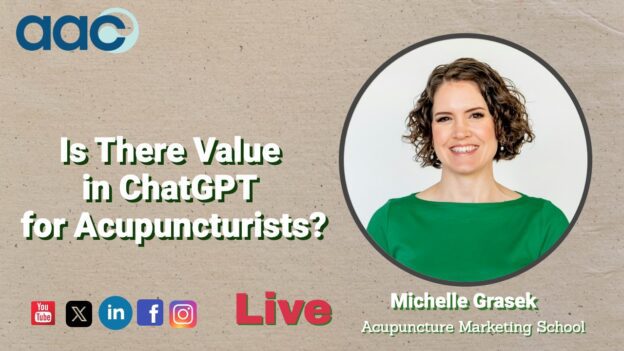
Hi there. My name is Michelle Grasek and I’m the host of the Acupuncture Marketing School podcast. And today we’ll be talking about how to use AI to generate content for your marketing so you can save time and just generally make your life easier. And before we dive into the slides, I’d like to thank the American Acupuncture Council for the opportunity to be here with you today.
All right, let’s get started.
Click here for the best Acupuncture Malpractice Insurance
Okay, so let’s talk about using AI for your marketing content creation. How can you use it to be much more efficient? So very quickly, what will we be talking about today? First, why use AI for this? How is it helpful? Is it really helpful? And I also want to talk about this concept of content creation and whether it still matters.
I know everyone is drowning in a sea of content. The answer is yes, but we’ll talk about that in a moment. We’ll also talk about how to use AI and what to use it for. What are the things that you can ask it to do for you? And specifically, when I’m saying AI, I’m referring to the free version of ChatGPT.
We’ll talk about how to create effective prompts. This is one of the most important things you can learn about ChatGPT. The better prompts you ask, the better your results will be. Hands down. And I’ll give you some examples. Why use AI for content generation? The easiest answer, the simplest answer is that it will cut down the amount of time it takes you to create content by about one fourth, okay?
It is, it will just make the process so much more efficient, and we live in a world where we are expected for marketing. To do a ton of content creation and it can be very overwhelming. It’s a bit of a hamster wheel I’m sure you’re familiar and I personally think that one of the best ways to Retain your sanity in digital marketing is to use chat GPT or other AI to help you either generate content ideas or generate the content itself and to repurpose content, which you can see is the last bullet on this list.
chat GPT can help you with repurposing. Okay, and repurposing content simply means taking something that you’ve already created or written for one platform, like a blog post, and copying and pasting it, making it some tweaks, breaking it down into parts so that you can use it on other platforms, instagram captions or email newsletters. Those are the most common ones that acupuncturists are repurposing content for and Facebook, of course, other social media. But there’s this idea that. To retain your sanity in digital marketing, you do not need to keep writing similar content over and over. You can just repurpose what you’ve already created.
That saves time to begin with. And then, asking ChatGPT to do that for you drastically cuts down on the amount of time that you need. And of course, on top of that, asking AI to write the content or help you with ideas. Cuts down on that time yet again. Okay, so really to make content creation Reasonable and manageable in the world that we live in I think both of those things are essential chat GPT and repurposing content Okay, and sometimes people ask me does content still matter as I said earlier everybody’s drowning in content There’s more articles on the internet than any one person could ever read in their lifetime.
Like why should I contribute to that? Why should I keep adding? So something I want you to think about is Google and the way that it works for a search. So Google’s purpose is to provide the best possible experience for its users. So if you type a query into Google, it wants to give you the most relevant, best answer that it thinks answers your question that you will like.
Because Google wants you to keep using it. Do you remember Ask Jeeves? Yeah, I’m dating myself, right? Ask. No one uses it. It doesn’t even exist anymore. Because other search engines were better, okay? So Google never wants to become irrelevant like that. Its goal is to provide a good user experience. So you can help Google do that by writing content for your website.
So people always ask me, is blogging is old school. It’s dead, isn’t it? So I always say no for two reasons. One, every time you publish a blog post on your website, that’s another page on your website. Google likes websites that are updated regularly because it shows to Google that this business is still active.
And it’s still relevant compared to a business. Maybe the acupuncturist down the street from you who opened their doors 10 years ago, publish their website and has not touched their website in a decade. Clearly Google is going to think that your website where you’re publishing monthly or maybe every two months publishing a blog post, it’s more active.
It’s probably going to be a more relevant, better user experience and answer the person’s question better. than a website that’s been ignored for a decade. Okay, so that’s one reason. And two is that when you are publishing content on your website, whether it’s a blog post or a more formal page on your website, you are naturally including keywords that your ideal patient would be searching for.
So if you specialize in orthopedic acupuncture for runners, for helping them you know, recover from injuries and be able to do marathons, whatever it is, you could write a series of blog posts specific to that. Like I’m a marathon runner thinking about what are the questions that this person would put into Google if they need help, if they’ve got a knee injury, right?
How long after a knee injury can I, or before I start running again? with acupuncture. Think about what are they asking and then write blog posts about those topics so that all of those keywords are on your website and you just become so relevant to Google that it brings you up towards the top of the search because you are answering those questions and you are helping the person writing the query.
You’re the answer to that query. So I’m repeating myself, I’ll move on, but that really is why blogging and content creation is relevant for you as an individual with a brick and mortar local business. Because that’s what Google wants to send your way. But it needs you to help it do that. You have to establish your relevance on your website so that Google can crawl it and understand that relevance.
Yes, blogging and content creation are still important. And just in general creating educational content for your audience. It doesn’t matter if you only have a hundred followers on Instagram, teaching them about what you do and how acupuncture can help them is always going to be relevant. And it just falls under the name of content creation.
So one question that people always ask me about AI is they’re nervous about using it. They don’t know how to use it. They don’t know what its capabilities are, how far reaching it is, these sort of things. So I always tell people to use chat GPT to your comfort level. You could ask it to do brainstorming with you or to write you an outline for a blog post or an email newsletter.
You don’t have to ask it to write the entire content piece. You could ask it to write you the whole blog post, but you don’t have to. So use it to your comfort level. And you could also think about, AI from this perspective. I find this really helpful. And an AI professional that I met last year shared this idea with me that AI is like a really eager, enthusiastic assistant.
Imagine if you had a receptionist in your office who had free time and just loved to write and kept saying, let me help you write Instagram posts. Let me help you write blog content. What? Let me write your email newsletters. You’d have to teach that person a little bit about the tone. You want them to write the concepts that are important to include or things not to say.
And you would expect them to do an enormous amount of research, right? That is what ChatGPT is doing. It’s doing an enormous amount of research to find the answers. And when you write a prompt, that is the same as you explaining to your receptionist how you want them to put this content piece together.
You’re giving them instructions so that they write something that is relevant to your business, your community, your ideal patients, your specialty, etc. Including your tone of voice and all of the details. Okay, so Try to think about chat GPT in this really positive way where it’s a smart, enthusiastic assistant that just wants to lighten your load and make your job easier.
Okay. So what can you ask ChatGPT to help you with? Honestly, the sky’s the limit. Anything that you can think of. I would say that the major things that people tend to ask for are one, brainstorming or idea generation, two, writing outlines for content, or three, writing the content itself. So you could ask ChatGPT to write you a list of maybe Two blog posts.
Basically write me a content calendar outline for this year with two topics per month. Okay, so two blog posts. It’s just an easy place to start. Or two email newsletters per month. And what would their topics be for the whole year? So before you do this, in your prompt, It’s very important that you tell ChatGPT about your business, about your target market, about your specialty, if you have one.
Basically, give it as much information as you can so that it can give you relevant results. And we’ll talk more about things to include in your prompts in a little bit. But It helps enormously the more information you can give it. It could give you an outline for a blog post. Let’s say you really wanted to write that blog post about knee injuries and recovery with acupuncture for marathon runners.
And you just have writer’s block, and you just want to get it done so that you can repurpose it into an email newsletter and send it to your list. You could ask ChatGPT to write you an outline for this blog post, okay? And then you could write it yourself, or once you have that outline you could say, okay, this is great, please don’t include this bullet point, that’s not relevant.
But please write this blog post for me and also make sure you answer the question, how many treatments do I need and why? Okay. And then it will give you the blog post. You can also, of course you can ask it to write social media captions as well. You can also take content that you already wrote, copy and paste it into chat GPT, and then ask it to repurpose that content into other formats.
So if you wrote an email newsletter, you could. put it into chat GPT and say, please repurpose this as a blog post incorporating these important keywords for my website, or please take this email newsletter and break it down into two Instagram captions. Okay. So you can ask it to do. or help you create ideas for just about anything.
You can also talk with ChatGPT. This this class is really for beginners, people who don’t have a ton of experience or maybe you’ve dipped your toe in and you didn’t get great results from ChatGPT, so we’ll talk about how to improve your prompts so you get better results. But I just want you to know, if you don’t have a lot of experience with ChatGPT, you talk to it like a person.
You ask for revisions, you can say, I like this part, but this part’s not relevant, and here’s why. And if you stay signed in, it will remember, okay, most of the things that you’re telling it. Sometimes you have to repeat, but that’s okay. For the most part, it’s going to remember important things.
If you are just dipping your toe in and you’ve never used it before, I would recommend beginning with repurposing content. So find a piece of content that you wrote that really represents your business, your ideal patient, your specialty, and copy and paste it into ChatGPT and ask it to use that as the basis for creating other kinds of content.
So if it was For example, a really great Instagram post caption that got a lot of engagement with your audience, got people asking questions, maybe you got new patients because people were asking you questions about it, and you felt like it really represented you know who you are and what you’re doing in your practice.
That’s a great place to start. So you could put it into chat GPT and say, can you please write up like repurpose this as a blog post and or as an email newsletter or based on this information, can you suggest other Instagram post topics or other topics that I could write about for my blog? So if you are new, Begin with repurposing content.
And I put that little note in the first bullet that says repurposing content can go in any direction because I often talk about starting with a blog post and then breaking that down and repurposing it into email newsletters and multiple Instagram or Facebook posts, et cetera. But you can go in the other direction.
As I just mentioned, if you have a great Instagram post or email newsletter that could become a blog post or a new page on your website. etc. So as I’ve been saying, the way that you ask ChatGPT for something is very important, and that’s called the prompt. So the more descriptive and specific you can be in your request, in your prompt, the better results you’ll need and the fewer revisions you’ll need to ask for.
Now, If you ask ChatGPT to write a whole piece of content for you, a blog post from start to finish, it’s normal to expect that you will need it, you will need it to do some revisions. And, you’ll probably still have to do some tweaks and edits, even after the revision, just to make sure it sounds like you, that it feels authentic, that you think it is really going to resonate with your ideal patients.
And that’s normal. Okay? But the better prompts you write, the less of that you will have to do. So what can you include in a prompt? Let’s go with the blog post example. That’s clearly my favorite. So you can tell first, tell chat GPT about your business, describe your ideal patient and your target market and your specialty, and then tell it.
Why you need this piece of content. What are you going to use it for? What’s its purpose? That’s important for chat GPT to know and then you can ask it to write this piece of content in a specific tone of voice for example warm, but professional or you could say friendly and warm and So let’s say you ask for professional.
Please write this blog post about XYZ in a professional tone of voice, and then you add all the other information about your business, your target market, and the purpose of the piece, and maybe it produces something that is very formal, way too professional, and you realize, oh, this is not the tone that I use on my website.
All you have to say is, actually, this is too formal in tone. Can you please write it in a more warm and friendly tone? Or you might have to use a the, excuse me, thesaurus, to figure out what are the descriptive words that you want to use until you hit on the right tone. Now, let’s say you finally land on tone that feels appropriate, right?
Like you nailed it. Write down those descriptive words that you put in your prompt so that if needed, you can ask for them again in the future. So you get a consistent tone. Okay. And you can also say to ChatGPT anything you definitely want it to include or not, okay? You can tell it how long you want something to be.
If you want an 800 word blog post, then say that. You can Take a piece of content you’ve already written. Let’s say you wrote something about acupuncture for fertility and you feel like it really represents, again, your specialty and your target market. And you can copy and paste that in there, but then give it instructions to write a different piece of content, maybe about acupuncture for PMS, and you can ask it to use that content example as a formatting.
For writing this new piece of content, okay? So that can substitute for giving it all these specific instructions about like tone of voice etc. So that it basically tries to write something like your previous piece. So you have that consistency. You can also give it specific numbers. If you have a blog post and you want Instagram to give you three, sorry if you have a blog post and you want chat GPT to give you three Instagram posts, then say so.
Okay. If you want it to give you six ideas for a subject line for an email, Ask for six. And again, don’t be afraid to ask for revisions because once chat GPT produces something for you, it will typically say, I hope this is what you’re looking for. Let me know if you need changes. And if you want changes, just say so it will do it.
instantly. And if you don’t like the changes, you can always go back and use the initial for further revisions. Okay. And lastly, I’ll say that you can use chat. You can ask chat GPT questions about itself so that you can learn how to use it better. For example, when I first started using chat GPT and I’m using the free version, so I’m not sure if this is possible in the paid version, but I had asked it, if I give you the, Web the hyperlink for a website.
Can you then read the webpage and summarize the page for me and it answered and said, no, I can’t do that from you giving me the link. But if you want to copy and paste the text on the page, then I can give you a summary. Okay? So you can basically ask chat GPT or tell it, here’s what I want, and then ask it.
What information do you need to create this for me? Okay, so you can really engage with it so that basically you’re going to learn to use it more effectively and efficiently so that it takes up less of your time and you get a better result and then you have to spend way less time on your marketing.
That’s our goal. So I really hope all of this is helpful. It’s definitely a crash course in using ChatGPT for marketing and content. I hope it inspires you just to dip your toe in if you’ve never used ChatGPT before. Try repurposing a piece of content and, if you used it in the past and got like weird or mediocre results, really practice.
your prompts and give it a lot more information and play around with it. And I think you’ll see that you get even better results. Okay. So as always, it’s a pleasure to be here with you. If you have questions about marketing, you are more than welcome to send me an email, michelle at michelleGrasek.
com. I clearly love talking about and teaching marketing. So I am more than happy to chat with you. Mhm. Mhm.
Click here for the best Acupuncture Malpractice Insurance
This website uses cookies to improve your experience. We'll assume you're ok with this, but you can opt-out if you wish. Cookie settingsI ACCEPT
Privacy & Cookies Policy
Privacy Overview
This website uses cookies to improve your experience while you navigate through the website. Out of these cookies, the cookies that are categorized as necessary are stored on your browser as they are essential for the working of basic functionalities of the website. We also use third-party cookies that help us analyze and understand how you use this website. These cookies will be stored in your browser only with your consent. You also have the option to opt-out of these cookies. But opting out of some of these cookies may have an effect on your browsing experience.
Necessary cookies are absolutely essential for the website to function properly. This category only includes cookies that ensures basic functionalities and security features of the website. These cookies do not store any personal information.
Any cookies that may not be particularly necessary for the website to function and is used specifically to collect user personal data via analytics, ads, other embedded contents are termed as non-necessary cookies. It is mandatory to procure user consent prior to running these cookies on your website.